


The Petrol Crisis and Rupee Collapse: A Catastrophic Double Betrayal of India’s Economic Sovereignty and Everyday Survival

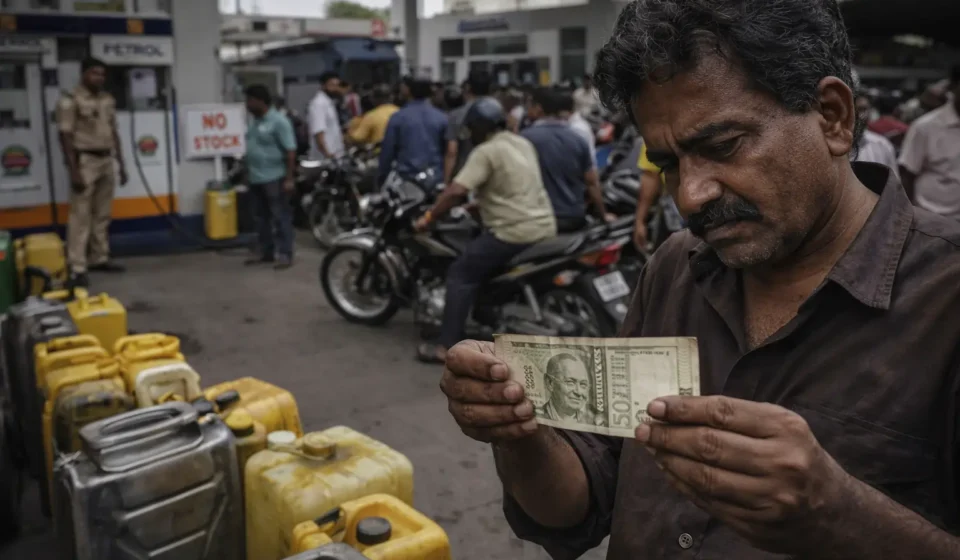
As of late March 2026, India finds itself trapped in a vicious economic storm that is ripping apart the daily lives of its people and exposing the raw fragility of its so-called rising power status. The Indian rupee has smashed through humiliating record lows, trading at around 94.7 per US dollar and registering over 10% depreciation in FY26 alone – the worst fiscal-year slide in more than a decade. At the same time, the country is gripped by chaotic scenes of panic buying at petrol pumps, with long serpentine queues stretching for hours in cities and towns across Gujarat, Ahmedabad, Delhi, Hyderabad, Mumbai, Goa and beyond. Some outlets flash “No Stock” boards while police are deployed to control frustrated crowds. People are hoarding fuel in milk cans, cookers, water tankers, and every container they can find. This frenzy has been triggered by the raging West Asia conflict, where India has positioned itself as a strong ally of the aggressor, that has disrupted crude shipments through the Strait of Hormuz, a route vital for a massive chunk of India’s oil imports. Global crude prices have surged well past $100-107 per barrel, with spikes going even higher, creating artificial demand surges, temporary rationing at pumps, and anxious motorists filling every last drop they can get.This twin disaster, the collapsing rupee and the petrol panic, is a dagger straight through the heart of every Indian household, every small business, every commuter, auto driver, delivery worker, farmer running diesel pumps, trucker hauling goods and the millions who keep the economy moving on two wheels or four. It shreds the country’s loud claims of robust energy management, resilient modern economy, and unshakable fundamentals. Millions of families are already paying 7-10% more for fuel, groceries, medicines, and essentials because of the rupee’s slide. Every 5% depreciation adds roughly 0.35% to headline inflation according to RBI models. The oil import bill, India’s perennial Achilles’ heel, balloons dramatically – every $10 jump in crude adds roughly $12-18 billion (or more at current spikes) to the annual bill, with the country staring at an extra burden running into tens of billions this year alone as prices have more than doubled in recent weeks. Foreign portfolio outflows have drained $12.5 billion in March 2026 alone, with monthly outflows routinely hitting $7-8 billion – money that should be building factories and creating jobs is instead fleeing what looks like a sinking ship called India.The impact on the ground is brutal and measurable. The government has been forced to slash excise duties sharply on petrol and diesel – from ₹13 to ₹3 per litre in some cases, or even removing them entirely on diesel – taking a direct and painful hit on its own revenues just to prevent immediate retail price explosions at the pump. Private players have still hiked prices by ₹5 per litre for petrol and ₹3 for diesel amid soaring input costs. Transport and logistics expenses are climbing fast, feeding directly into higher prices for food, goods, and services nationwide and amplifying inflation pressures across the board. LPG shortages are compounding the misery, with panic buying, black-market rates exploding to ₹3,000-6,000 per cylinder, and households skipping hot meals or reverting to dangerous firewood. Industries from ceramics in Morbi to tea estates in Darjeeling are shutting or scaling down, threatening tens of thousands of jobs. Small and medium enterprises, which employ over 110 million people, are choking on higher input and freight costs. This is unfolding as a COVID-like economic shock, pushing daily-wage earners, gig workers, and rural families into deeper squeeze while disrupting normal supply at thousands of outlets and creating huge shortages despite official assurances.If this double crisis drags on unchecked – and every indication from desperate RBI dollar sales, sharp duty cuts, emergency measures, and repeated hollow claims of “60 days of stocks” and “no shortage” suggests thin buffers and poor long-term preparedness rather than genuine insulation – the consequences will be nothing short of apocalyptic for an economy already battered on multiple fronts. A sustained rupee slide toward 100 per dollar would push the current account deficit to unsustainable levels (already widening fast), trigger double-digit inflation within months, wipe out whatever remains of middle-class savings and force further subsidy slashes or tax hikes just to stay afloat. Sustained high oil prices could force eventual sharp hikes at the pump, ignite broader transport-led inflation, balloon the current account deficit even more, and drag down overall GDP growth by raising costs for everything from supply chains and agriculture to manufacturing. Small and medium enterprises in logistics, manufacturing, and services, which support tens of millions of jobs, will struggle, shut down, or pass crushing costs to already squeezed consumers, worsening stubborn unemployment, rural distress, and inequality. Black-market profiteering will explode, corruption will flourish, public anger will boil over, and India’s image as a stable and so called self-reliant emerging giant will lie in complete tatters. The country risks losing hard-earned credit ratings, scaring away genuine FDI and becoming a permanent supplicant at the doors of global lenders all while continuing to boast about grand visions on television.This is economic sabotage of the worst kind, laid bare for the entire world to see in real time. India has spent years bragging about strategic reserves, energy diversification, fiscal discipline and unshakable fundamentals while failing miserably to break free from crippling dependence on imported crude, build genuine multi-month safeguards against faraway geopolitical fires or create a currency that commands respect. Short-sighted policies of Hindutva led government have left the country completely exposed and turned what should be a position of strength into a national joke. Instead of shielding its people, the approach has put 1.4 billion citizens – especially the working poor, lower-middle class, women managing households, and those in the informal sector who need affordable fuel and stable prices just to survive and earn a living – directly in the line of fire from every distant conflict. The rupee’s continuous collapse and the petrol crisis together prove beyond doubt that India is no longer in control of its own destiny. It remains a vulnerable supplicant in global energy and financial markets, not the sovereign powerhouse it claims to be.
The root cause of this self-inflicted disaster is the disastrous Hindutva alignment with the aggressors in the West Asia war – a catastrophic diplomatic failure of epic proportions that has shamelessly ditched long-standing ties with Iran in favor of ideological bootlicking. By positioning itself as a strong ally of the very forces that triggered this regional firestorm, India has torpedoed decades of strategic balancing, abandoned a vital partner for discounted oil and geopolitical leverage and reduced itself to a pathetic footnote in someone else’s conflict. The shortsightedness of Hindutva policies has turned India’s national interest into a joke, isolated the country diplomatically, destroyed energy security overnight, and left 1.4 billion citizens directly in the crossfire of a war they had no business escalating through blind alignment. India’s foreign policy is a national self-harm on steroids and a betrayal so profound that it borders on treason against the Indian people.