



What we are witnessing in West Bengal today demands a re-examination of the darkest chapters of modern South Asian history. Congress ministries’ successive victories across eight Indian provinces in 1937 did not advertise an exclusionary campaign through violent means but through the quite packaging and sanitization of the civil-sate machinery itself. In the order imposing bans on cow slaughter, in getting Vande Mataram sung in schoolrooms and coercing local administrations to overpower the minority communities it represented the sort of administrative chauvinism that finally made the Pakistani demand, based on Kevin Boyle, seem like the only realistic option left to Muslims.
The insistence on Pakistan did not grow out of religious zealots alone; it originated in systemic state-sponsored suppression. Decades later, the BJP has only changed the author in the West Bengal version of this same playbook. The now saffron regime has brought the old script to new heights of sophistication with a multi-step majoritarian project of domination. What is happening in Bengal today is not mere governance; it is the methodical construction of an internal partition.
The assault had begun long before a single popular vote was cast, through a surgical hollowing out of the electorate. As many as 9 million voters (12 per cent of the state’s electorate) were silently expelled from the electoral list before the assembly elections, although this was not in any case an administrative fare well. A probabilistic analysis shows that the Muslim minority and the poor were it target.
Considered district-wise, the numbers speak volumes about the efficacy (or lack of it) of the Election Commission: Murshidabad-460,000 deletions, North 24 Parganas-330,000 and Malda-240,000. Through the instrumentation of small transliteration variations in the different spellings of Urdu, Bengali and English names, the state successfully identifies and deletes Muslim-sounding names.
While BJP cynically renders this disenfranchisement as a patriotic effort to rid the state of “illegal infiltrators,” the fact is that it amounts to undermining the political capital of the minority community before the election even begins. By rigging the demographic arithmetic, the BJP could afford an astonishing 207 seats for the 294 members assembly. As show of inclusiveness was dropped with Sabka Saath, Sabka Vikas, the future CM sent out a statement bragging that we are happy that we will not get a mandate for development but a mandate for Hindutva. The disguise was gone. the fundamental promise of secular democracy was vanished with the unabashed claim of formation of Hindu Rashtra.
Once state power was solidified, the onslaught on the ideological front was swift. Using an obscure 1950 law and the apex court order of 2018, the BJP BJP government banned slaughter of cattle with any incentivized certification and closed slaughterhouses in public places. The date could not have been more perfectly chosen exactly two weeks before the Eid-ul-Adha, the holiest sacrifice festival. This targeted legislation is a triple-edged weapon.
While clearly an outrage on the freedom of the states minorities to freely propagate their faith, this policy also destroys, politically and economically, the very terrain that sustains the health and well-being of India’s disprivileged populationstheir access to protein, and to manpower for the meat and the shoe industries. The process is chilling in its logic: first deprive a community of political agency, then their economic sustenance, then their chosen expression of faith. The end of the operation also brings the parallel 1937 into a sound, chilling climax.
Through the labyrinthine paperwork of voter verification processes, combined with the looming threats of the Citizenship Amendment Act (CAA) and the National Register of Citizens (NRC), the BJP is destabilizing the very citizenship of Bangla-speaking Muslims. Following the Assam experiment, where over a million people, predominantly Muslims, were rendered stateless, Bengal is being primed for a massive demographic crisis. The state is weaponizing procedural uncertainty, transforming the simple act of living in one’s homeland into an exhausting, adversarial battle against paperwork and deportation notices.
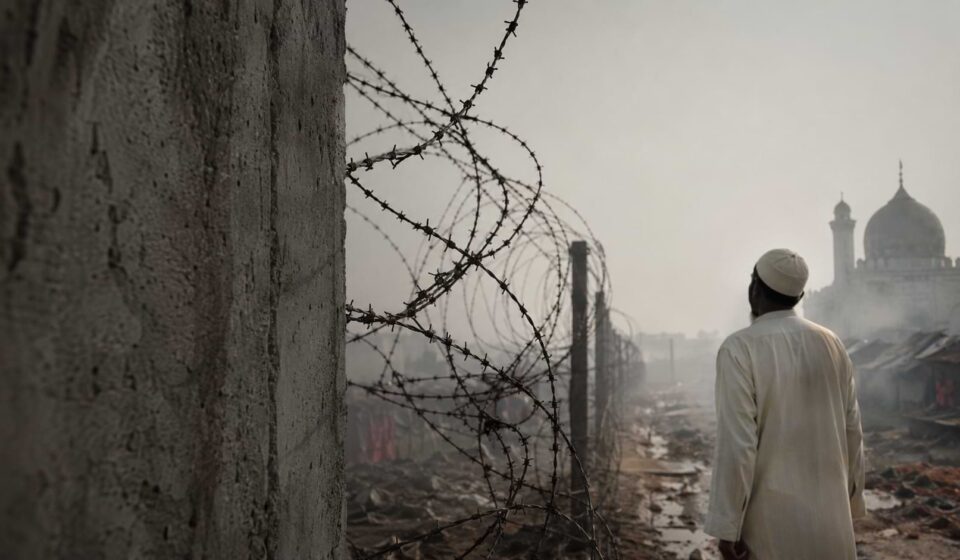
This is the creation of “Pakistan 2.0″—not as a geographic entity, but as an existential condition. The BJP does not require a physical line drawn across the map. Instead, it is erecting walls of disenfranchisement within India’s borders, effectively reducing 27 million Bengali Muslims, and by extension, 200 million Indian Muslims, to permanent second-class subjects.
History will record a bitter, tragic irony in the BJP’s strategy. Jinnah used the grievances of administrative tyranny to validate the Two-Nation Theory and fracture a subcontinent. Today, the BJP has inverted that theory. By pursuing total domination rather than separation, the ruling dispensation is proving that a minority cannot trust a majoritarian state with its future. India does not need to partition again; the BJP has already succeeded in making millions of its own citizens feel like refugees in the only land they have ever called home.