


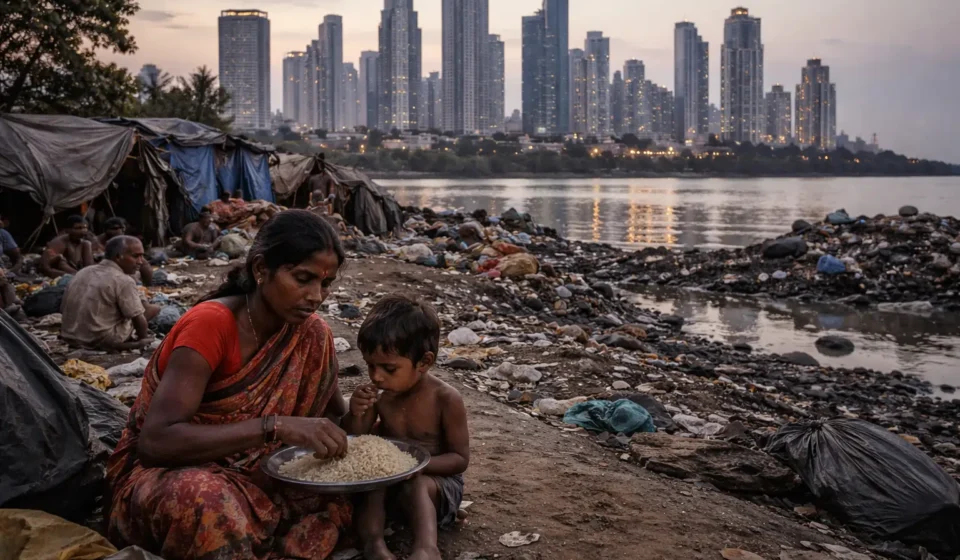

India’s GDP is hitting $3.9 trillion, and it’s being called a rising global economic power. Growth sits around 6 to 7% each year – sounds solid on paper. The benefits don’t trickle down. The average Indian makes just $2,600 to $2,700. That’s not much for rent, food, or transport. The top 1% owns about 40% of the country’s wealth, more than half the population, who earn a tiny fraction of it. Millions still wake up every day with nothing more than survival money. Development hasn’t reached most people. The story of progress doesn’t match what ordinary lives look like. Wealth keeps stacking up at the top. Growth isn’t shared, it leans heavily on a small group. Even if numbers keep rising, most can’t step inside that economic door. The whole picture shows how much of this narrative only benefits a few.
According to the government, poverty reduction remains one of the major indicators of success. Both official and independent data of extreme poverty reveal a decline to 2-3%. At the same time, a report shows a decrease in multidimensional poverty. Data however is insufficient. About 234 million Indians still do not have access to clean water healthcare education, or safe housing forums. The $2.15 a day poverty threshold is quite a controversial figure and still it’s only barely covers the basic requirements in India where living expenses especially housing, medical, and food keeps on growing. Millions of so-called poor people deprived of regular food and suffer from economic instability. They are excluded socially even though they are considered financially well-off.
The difference becomes strikingly clearer when one looks at human development indicators. As per the Human Development Index, India is ranked approximately 130th globally, which is much lower than many smaller and less resource-endowed countries. This ranking exposes India’s deep-rooted problems in healthcare, education, and the standard of living, to name a few. The growth-centric approach to development has failed, as is clear from the fact that economic growth has not resulted in corresponding enhancements in life expectancy, literacy, and income equality. The situation is further aggravated by the problem of unemployment. Official figures, while showing a low level of unemployment, generally fail to reveal that underemployment is a major issue and that informal sector jobs are very common.” A large chunk of india’s workforce works in the unorganised sector, earning low pay, facing job insecurity, and missing basic rights like health coverage or pensions. Many are educated but still struggle to find stable work, youth unemployment is mostly on. This creates what’s called ‘jobless growth’: the economy grows, yet new jobs don’t keep up. And without enough employment creation, growth remains hollow. The system doesn’t deliver on job outcomes for most workers.
Living in rural India – where 63% of people reside, means facing gaps in services and infrastructure. Cities offer modern facilities, advanced technology, and solid economies. Rural areas lack good hospitals, quality schools, and stable employment. That gap locks people into lower social strata and reinforces inequality. Gender, caste, and location determine life outcomes. Poor families in remote zones have fewer options. Women work less and lack financial strength, this hinders fair progress for all. Public healthcare in india remains inadequate, so most people turn to costly private options. Out-of-pocket spending spikes during emergencies, pushing poor families deeper into debt. School enrollment has grown, but skills training hasn’t kept pace, leaving graduates unprepared for modern jobs. That gap fuels doubts about the quality of education. Poor education leads to unemployment. Unemployment keeps people in poverty. The cycle continues without relief. Public healthcare remains inadequate, forcing many to rely on costly private options. Out-of-pocket spending soars, pushing poor families deeper into debt during health crises. School enrollment has grown sharply, but training programs haven’t kept pace. Graduates enter the job market without needed skills. Employers struggle to find qualified workers Unemployment rises. Poverty persists. The cycle continues without breaking point.
The central question, therefore, remains unavoidable: who is development really for?
This pattern is not only restricted to counting figures. An economy running on growth can aggravate the inequalities if the profits are shared by a limited few only. Despite a constant rise in GDP, there are still scores of people who cannot make ends meet; and to top it all, the gap that separates the wealthy from the poor continues to get wider. Even if it isn’t uniform, India’s progress is a fact. The paradox of growth is that the nation is progressing on a scale while people ‘stuck’ locally. Genuine development implies not just earning money but also getting opportunities. Especially, the equitable distribution of resources is indispensably more significant than mere economic growth rates. We need a modification of the existing system whereby everyone – all the citizens – get to feel that they belong. Otherwise, achieving success would be like a mere empty shell.