


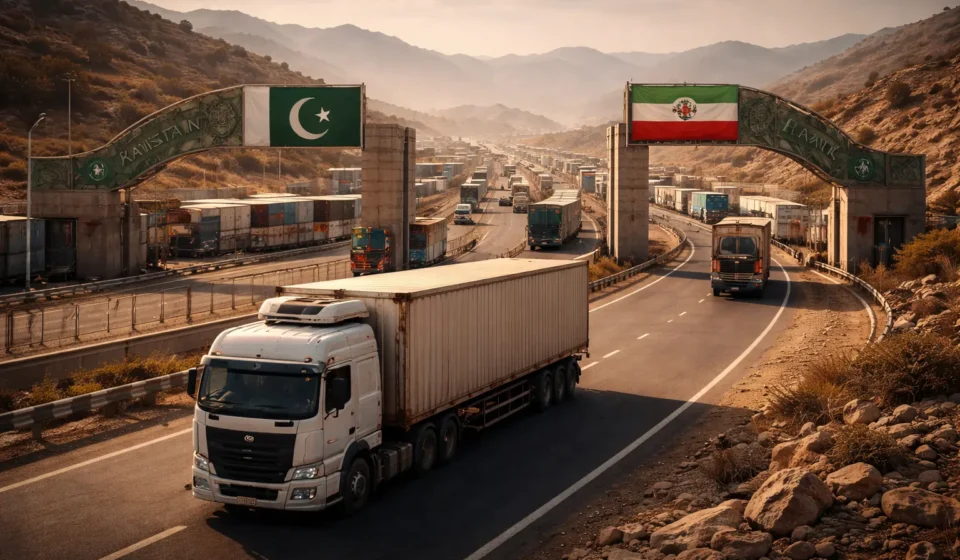

A refrigerated truck is leaving Karachi’s port carrying frozen beef. On the surface, an unremarkable cargo. But on April 12, 2026, that single consignment became the opening chapter of what could prove to be one of Pakistan’s most consequential geo-economic decisions in decades, the formal operationalization of the Pakistan-Iran Transit Corridor via the Gabd-Rimdan border crossing.
This is not merely a trade route. It is a strategic repositioning.
What Actually Happened – and Why It Matters
The first shipment under the new corridor departed from BOML CFS Karachi, crossed into Iran through the Gabd border post near Gwadar, entered Iranian territory at Rimdan, and proceeded onward to Tashkent, Uzbekistan. It was transported under the internationally recognized TIR system, Transports Internationaux Routiers, a customs transit framework that allows cargo to cross multiple borders under a single document, reducing inspection delays and administrative friction at each crossing.
Director General, Transit Trade Customs Sanaullah Abro, who personally flagged off the inaugural consignment, stated clearly that the corridor’s operationalization “would not only accelerate Pakistan’s economic growth but also increase traffic at the country’s ports.” Border crossing points at Taftan, Rimdan, Sost, and Gwadar have all been enabled by the International Road Transport Union (IRU) in Geneva for international transit consignments.
The timing is anything but coincidental.
Afghanistan Is Closed. Iran Is Open.
Pakistan’s traditional overland access to Central Asia ran through Afghanistan. That route has been functionally severed. Escalating border clashes, closed crossings, and an increasingly hostile frontier with Kabul have strangled bilateral trade and cut Pakistani exporters off from the five landlocked Central Asian republics, a combined market of over 75 million people.
The decision to route exports through Iran provides exporters with a parallel corridor, reducing reliance on the Afghan route and potentially stabilizing regional trade flows at a moment when Pakistan’s exports had already declined seven percent in the July-February period of FY26, falling to $20.5 billion from $22.1 billion the previous year.
The numbers reveal a country that cannot afford to be geographically isolated. Pakistan posted a trade deficit of over $26 billion last fiscal year, with exports of $32.1 billion against imports of $58.4 billion. Arab News) Every new export corridor is, in this context, an economic lifeline.
Gwadar: From Port on a Map to a Living Trade Hub
The Gabd-Rimdan corridor does something that years of CPEC announcements have promised, but only partially delivered: it activates Gwadar as a functional transit node, not merely an infrastructure investment on paper.
Gwadar is emerging as a strategic hub with the potential to transform regional logistics, given its proximity to international shipping lanes and border crossings, making it an ideal gateway for trade between South Asia, the Middle East, and Central Asia.
Under this corridor, goods arriving at Karachi or Gwadar by sea can now be loaded onto TIR trucks, cross into Iran at Gabd-Rimdan, and proceed through Iranian territory into Uzbekistan, Turkmenistan, Kazakhstan, or Tajikistan. This creates for the first time a seamless multimodal chain linking Pakistan’s Arabian Sea ports directly to the landlocked heart of Eurasia, without the bottleneck of Afghanistan.
Transit volumes through Iran had already exceeded 20 million tons annually before the current regional conflict, reflecting its established role as a land bridge between Central Asia and global markets. Pakistan is now formally inserting itself into that architecture.
The Pipeline Question-and the Larger Opportunity
Hovering in the background of all of this is the long-stalled Iran-Pakistan gas pipeline – a project signed in 2009, inaugurated in 2013 by then-President Asif Ali Zardari and Iranian President Mahmoud Ahmadinejad, and frozen ever since by the weight of U.S. sanctions. Iran completed its 900-kilometer portion years ago. Pakistan has yet to break ground on its side.
With U.S.-Iran peace talks now underway – with Pakistan itself serving as a mediator, a role confirmed by U.S. Special Envoy Steve Witkoff-the sanctions calculus may be shifting. If a diplomatic resolution emerges, the pipeline project could be revived, potentially delivering gas to an energy-starved Pakistan at a fraction of what LNG imports currently cost. U.S. Secretary of State Marco Rubio has acknowledged the diplomatic channel, while Pakistan’s Foreign Minister Ishaq Dar described Iran’s recent cooperative gestures as “a harbinger of peace.”
The transit corridor and the pipeline are, strategically, two arms of the same vision: transforming Pakistan from a country perpetually squeezed between hostile neighbors into the connective tissue of South and Central Asian trade.
What This Means for Pakistan’s Economy
The benefits, even in the corridor’s infancy, are structural. The corridor reduces transit time, simplifies logistics operations, and lowers transportation costs, making Pakistani products more competitive in international markets, particularly for perishable goods like frozen meat, where delivery speed directly affects product value and profitability.
For a country navigating a $7 billion IMF program and scrambling to unlock a fresh $1.2 billion tranche under the Extended Fund Facility, every percentage point of export competitiveness matters. Increased international container traffic has already been observed at Karachi Port in recent weeks, an early signal that the corridor is generating real economic momentum, not merely ceremonial symbolism.
A frozen beef shipment to Tashkent may not dominate headlines the way missile strikes and diplomatic summits do. But in the long ledger of Pakistan’s economic history, the operationalization of the Gabd-Rimdan corridor may be remembered as the quiet turning point, the moment when Islamabad stopped waiting for geography to cooperate and decided, instead, to redraw its own map.
The Central Asian market is vast, underserved, and hungry for the agricultural and industrial goods Pakistan can supply. The route is now open. The TIR system is in place. The border crossings are live.
What Pakistan does with this opening, whether it scales it aggressively or treats it as a ribbon-cutting exercise, will determine whether this corridor becomes a footnote or a foundation.