


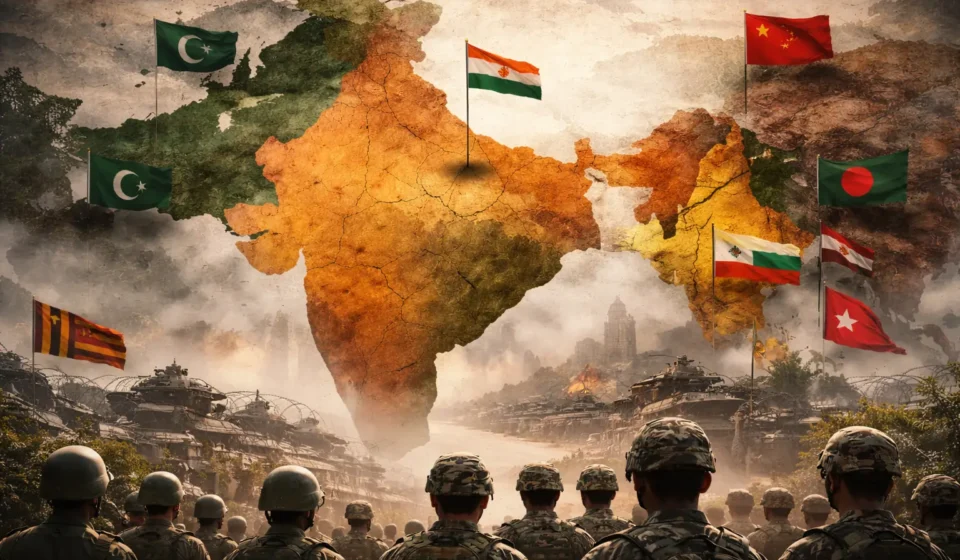

India’s position is very special in South Asian geopolitics. It has either maritime boundaries or shares land borders with eight independent countries namely Pakistan China Nepal Bhutan Bangladesh, Sri Lanka, the Maldives, and Myanmar. Each of the post-1947 bilateral histories is marked with the occurrence of disputes with every neighbouring country, which is complemented by New Delhi’s habit of self-positioning as the victim. The strategy of deliberately provoking incidents, selective referencing of multilateral forums in a cry-wolf manner to hide true intentions is one of the ways of the Indian diplomacy.
The mood of regional estrangement, in turn, weakens India’s assertions of the first strategic role, which to a large extent remains a result of domestic cinematic rather than diplomatic or operational achievement sustained over time. The structural similarity to Israel however is very much in the point: both are having hostile relations with more than one neighbour going back many decades, and are security- policies rely on narratives of existential vulnerability, and are becoming diplomatically isolated in their neighbourhood with the exception of few, despite military asymmetries. Besides, the 4-day India-Pakistan war in May 2025 and India’s oral endorsement of Israel in the current US-Israel military campaign against Iran in 2026 provide further examples of the issue.
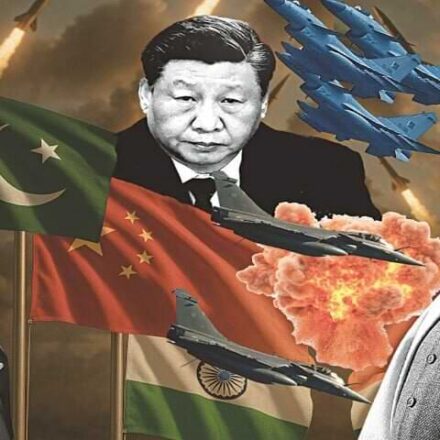
The history of conflict is well documented. In the instance of Pakistan, four major wars were fought prior to the April 22, 2025 False Flag Pahalgam incident where 26 civilians were killed, Indus Waters Treaty and border measures suspended by India. On May 7, India through missile and drone strikes targeted areas suspected to be terrorist infrastructures in Pakistan and Pakistan-administered Kashmir. Pakistan retaliated using integrated air defence operations, electronic warfare and beyond visual range attacks. Indian multi-domain verified losses: Pakistan systems destroyed multiple Indian platforms, at least one Rafale, one MiG-29, one Su-30MKI, and air and electronic domains. Defence analyses and open-source intelligence reveal tactical losses for India in air, cyberelectronic, and precision-strike vectors, with no strategic equivalent to Pakistani capabilities.
The 4-day conflict ended with a ceasefire facilitated by the USA on May 10. While the Indian perspective inevitably labeled the result as the attainment of a degree of success in the fight against terrorism, Indian narratives not only highlight that all the instability is a consequence of Pakistani sponsorship but also intentionally downplay the initial treaty actions and operational lapses. Also, China’s behavior is no exception: the 1962 war, the Galwan 2020 clash, and the ongoing deployments in Ladakh all largely stem from the territorial disputes and the race for infrastructure. Nepal is an example of economic leverage: supplies to the country were interrupted during the 2015 blockade due to the constitutional dispute; Kalapani and Susta are still under Indian administration despite the Nepalese claims.
Bhutan has a defence setup that is quite light and allows India’s military presence, as happened during the 2017 Doklam standoff. Bangladesh has water-related issues (Farakka) and border tensions post-2024 transitions. The people of Sri Lanka still remember the IPKF intervention of 1987-90 and the maritime issues continue. With the “India-Out” campaign, Maldives got the military assets withdrawn in 2024-25 on the ground of a sovereignty issue. Myanmar has unresolved borders and insurgent flows. Besides these, even after settling the boundaries, secondary disputes over water, migration, and minority rights arise. Due to India’s size – 1.4 billion population, 5th largest economy, – it is easier for asymmetric tools – control of transit, selective use of treaties and for double use of projects. Neighbours offer diversification as a counterargument: Chinese infrastructure in Nepal and Maldives, security hedging in Bangladesh and Sri Lanka; India is a source of insecurity, rather than assurance.
Victim framing provides an excuse. Outsourcing. Pakistan’s terrorism, Chinese encroachment, and interference in small states. Sequence analysis reveals some of India’s actions such as treaty suspensions and forward deployments as the main initiators. Diplomatic cry-wolf raises the number of incidents with a multilateral approach while reworking bilateral channels. The 2025 Indus suspension avoided, the Ladakh relied on global dependencies although having local roots. When neighbors expose the previous Indian moves, the claims of existence lose their force, resulting in a loss of credibility.
The mathematical return of the May 2025 multi-domain scenario results in India effectively striking, Pakistan responding with countermeasures, and the final kills being verified or a main without a deciding degradation. However, the message mishandled this so much that it not only turned restraint into its opposite but kept the victim story running despite the operational facts showing otherwise. Any claim for supremacies will not survive the checking. SAARC has not been functioning since 2016. BIMSTEC is very poorly funded. “Neighbourhood first” ends up with alienation. Economic measures mostly work lead to counter-balancing through Chinese corridors. Military expenditures (2.4% of GDP) Per Support Platform, not Multi-Front Deterrence.
Cultural projection is in full swing: every year more than 1,800 Bollywood (the Hindi language film industry of India) movies that will tell stories of strong leadership and unstoppable forces are produced. They act as a replacement for real relational gains, global audiences are entertained by the spectacle, and regional players notice the discrepancy with ground realities. Hence, primacy is working to a narrative rather than a substantive one.
Israel parallel gets even deeper by, first of all, making the point that both countries not only have several hostile neighbours but also derive their core ideologies from historical grievances and militarily control disputed areas as a means of self-defense. In a way, changes in Kashmir in 2019 are reminiscent of the policies in the contested areas. Both rely on the support of foreign powers: India’s US alliance is similar to Israel’s. Both frame their measures as existential threats justifying pre-emptive actions. Since the US-Israel initiative, being launched in 2026, to counter Iran by attacking its leadership and nuclear and missile facilities, is a continuation which shows how the patronage dependence under the encirclement situation is demonstrated. India’s side-taking can be seen also from the highest leadership statements. In his speech at the Knesset in February 2026 he drew on the “fatherland” of Israel and “motherland” of India of Indian-origin Jews to express a feeling of civilisational affinity.
Such references in Israel’s war-time message clearly suggest a strategy of appeasement, i.e. Israel sorting out its extra-regional activities while India is experiencing a neighbourly drift and is likely to be hit by some 2025 setbacks. Tactical asymmetries at the time of strategic solitude: while selective normalisations are brokered by Israel, India’s periphery remains unreconciled even after 78 years. The after-effects continue to be regional. Alienation is the biggest enemy of worldwide positioning: as a Security Council aspirant and Indo-Pacific player, India is finding it hard to project stability due to the accumulation of mistrust.
One of the ways through between the sequence 2025-26 — Indus suspension, multi-domain losses, Bangladesh spillovers, Maldivian shifts — is a security signaling, hitting engagement earlier than usual, and speeding up the encirclement sequence. What is needed is a change: focusing on bilateral relations rather than letting multilateral escalations happen, using leverage for restraint, and divorcing ideology from foreign policy to improve India’s standing and influence globally.
India’s neighbourhood conduct is creating a self-enhancing loop: Dispute extension, victim externalisation, diplomatic amplification, cinematic substitution. Pahalgam incident and the loss during Operation Sindoor are among the verified events which, combined with abrogation of treaty and fatherland siding with Israel during its US-supported campaign in Iran, peripheral diversification, confirm performative supremacy. If there is no change in attitude to allow the regional order defiance by one-sided imposition, there will be ongoing cry-wolf effects in an unreceptive arena. Stability in Asia is tied to India taking the initiative and breaking away from the common pattern in the region.