


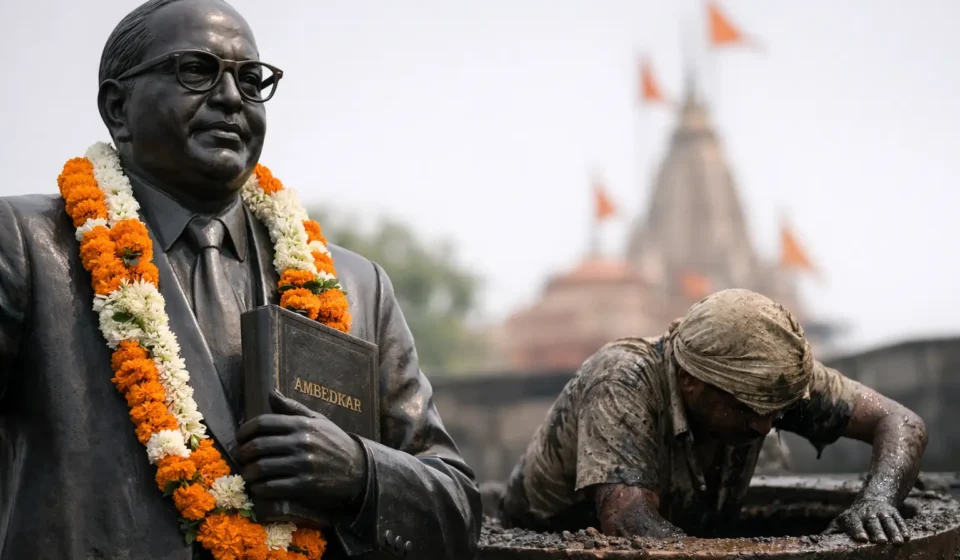

On Ambedkar Birth Anniversary 2026, every statue is garlanded. Every warning he gave is ignored.
“On the 26th of January 1950, we are going to enter into a life of contradictions. In politics we will have equality and in social and economic life we will have inequality… How long shall we continue to live this life of contradictions?”- B.R. Ambedkar, Constituent Assembly, November 25, 1949
Seventy-six years after Ambedkar asked this question at the dawn of the country’s independence, the contradiction he feared is still unresolved, rather it has been institutionalized and decorated with slogans, and even sold back to the same people he fought for all his life.
The Numbers That Indict Minorities
The data is not abstract. A report by the National Crime Records Bureau reveals the number of crimes committed against Dalits increasing by 34. 5% in merely four years, from 42,793 cases in 2018 to 57,582 cases in 2022, which translates to one crime committed against a Dalit every 18 minutes. The weekly rate of Dalit murders is 13, and daily, 10 Dalit women are raped. The number of crimes against Dalit communities has increased 177. 6% between 1991 and 2021. The crime rate, not only the absolute numbers, rose from 21. 6 to 28. 6 per lakh population over the same period.
57,582 – Anti-Dalit crimes in 2022 (NCRB)
96% – SC atrocity cases pending trial (2021)
71%- Dalits who are landless laborers (Census 2011)
Under the political establishment which has been continuously ruling Ambedkar’s legacy, Uttar Pradesh has reported 15,368 cases of anti-Dalit crimes in 2022 only, a 16% rise over the figure for 2021. Rajasthan made the next largest contribution with 8,752 cases while Madhya Pradesh follows with 7,733 cases. These are not states on the margins of power. They are its heartland.
And Human Rights Watch reminds us: even these numbers are a severe undercount. Dalits routinely do not report crimes due to well-founded fear of police hostility and upper-caste retaliation. The true scale is incalculable.
The Sewer That Proves Everything
Manual scavenging, the practice Ambedkar called a mark of civilizational shame, was banned in 1993. Banned again, more firmly, in 2013. Yet the government itself admitted to Parliament in July 2024 that 377 people died between 2019 and 2023 cleaning sewers and septic tanks, and simultaneously declared there is “no report of the practice of manual scavenging currently in the country.” These two statements were made in the same written response.
The Safai Karmachari Andolan (SKA), which conducts the tracking of these deaths locally, registered 339 deaths just in 2022-23. The National Commission for Safai Karamcharis has recorded 1,313 such deaths in sewer and septic tanks from 1993 till mid-2025. Most of those who do this work (92%) belong to Scheduled Caste, Scheduled Tribe, or OBC communities yet the government maintains that the classification is “occupation-based rather than caste-based.” Bezwada Wilson of SKA put it plainly: “This is a modern form of untouchability in a modern caste system.”
Land, Wealth, And The Permanence of Hierarchy
The 2015-16 Agricultural Census revealed that 92% of Dalit landholdings are marginal, under 2 hectares, comprising just 9% of India’s total agricultural land. The Census of India (2011) found 71% of Dalits are landless laborers working on others’ land. In states like Haryana, Punjab, and Bihar, 85% of Dalits depend on upper-caste landlords for survival. Ambedkar understood that without economic independence, political rights are a performance. The land question has not moved.
Globally, a UN Multidimensional Poverty Index report found that nearly 100 million Dalits, one third of their total population, remain in multidimensional poverty. The Equality Labs survey found 67% of Dalits living in the United States reported caste-based harassment at the workplace, and 27% reported physical assault. Caste has followed its people across oceans.
The Warning They Have Chosen Not To Hear
“If Hindu Raj does become a fact, it will, no doubt, be the greatest calamity for this country… Hindu Raj must be prevented at any cost.” – B.R. Ambedkar, Pakistan or the Partition of India, 1946, pp. 354-355
Ambedkar was not vague. In his final address to the Constituent Assembly, he issued three precise warnings: hold to constitutional methods; never lay your liberties at the feet of even a great man, however worthy; and do not be content with political democracy, make it social democracy. He quoted John Stuart Mill directly: do not trust any man with “power which enables him to subvert institutions.”
He also said something that has proved prophetic beyond comfort: “Constitutional morality is not a natural sentiment. It has to be cultivated. Democracy in India is only a top-dressing on an Indian soil which is essentially undemocratic.” He further warned that it is entirely possible for a new democracy to “retain its form but give place to dictatorship in fact.” He called this condition, form without substance, democracy becoming a word emptied of its meaning.
A noted legal scholar, A.G. Noorani, writing in Frontline, drew the same thread: “It is not necessary to declare India a Hindu state formally by amending the Constitution and making Hinduism the state religion. The same result can be achieved by administrative measures.” Ambedkar had anticipated exactly this. The Constitution does not need to be torn up to be emptied.
The appropriation
The RSSwas founded in 1925. Ambedkar asked it a direct question for decades: what is your answer to caste? The question went unanswered then. What we have instead, today, is the spectacle of the same ideological lineage installing Ambedkar’s statues in party offices — the man who burned the Manusmriti, who called Hinduism a system that denies freedom of thought, who said “In the Hindu religion one cannot have freedom of speech… A Hindu must surrender his freedom of speech”, made into an icon by those who have never once engaged seriously with his critique.
Meanwhile, Dalits and Adivasis together make up 32% of all prisoners in Indian jails, despite being a far smaller proportion of the total population. A community over-policed and under-protected. The same Constitution that Ambedkar laboured over, which he said studied 60 different constitutions to write, is being administered, as he feared it might be, “with an evil eye and an unequal hand.”
“Indians today are governed by two different ideologies. Their political ideal set in the preamble of the Constitution affirms a life of liberty, equality and fraternity. Their social ideal embedded in their religion denies it to them.”- B.R. Ambedkar
That contradiction, preamble versus practice, is the open wound of the Republic. Ambedkar did not leave us without a diagnosis. He left us without the will to act on it. On his birth anniversary, as the garlands are placed and the speeches are made, the honest tribute to the man is not a wreath. It is a reckoning. The building, as he said, still has no stairs.