


Pakistan as South Asia’s “Military‑for‑Hire” Power: How Growing Security Exports Are Reshaping Regional Balance in 2025–2026

In 2025, the world held a different opinion about Pakistan, viewing it as both a state transformed by turbulence of an emerging and as a regional security-service provider, privileged to be reciprocated. This two-sided nature of being highly dependent on the importation of foreign arms. and at the same time, a military trainer, a military doctrine, and a niche producer makes Pakistan a special research paper in the South Asian geopolitics today.
Pakistan’s New Role as a Regional Security Supplier
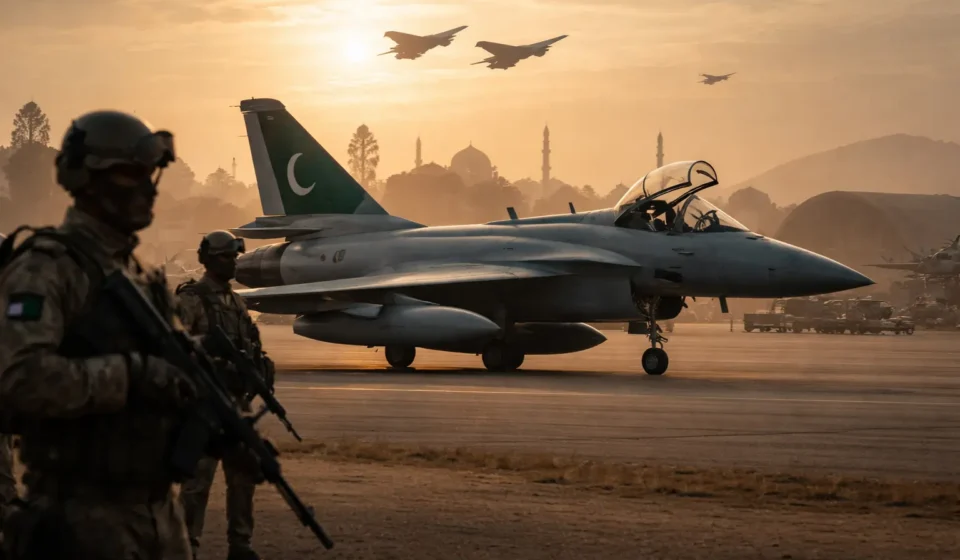
An example was the military performance in a short India-Pakistan confrontation in May 2025 which attracted international attention in which a report commissioned by the Congress of the United States state that the Pakistan Air Force achieved military victories over India involving Chinese-provided platforms. It was reported to be the first deployment of Chinese sophisticated equipment, which included the HQ-9 air defense system, PL-15 air-to-air missiles, and J-10 fighter aircraft to combat situations which was actually a field trial for the weapons industry of Beijing.
By 2023-2024, China was already supplying approximately 82 percent of Pakistan’s published armaments, thus ensuring that Islamabad relies on Beijing to supply heavy weaponization setup. China is seen to have supplied up to 40 J-35 fifth-generation fighter jets, KJ-500 airborne early-warning aircraft, and ballistic-missile-defense to Pakistan, further solidifying such a triage in defence-industrial relations in mid 2025. In 2025-26, the defense budget of Pakistan also increased by approximately 20 percent to an estimated 9 billion dollars whilst the total state budget is shortened; this is an indication that the capacity to provide security is a priority.
Exporting “Turkey” Military Capability to the Gulf
The reputation of Pakistan as an operable, battle-tested force has led the Gulf states to view it as a “regional security agent/ provider that can provide high-end military capability without the domestic political cost of depending on the western or Israeli forces. A Strategic and Mutual Security Agreement with Saudi Arabia in 2025 was a formalization of an informal arrangement longstanding, in which Pakistan committed itself in collectivist Gulf-based security structures and multinational drills and dests.
Participating in these multinational exercises, including China3 East Asia Pakistan was a part of, such as China-Pakistan Warrior-VIII counter-terrorism drills (three weeks in 202425) and the AMAN multinational naval drills hosted by Pakistan in 2025, has since become one of the demonstrations of how this is possible. All of these exercises and the fact that Pakistan has displayed its ability to outperform India in air combat thus making some regional players consider Pakistan as the power capable of balancing the conventional dominance of Israel and mitigating perceived constraints in the willingness of the United States to rein-in Tel Aviv.
US–China–India Triangle and Pakistan’s Balancing
The security-exportation position of Pakistan has become an element of a bigger US-China triangle with India, whereby Washington, Beijing and New Delhi are all interested in determining who exercises force-projection in South Asia. A U.S.-Pakistan trade agreement, discussed in a Regional-Studies-based article, would add more wholeness to the relationship but would also enable more space on dual-use security and logistical collaboration, although Washington will worry about how Pakistan spends its military-aid funding and human rights practices.
Meanwhile, the further escalation of Chinese defense alliances with Pakistan frightens India: the 2025 conflict report highlights that Beijing increased military interdependence with Pakistan, involving joint trainings and intelligence-based activities, and that New Delhi claims that Beijing gave direct contributions of Indian military location dispersals to the emergency. In the eyes of Indian analysts, it would be perceived as a threat on the territorial integrity of India and a move towards a China Pakistan and Gulf security axis, which would threaten the regional hegemony of New Delhi.
Conclusion: A High‑Risk, High‑Reward Model
The rise of a military-for-hire power in 20252026 that offers its services to Pakistan is both a strength and a weakness of the country because of its geopolitical position. On the one hand, it will be able to offer its military skills to the Gulf and other regional actors, and its participation in the 2025 Indian-Pakistan conflict can be used as a live-fire test of its abilities. On the contrary, it has an emerging economy, with a level of debt and a chronic insurgency and thus any overextension in foreign security contract will compromise the internal stability and the sustainability in the long run.