


It is always tempting to ponder how nations carve out their place in the international arena. Time and again, a characteristic that has stood the test of time is the method of making no noise but being a staunch friend in diplomacy that Pakistan has employed since the day it was born in 1947, following a tradition of peace.
The very beginning of it all was quite early. When Algeria was fighting for its freedom from the French colonial rule in the 1950s, Pakistan was among the very first nations to recognize the Provisional Government of the Algerian Republic in 1958. That was not only a verbal expression of support, as Pakistan issued passports to the Algerian political leaders enabling them to travel worldwide and advocate their cause in international platforms like the United Nations.
Almost concurrently, I also observed that Pakistan’s stance on Palestine has been quite intriguing. From the very beginning, it was averse to the UN Partition Plan in 1947 and denied recognizing Israel as a state. Its airmen also participated fighting alongside the Arab pilots in both wars of 1967 and 1973. It was one of the very first countries to recognize the State of Palestine in 1988 and even today, stands as a staunch supporter of an independent Palestine based on pre-1967 borders and East Jerusalem as its capital.
During the whole series of the recent events of the Gaza crisis, it sided by supporting the peace efforts at the UN and OIC levels through advocating ceasefire, humanitarian aid access in Gaza and a just political solution. It really surprises me how Pakistan’s stance hasn’t changed even a bit over the years that peace should be founded on justice.
The story is one of the most remarkable one I have ever read. In 1971-72, under the Presidency of Yahya Khan, Pakistan went a step further and acted as the secret channel which helped Henry Kissinger, US National Security Advisor, to make a clandestine trip to China, and then marked Nixons historic visit to the Middle Kingdom. Pakistan gave two bitter enemies, who would not even speak, a way to do so.
After the conflict between Iran and Iraq broke out in 1980, Pakistan rising once more and going as far as firstically proposing themselves as a mediator to end the conflict between those two Islamic countries. It was through the prolonged nature of the war, that their willingness to getting involved showed that any intra-Islamic conflict, regardless of how difficult, will always require a diplomatic.
Pakistan played a major role in the peace talks that led to the 1988 Geneva Accords. As the frontline country being the shelter to millions of Afghan refugees, it along with the United Nations, ensured the Soviet withdrawal from Afghanistan, which is highly uncommon in international diplomacy.
Throughout the 1990s, Pakistan continued to take a relatively low-key role. It was at the 1997 OIC Summit in Islamabad that Pakistan was given the chance to bring together a high-level meeting between Saudi Arabia and Iran, which helped the two influential countries to iron out their differences. Time and again it was said that Pakistan, being equally trusted by both Saudi Arabia and Iran, is ready to mediate between the two countries.
During the long peace talks in Afghanistan, Pakistan acted not only as the meeting place of the major participants but also played a role in facilitating the exchange of messages among them. I want to point out that these efforts played a key role in the US and Taliban regime Doha Agreement of 2020 which in fact marked the end of the longest war of America.
Pakistan recently acted as a crucial player in promoting peace in 2026, at a time when the US-Iran conflict was spiraling out of control. The country came to the rescue again by playing the part of a key mediator in the entire process. It facilitated talks between senior officials from both sides and will soon hold the second round of talks.
Reflecting on all these instances, beginning with Algeria and Palestine, the US-China diplomacy, the Geneva Accord, the Saudi Arabia and Iran initiatives, the Afghan negotiations, to the US-Iran talks in 2026, have made me hold my opinion very strongly.
Over time, Pakistan has not shown a craving for fame or acknowledgment in terms of its contribution. On the contrary, it has chosen the harder path of negotiation over complete isolation. Even in the face of its own problems, the country has consistently played the role of a mediator in different situations: it has held talks amongst bitterly opposing countries, supported freedom fights, and advocated for peace based on justice.
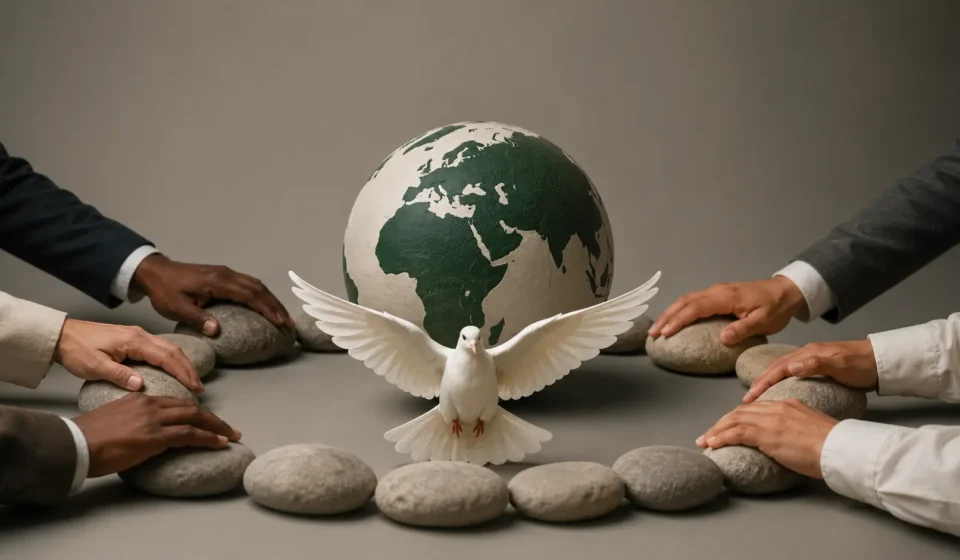
In our hectic world filled with animosity and suspicion, the desire of Pakistan to look for peace has been a constant determination extending from Algiers to Beijing, Lahore to Gaza to Tehran and Islamabad. The point has been made more than once. Pakistan has always been, and continues to be, a country that does, \” understands dialogue and respect will open doors where others only see walls. The real scene is that the track record is one that already speaks for itself. Dialogue and respect to Pakistani are doors while others open only see walls.
Author