


Pakistan’s SRO 691: The Six-Route Transit Order That Could Permanently Rewire Regional Trade

When a government issues a statutory regulatory order, it rarely makes headlines. But SRO 691(1)/2026-the “Transit of Goods through Territory of Pakistan Order 2026”- is not a routine administrative act. Signed into effect on April 25, 2026, it is a document that quietly reshapes Pakistan’s role in regional geopolitics, transforms Gwadar from a promise into a functioning artery, and places Islamabad at the center of one of the most consequential trade realignments since the Belt and Road Initiative was conceived.
The timing tells you everything. It tells you this was not planned in a conference room. It was forced by a crisis.
The Crisis That Wrote the Policy
At Karachi port, 3,000 stranded containers hold cargo that was meant to be shipped to Iran. The vessels that were supposed to collect them have not arrived – and with tensions in the Strait of Hormuz escalating, there is no clarity on when those ships might finally be able to reach Karachi.
Until the US-Israeli war against Iran began on February 28, roughly 20% of the world’s oil and 20% of its liquefied natural gas passed through the Strait of Hormuz. Since then, tanker traffic has dropped first by about 70% and subsequently to near zero, with the International Maritime Organization reporting that approximately 20,000 mariners and 2,000 ships remain stranded in the Persian Gulf.
For Pakistan’s port operators and logistics sector, the consequences are immediate and logistically suffocating. Shipping insurance costs have surged catastrophically since the start of the war. Before the conflict, war-risk insurance stood at around 0.12 percent of a vessel’s value. It has since climbed to roughly 5 percent, if coverage is available at all. For a very large crude carrier valued at $100 million, that means a premium of approximately $5 million for a single transit.
Pakistan could not wait. It acted.
What SRO 691 Actually Does
Issued under the Imports and Exports (Control) Act 1950 and in pursuance of the 2008 Pakistan-Iran Agreement on International Transport of Passengers and Goods by Road, the Transit of Goods Order 2026 came into force immediately upon notification. It formally permits goods originating from third countries and destined for Iran to pass through Pakistan under a defined legal and regulatory framework.
The order designates six land corridors linking Pakistan’s major ports – Karachi, Port Qasim, and Gwadar – to Iran’s border crossings at Gabd-Rimdan (near Gwadar) and Taftan (further north in Balochistan). All cargo moves under the supervision of Pakistan Customs, regulated under the Customs Act 1969 and Federal Board of Revenue procedures. Traders or authorized brokers must submit an encashable bank guarantee equivalent to Pakistan’s applicable import duties, a safeguard that ensures accountability without strangling trade.
Pakistan’s Federal Minister for Commerce Jam Kamal Khan described the initiative as “a significant step toward promoting regional trade and enhancing Pakistan’s role as a key trade corridor.”
Gwadar’s Moment – Finally
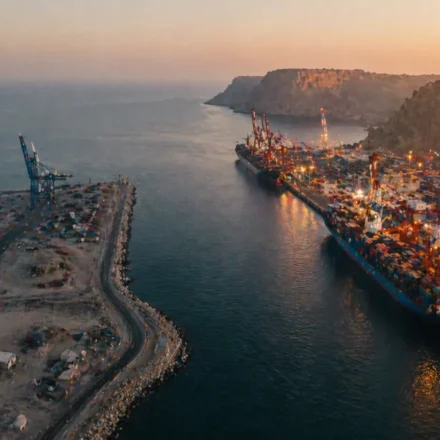
Of the six designated routes, the Gwadar-Gabd corridor stands out as the most strategically transformative. According to Gwadar Port Authority Chairman Noorul Haq Baloch, the Gwadar-Gabd route reduces transit time by nearly 87% compared to traditional routes from Karachi. Goods that previously took 18 hours to reach the Iranian border can now arrive in just three hours, potentially cutting transport costs by 45 to 55 percent. These are not marginal efficiency gains. They are the difference between a trade route that businesses use once as a novelty and one that becomes structurally embedded in regional supply chains. For perishable goods, temperature-sensitive pharmaceuticals, and time-bound commercial contracts – categories that dominate the Iran trade-a reduction from 18 hours to 3 hours is transformative.
Officials described the Gabd-Rimdan corridor as strengthening Gwadar’s strategic connectivity and expanding access to emerging export markets, with increased international container traffic already observed at Karachi Port in recent weeks.
Pakistan as the Pivot – Not a Bystander
What distinguishes SRO 691 from previous Pakistan-Iran trade gestures is its structural ambition. Previous arrangements were ad hoc, bilateral, and largely driven by necessity. This order creates a permanent legal architecture – with defined routes, customs supervision, TIR-compatible procedures, and a regulatory framework that can outlast the current conflict and function in peacetime as standard commercial infrastructure. Former Pakistani Ambassador Jamil Ahmed Khan framed the stakes clearly: “Iran remains significantly dependent on oil revenue, which cannot be fully realised when key export routes – particularly maritime ports-are restricted or disrupted. Such constraints directly impact the country’s foreign exchange earnings and overall economic stability.” By providing Iran a reliable overland bypass, Pakistan is not simply performing a neighborly act. It is inserting itself as an indispensable node in Iran’s supply chain-a position that carries economic leverage, transit fee revenue, and long-term diplomatic weight.
The broader connectivity vision is equally significant. Under the new framework, goods from Asia and South Asia can arrive at Karachi or Gwadar, transit through Pakistani territory, enter Iran at Gabd or Taftan, and continue onwards into the broader Middle East and Central Asian markets. Pakistan becomes, in this architecture, what it has always had the geography to be but rarely the policy coherence to achieve: the connective tissue between South Asia, the Persian Gulf, and Eurasia.
The Numbers Behind the Opportunity
Pakistan’s trade position entering this period was already strained. Pakistan’s exports declined seven percent in the July-February FY26 to $20.5 billion from $22.1 billion a year earlier. Last fiscal year, the country posted a trade deficit of more than $26 billion, with exports of $32.1 billion against imports of $58.4 billion. Every transit fee collected, every truck deployed, every container moved through Pakistani territory generates revenue that does not require a new factory, a new export market, or a new product line. It requires only the road, the legal framework, and the political will-all three of which now exist.
Pakistan is simultaneously navigating a $7 billion IMF program and seeking to unlock a fresh $1.2 billion tranche under the Extended Fund Facility. In that context, becoming a paid transit corridor for Iran-bound international trade is not a geopolitical luxury. It is a fiscal necessity dressed in diplomatic clothing.
Conclusion
SRO 691(1)/2026 will not dominate television debates or social media timelines. It is written in the dry language of statutory regulation, routes, guarantees, customs acts, and bilateral agreements. But beneath that bureaucratic surface lies a decision of genuine historical consequence. Pakistan has chosen, at a moment of maximum regional volatility, to formalize its role as the land bridge between a sanctioned Iran and the world’s supply chains. Whether that decision pays dividends will depend on implementation, on the trajectory of the US-Iran conflict, and on whether Islamabad has the institutional capacity to transform a six-route legal order into a functioning continental corridor.
The order is signed. The routes are live. The containers are waiting.
What Pakistan does next will define whether it is a transit state- or a transformational one.
Author