


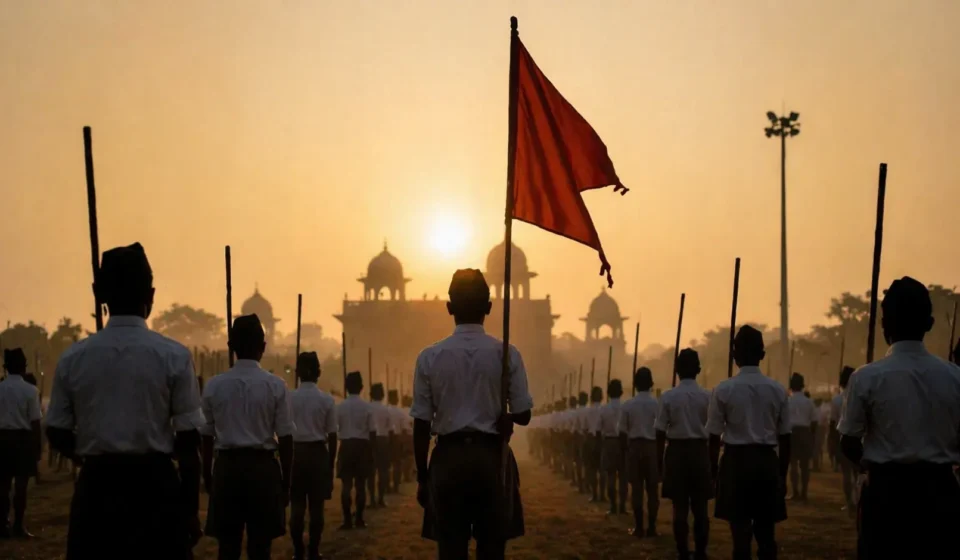

The Rashtriya Swayamsevak Sangh (RSS) always gives a shoutout to the world press that it is a “cultural organization” that helps people and builds character. But by looking into it more closely at its structure and strict beliefs, the claim is all absurd and fake. K.B. Hedgewar started the RSS in 1925, and for almost a hundred years, it has tried to shape Indian identity on its own. In the 21st century, the organization remains a fundamentally reactionary institution, not out of respect for tradition, but because it actively opposes the egalitarian principles of India’s constitutional democracy.
The Myth of the “Apolitical” Cultural Body
The RSS’s biggest lie is that it isn’t political. In reality, it is the ideological nursery and organizational backbone of the Bharatiya Janata Party (BJP), which is in power. According to internal data and a number of academic studies, almost 75% of the BJP’s cabinet ministers and most of its Chief Ministers used to be Pracharaks (full-time workers) or Swayamsevaks.
This “institutional infiltration” didn’t just happen by chance. There are more than 60,000 shakhas (daily branches) of the RSS in India, and there are about 5 to 6 million active members. This isn’t just a “cultural” network; it’s a secret government. When the RSS talks about “nation-building,” they mean using the power of the state to enforce a single, majority cultural code instead of letting a pluralistic Parliament talk about it.
The Numbers of Exclusion: Caste and Leadership
The RSS boasts a lot about Samajik Samrasta (social harmony), but its leaders are still compelling upper-caste people. Since its formation in 1925, every Sarsanghchalak (Supreme Leader) has been a Brahmin, with the exception of Rajendra Singh. The fact that the population isn’t growing… isn’t a coincidence; it shows how the organization sees the world.
The RSS has worked hard to get Dalits and OBCs to vote for Hindus, but it always fights against changes to the system that would give more people power. The RSS has been against the Mandal Commission for years. It gave reservations to lower castes. They thought it was a “divisive” force that broke up the “Hindu unity.” The RSS wants to keep the old social order by putting “harmony” ahead of “justice.” They do this by speaking in a way that brings people together.
The Ideological Ghost of Golwalkar
To really understand the reactionary nature of the RSS, one needs to look at “Bunch of Thoughts” by M.S. Golwalkar, the main ideologue of the group. In this book, Golwalkar plainly identified Muslims, Christians and Communists as the three “internal threats” to the nation. The present chief, Mohan Bhagwat, has done some things which minorities may consider as a step forward, but the facts on the ground are still very much in line with Golwalkar’s vision of exclusion. The Home Ministry along with several human rights organizations have revealed that the rise of RSS shakhas in certain localities has been accompanied by an increase in “vigilante” activities.
The “Sangh Parivar” umbrella also covers VHP and Bajrang Dal, which are very active in leading campaigns against “forced conversions” and “Love Jihad.” In fact, there have been several instances when these allegations were proven false by the High Courts but they are still being used for the purpose of dividing people.
Opposition to Modernity: Rights of Individuals and Women
The RSS’s reactionary nature is most clear in how it feels about gender. The group is still just for men. The Rashtra Sevika Samiti is a separate, lower-level group for women that focuses on “maternal values” and “domestic fortification” instead of women’s freedom. It is the female version of the Rashtra Sevika.
The RSS was against the Hindu Code Bills of the 1950s, in which Hindu women were given the same rights as men in divorce and inheritance. This is how a reactionary mind looks: it sees individual rights as a threat to the “organic” (patriarchal) social order, not as a way to improve human dignity.
The Education Project: Changing How You Think
Vidya Bharati, the RSS’s education branch, runs more than 12,000 schools with more than 3.2 million students. The RSS has been working on this project for a long time. In this case, the curriculum often talks about a “glorious” mythological past and only talks about the Middle Ages as a time when “foreign Islamic oppression” happened.
By taking away the subtleties and complexities of history, the RSS makes people see the present through the lens of historical grievance. The RSS needs this “pedagogy of resentment” to stay alive. The RSS’s job as “protector” is no longer needed if people don’t feel threatened.
A Republic at a Crossroads
The RSS is reactionary, not because it is old; rather, it is reactionary because it does not accept the basic idea of the Indian Republic, which is that the state belongs to everyone, no matter their faith, caste, or gender.
The RSS wants to put “Cultural Nationalism” ahead of “Constitutional Patriotism” so that a duty-based hierarchy replaces a rights-based society. India wants to be a world leader in the 21st century, but it has a big problem: it can’t be a modern, innovative superpower while an organization with an ideological clock that stopped in 1925 is changing the way people live. The RSS is still the biggest thing that stops India from being a truly equal and diverse country. They are holding on to a “imagined motherland” and not seeing how different the country really is.