
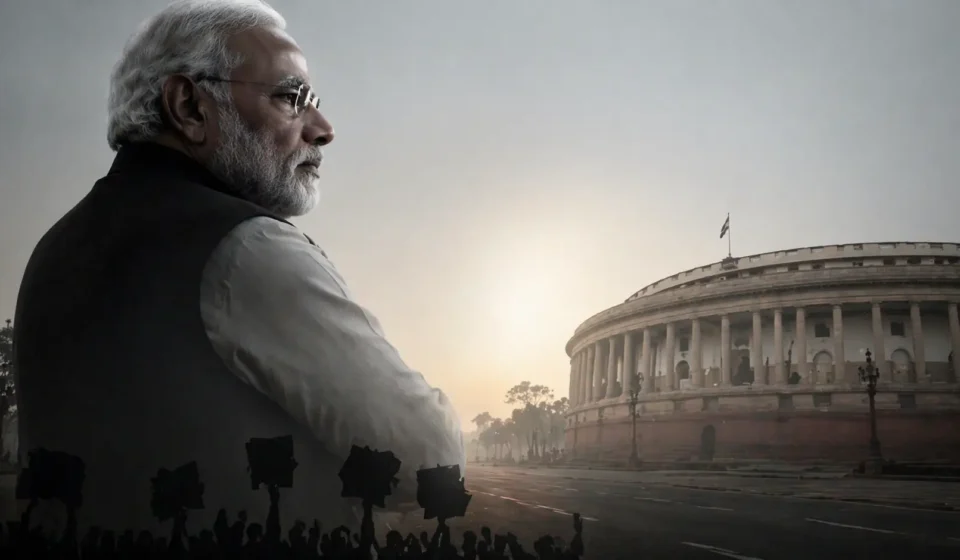

The idea that India is the largest democracy in the world has been seriously questioned recently. Political analysts, international organizations and even some segments of the Indian media are highlighting a trend of increasing concentration of power in the hands of Narendra Modi. Previously, decision-making by the government was somewhat spread out, but now it seems like all government works are being done through the PMO (Prime Minister’s Office). For example, demonetization in 2016, Article 370 abrogation in 2019, and the sudden lockdown due to COVID-19 in 2020 are major decisions which were taken and executed at the PMO level with very little parliamentary loopholes given. Indian media such as The Wire and The Hindu have been continuously highlighting through their reports and articles how the importance of cabinet functioning and parliamentary discussion has been worsened which is a feature of transition to the system of executive domination where power comes from one center only instead of democratic consensus.
This centralization of power is manifested not just in the style of ruling but also in a measurable reduction in democracy. Actually, the V-Dem Institute, whose data has been extensively used in Indian debates, recently declared that India is to be considered an “electoral autocracy” now. Its rating on the Liberal Democracy Index has experienced a very sharp decline over the last decade, and this recent drop even places India at a level lower than some smaller, historically less democratic countries. Another important organization, Freedom House, also well-known for its reports on democratic freedom has in its latest publication classified India as “Partly Free,” awarding the country a score of about 62 out of 100. They have noted the increased limitations on civil liberties, minority rights, and political opposition. The Hindu Centre for Politics and Public Policy is among the Indian academics who support the idea of democracy being on the decline in India. Scholars there outline the slow dismantling of democratic standards and the erosion of institutional independence.
The main concern is that investigative and regulatory agencies have played a big part in these instances. ED, CBI and the Income Tax Department are the agencies that have been at the center of controversy with the opposition parties accusing the agencies of selective targeting. The data that is quoted in Indian political debates reveals that an extremely high proportion of the cases these agencies pursue are opposition figures, thus giving the perception that law enforcement is being turned into a political weapon. At the same time, the question has been raised about the independence of ECI, especially in matters of the scheduling of elections, handling of complaints and enforcement of the Model Code of Conduct. Judiciary, which, according to traditional thought, is the strongest pillar of Indian democracy, has also been the target of criticism for trafficking in politically sensitive cases, which have also been perceived as a reluctance to challenge executive authority in key matters.
Another critical aspect is the dwindling availability of media and independent journalism. India’s global ranking in press freedom has been falling drastically, and the country stands among the lowest-ranked ones globally. Indian journalists and media houses have been narrating that their freedom is being limited through the use of frequent defamation cases, sedition charges, and financial investigations. Media like The Wire and Scroll have extensively covered the big raids on media houses and the government crackdown on foreign-funded NGOs. The term ‘Godi media’ is now commonly used to denote those TV channels that are thought to be government-aligned, reflecting a concern about control of the narrative and a loss of investigative journalism. In addition to this, the government can very well track and control online content due to the regulations of digital media and IT rules, which causes a further restriction of public discourse. The freedom of academics and intellectuals has also taken a hit. According to the study by The Hindu Centre, India’s Academic Freedom Index has plunged dramatically. Due to this, India is now being ranked among the countries with the most severely limited academic freedom. Universities have faced the folding of courses with very limited options, withdrawal of seminars and even disciplining students for expressing opposing views. Therefore, what results is a situation where not only are critical questions seldom raised, but they are also despised, thus turning academia into a place where independent thinking and democratic debates are hardly found. Simultaneously, civil liberties along with the social cohesion problems have risen as well. Many human rights reports quoted by the Indian media show increasing religious tension and the greater harassment of minority communities, mainly Muslims. The statistics referred to by foreign media indicate that there have been many more incidents of hate speech, most of them occurring during the election period. Besides, moves to pass laws such as anti-conversion laws or modifications of citizenship policy have put the concept of equal rights and the protections under the Constitution in jeopardy. In addition, India is amongst the top few countries which have the highest number of internet shutdowns, and it is one way the government uses its power to restrict the flow of information, especially in sensitive areas like Jammu and Kashmir.
Economic governance also incorporates elements of centralizing control. For instance, a policy like the Goods and Services Tax (GST), which was designed to unify the market, has been pointed out by a few state governments as diminishing their fiscal autonomy. The center’s growing supremacy in sharing revenues and making policies has led to arguments about how India’s federal structure is being diluted. States that are governed by the opposition have often blamed the central government for utilizing financial instruments and the power of governors to interfere with or discredit local governments, thereby increasing the strain within the federal system.
There is something deeply alarming about this pattern of change precisely because it has been unfolding steadily for a long time. Multiple data sources, including V-Dem and other research institutions have been showing that the freedom of expression, media independence, and governance through checks and balances, among other features, have been on a gradual, continuous decline since 2014. There are even scholars who have drawn parallels between the current political climate and the Emergency period in 1975-77, suggesting that both times the main features were centralisation of power and suppression of dissent, although the ways in which these have occurred are different. Such comparisons, which are frequently used in political and journalistic debates in India, reflect how serious the matter is. Individually and collectively, they show that on the one hand, Indian democracy is being changed at its most fundamental level, and on the other hand, elections are held and voter turnout is high. However, playing democracy merely means voting. Democracy is about institutions functioning independently without any interference, the right to dissent being protected, and power being distributed rather than being concentrated. Presently, these fundamentals, which are the very pillars of democracy in India, appear to be under persistent pressure.
The concentration of power in the hands of Narendra Modi has changed governance in a manner that a lot of people who study these things say is a weakening of the democratic balance. The questions about the independence of the institutions, the media operating under constraints, the civil liberties being severely contested, and the federal principles being weakened are pieces of evidence indicating that there is a system in which the democratic structures are there but they are losing their essence. Against this backdrop, as more and more analysts, journalists, and researchers are coming to the same conclusion, the conclusion is that Of course, India’s democracy is not only shrinking but also failing in some critical and measurable ways, thereby causing serious concerns about the future of the country.