


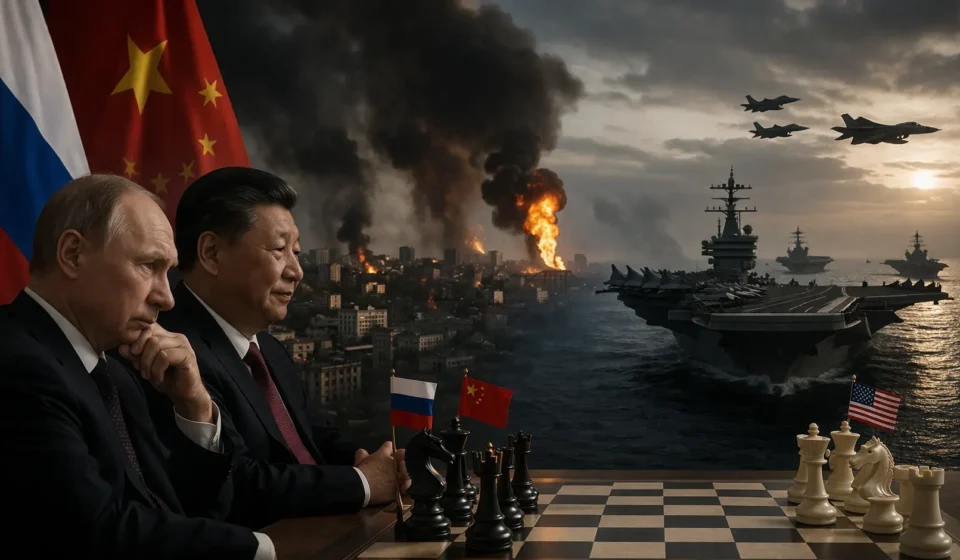

As America burns through cash and reputation in the Gulf, China and Russia are reaping the rewards of conflict – without ever firing a shot.
Bombs are falling in Tehran. The USS Abraham Lincoln and USS Gerald R. Ford carriers are sailing the Persian Gulf. America is counting the bodies and burning through the military budget. But in Moscow and Beijing, no one is crying.
This is not a conflict China and Russia need to fight. And because of that, they are already winning. Since the joint US-Israeli attack on Iran on February 28, 2026, America’s two most powerful enemies have been doing something far more clever than engaging in proxy warfare – they have been observing, waiting, and reaping the benefits. The Iran conflict is not simply a Middle Eastern conflict. It is a lesson in how to defeat vour enemy not on the battlefield. but through superior strategy. timing, and silence
Russia’s Windfall: From Bankruptcy to Bonanza
First, the money: the figures are enormous. Before the Iran crisis began, Russia was in deep financial trouble. Its oil export revenues had dropped to less than $10 billion in February, and the Kremlin was reportedly planning to cut all non-security spending by 10 percent. Geopolitical Monitor Russia’s war in Ukraine had drained the country dry.Geopolitical Monitor
But then the Gulf went up in flames, and Moscow struck gold.
The Russian government had budgeted its budget on the basis of oil prices at $60 a barrel. The outbreak of war in the Gulf pushed oil prices to $120 a barrel, and the Kremlin had money to fund its military campaigns in Europe. The figures are staggering. The KSE Institute report estimates that Russia could collect an extra $45 billion to $151 billion in revenues in 2026. depending on the length of the conflict. Geopolitical Monitor Even in the most favorable scenario, in which the war in the Gulf ends in six weeks, Russia can collect an extra $84 billion in export revenues compared to a baseline in which there was no war. That’s not a bonus; that’s a lifeline.
And the geopolitical gifts just kept coming. Putin also benefited from a decision by U.S. President Donald Trump to lift sanctions on some Russian oil and gas supplies after a phone call between the two presidents, as well as a decision by the European Commission to delay a plan to permanently bar Russian oil imports, saying “current geopolitical developments” warranted such a move.
“The current situation in Iran and the Middle East is relatively favorable for Russia’s geopolitical and geoeconomic position, particularly in the short term,” said Zhang Xin, deputy director of the Centre for Russian Studies at East China Normal University in Shanghai. Council on Foreign Relations
Translation: Russia didn’t fire a single shot at America, and America rewards Russia with a financial rescue package
China’s Game: Quiet, Calculated, Consequential
China’s game, while less obvious, is no less potent.
Iran has traditionally played a critical, under-the-market role as a source of energy for China, especially after the signing of a 25-year cooperation agreement in 2021, which secured $400 billion in oil at below-market prices in return for investment in Iranian infrastructure and security cooperation. But with this supply chain now in disarray, China has moved swiftly to fill the gap. Chinese oil imports increased by 16 percent in the first two months of 2026 for stockpiling purposes, while Russia shipped 300,000 barrels per day more oil to China in January and February alone. Wellington Management
From an economic point of view, China is better placed to weather the energy shock than its Western competitors. Unlike the US, which came into the conflict with an existing inflation problem, China was facing a deflation problem, with factory gate prices and wage growth of only close to 1 percent. A modest increase in oil prices will have a positive impact on the Chinese economy. The factory goods of China will remain more competitive compared to those of the West, which will see input costs rise more rapidly.
But the real prize isn’t the price of oil. It’s the Indo-Pacific.
The US military will be distracted by a long conflict in Iran, which could have major implications for the future of Taiwan and the South China
Sea.. Watching US military operations in real-time in the Gulf could be extremely valuable to China in the event of renewed tensions in the Strait of Taiwan. Every U.S. aircraft carrier in the Gulf is one less patrolling the waters that China wants to dominate. Every billion dollars spent on Tomahawks is one less for deterring China in the Pacific. China doesn’t need to shoot a single bullet at Taiwan. It simply needs America to remain Preoccupied.
The Shadow War: Intelligence, Technology, and the Invisible Battlefield
Now, let’s get to where things get a little darker. The truth is, neither Beijing nor Moscow is a bystander. They’re active players, just not in a way that sparks a war declaration. When senior American officials informed The Washington Post that Russia was providing sensitive intelligence to Iran, including the locations of U.S. warships and aircraft throughout the Middle East, they were exposing the framework of a brand new kind of war, a war that has no front lines, a war not fought with tanks or missiles, but with radar, satellites, and encrypted communications. EY
China’s involvement is not as prominent, yet no less significant. For years, Beijing has been busy remaking the electronic warfare environment in Iran, delivering advanced radar systems, transitioning Iranian military navigation systems from U.S. GPS to China’s encrypted BeiDou-3 svstem. and tapping its expanding satellite infrastructure to support signals intelligence for Iranian forces.
The equipment on the battlefield is just as frightening. The YLC-8B anti- stealth radar, a Chinese-supplied UHF-band system, utilizes low- frequency signals designed to counter the stealth capabilities of radar- absorbent coatings on US stealth aircraft. The B-21 Raider and F-35C were designed to be invisible, but they will not be nearly so invisible in a YLC-8B system.
The Strategic Trap America Walked Into
This is the brutal irony of this conflict. From the opening of the door to China by Nixon and Kissinger, through the Reagan administration’s management of late Cold War international relations, there has been a constant in American strategy: the desire to prevent Russia from ever forming a durable alliance with China. Just in 2017, the U.S. National Security Strategy recognised China and Russia as distinct revisionist states that needed to be managed separately.
That strategy has been laid in ruin. In escalating the war in Iran, the United States is removing the pressure on Russia. As the United States remains in the Middle East, the longer it will take for the alliance between China and Russia to be cemented. The deafening silence emanating from the normally garrulous Chinese and Russians is telling. From their point of view, silence is golden in allowing Washington to get bogged down in a protracted war in the Middle East while they themselves seek to expand their influence in Europe and Asia under Vladimir Putin and Xi Jinping, respectively.