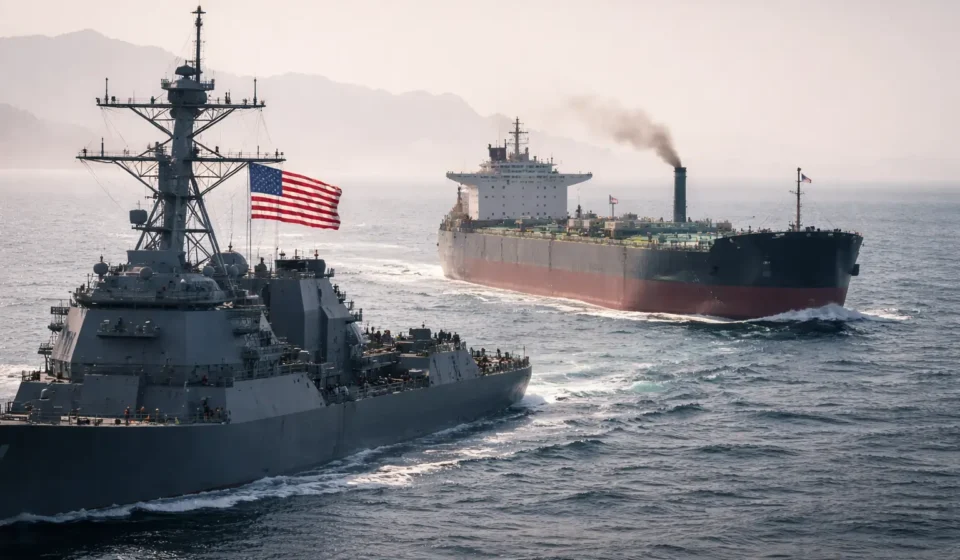

Trump’s Hormuz blockade began yesterday on 13th April, after weekend talks in Islamabad collapsed without agreement. The US Navy now intercepts all maritime traffic entering or exiting Iranian ports, aiming to strangle Tehran’s oil revenues and force concessions. Yet the very first full day of enforcement saw a US-sanctioned Chinese-owned tanker, the Malawi-flagged Rich Starry, successfully transit the Strait of Hormuz from Iranian waters, according to MarineTraffic and LSEG shipping data.
This single crossing is not an anomaly. It signals the strategic limits of unilateral naval coercion in a multipolar era. Data and historical patterns show the blockade is unlikely to collapse Iran’s economy or deliver decisive US victory. Instead, it risks accelerating America’s relative decline while strengthening Beijing-Tehran ties.
The Blockade’s Stated Objectives and Immediate Realities
President Trump ordered the blockade to cut off Iran’s estimated 1.71–1.84 million barrels per day of crude exports recorded earlier this month. Kpler data shows Iran shipped roughly 1.68 million bpd on average in 2025, generating around $45 billion annually, equivalent to 13% of GDP. The goal is clear; deny Tehran this lifeline and compel surrender or major concessions on its nuclear programme and regional proxies.
Yet enforcement faces immediate defiance. The Rich Starry tanker crossed despite explicit US warnings, joining a pattern where Chinese-linked vessels continue operating. Before the war, the Strait of Hormuz carried 21 million bpd, roughly 20% of global seaborne oil trade. War-induced Iranian restrictions had already slashed traffic to an average of 7 ships per day (down from 130–150), with only 36% of remaining tanker movements linked to Iranian ports.
The blockade tightens this chokehold on paper. In practice, selective Chinese transits expose enforcement gaps. China, Iran’s largest customer, imported over 1 million bpd of Iranian crude in March alone, according to United Against Nuclear Iran tracking. Beijing has publicly declared the blockade “against the international community’s interests,” per Reuters reporting on Foreign Minister Wang Yi’s statements.
Iran’s Economic Resilience
Iran’s economy has survived far harsher sanctions regimes since 2018. Pre-war oil exports recovered to near-record levels through shadow fleets, ship-to-ship transfers, and yuan-denominated deals. Even during the current conflict, Tehran maintained 1.85 million bpd averages in March, with 180 million barrels afloat in storage as a buffer, according to Kpler.
A full blockade would hurt, but not collapse the regime. Iran’s non-oil GDP, now over 70% of the economy, includes petrochemicals, agriculture, and manufacturing. Russia and China provide alternative financing and technology. Land corridors via Iraq and Pakistan offer partial workarounds for refined products. Historical precedent is instructive, for instance, maximum-pressure sanctions under Trump 1.0 reduced Iranian oil exports by 80% at peak but failed to trigger regime change or major policy shifts.
Strategic analysts at the Economic and Political Research Foundation note that asymmetric tools like naval mines, drones, and proxy harassment allow Iran to impose disproportionate costs on enforcers. Daily US operational expenses in the Gulf already exceed $2 billion, per Oxford Economics estimates. Prolonged blockade risks environmental catastrophe, insurance spikes, and retaliation against Gulf shipping, further inflating global oil prices beyond the current $150+/barrel threat levels warned by Al Jazeera analysts.
The Chinese Tanker Crossing: Symbol of Multipolar Defiance
The Rich Starry crossing is emblematic. This sanctioned vessel ignored US naval presence and completed its transit from Iranian ports toward China. Similar Chinese supertankers (Cospearl Lake and He Rong Hai) had already tested routes in recent weeks, per LSEG data.
China imports 60–70% of its crude via Hormuz-adjacent routes and has no incentive to abandon Iranian supplies amid its own energy security needs. Beijing’s response is diplomatic condemnation plus practical defiance, which underscores a core multipolar reality that the US no longer enjoys uncontested naval hegemony. Academic analyses from the Lowy Institute and Munich Security Report 2026 show Global South actors increasingly reject US-led enforcement when it conflicts with their economic interests.
This dynamic echoes Cold War-era sanction-busting but with faster, technology-enabled shadow fleets. Iran’s exports to China have persisted at scale despite sanctions, proving the blockade’s leakage points. A single tanker crossing may seem minor, but it normalises non-compliance and invites others to test boundaries.
Costs to US Credibility and Global Order
The US’ Hormuz blockade aims to reassert unipolar control but achieves the opposite. It diverts US naval assets from the Indo-Pacific, weakening deterrence against China. It alienates Gulf allies wary of higher energy costs and escalation risks. Most critically, it accelerates the perception of American overstretch.
V-Dem Institute data already records a 24% drop in the US Liberal Democracy Index in 2026, stripping America of its “liberal democracy” status for the first time since the 1970s. Externally, the blockade reinforces narratives of declining hegemony. Brookings Institution and China-US Focus scholars describe it as exposing “material boundaries of American military projection” in an era where middle powers and economic interdependence constrain unilateral action.
Oil market reactions confirm the risks. Prices have climbed on blockade news, with analysts forecasting $150–175/barrel scenarios if enforcement persists. This hurts US consumers and allies far more than a sanctions-hardened Iran. Global supply chains, already strained, face further disruption, which is exactly the outcome Beijing and Moscow benefit from observing.
Why the Blockade Cannot Deliver Victory
Intellectually and strategically, Trump’s Hormuz blockade fails on three levels:
- Economic Resilience: Iran’s diversified revenue streams and Chinese lifeline prevent collapse. Oil accounts for only 13% of GDP today versus higher historical dependence.
- Enforcement Limits: Naval blockades require sustained presence and risk escalation. Iran’s mine-laying and drone capabilities impose high costs on US forces without symmetric engagement.
- Multipolar Backlash: China’s open defiance, as seen with the Rich Starry, proves the US cannot isolate Iran without confronting Beijing, a confrontation Washington is unprepared to win economically or militarily.
Historical Parallels: The 1980s Tanker War, 2019–2020 maximum pressure, and recent Red Sea disruptions all show chokepoint coercion rarely delivers decisive strategic wins. It instead breeds adaptation and new alliances.
Broader Geopolitical Implications
A prolonged blockade would not “win the war” for America. It would hasten multipolar consolidation, with China emerging as the indispensable energy player and Russia gaining from diverted US focus. For Iran, the episode reinforces survival narratives and strengthens hardliner positions domestically.
The real winner is the narrative of declining US primacy. As Reuters and The National analyses note, even limited Chinese tanker transits undermine the blockade’s credibility. This is not 1991-era unipolarity, it is 2026 multipolarity, where economic interdependence and great-power rivalry constrain American options.