


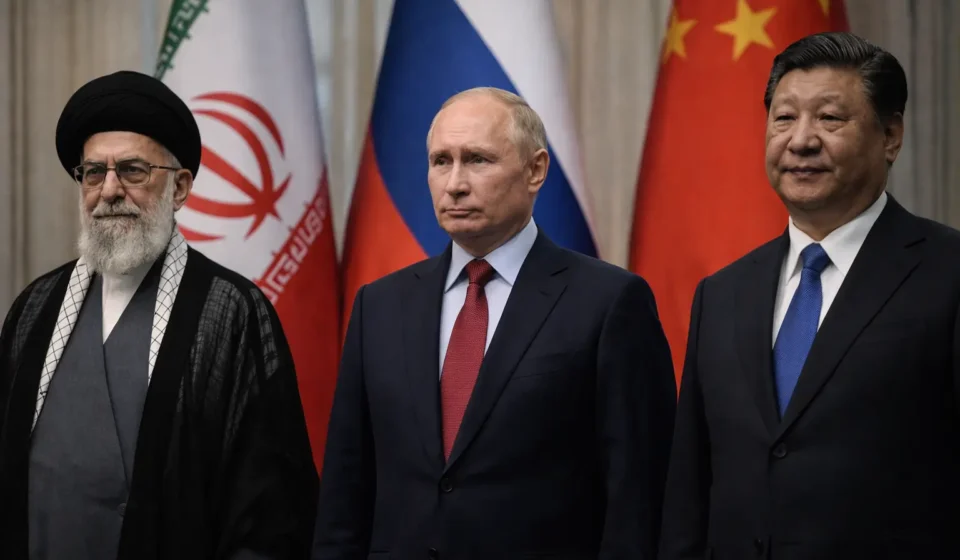

The American foreign policy over several decades was based on one, undisputed premise namely; that America was the only designer of the global order and that there was no serious coalition that could ever oppose it. That supposition is now crumbling right before our eyes. The fact that a new multipolar resistance bloc is beginning to take shape with a structured alignment between Iran, Russia, and China, is not only a diplomatic realignment but a challenge to the post-Cold War world that Washington constructed, and has three decades since been unwilling to share.
This is not being paranoid or against America. It’s math. When you look at the numbers clearly, they tell the story of a superpower that went too far, thought it would last forever, and is now quietly watching its dominance fall apart from three different directions at once. The age of multipolar resistance has begun, not with a bang, but with pipeline deals, treaty signings, and the slow gathering of alternatives to everything America built.
The Pact That Changed the Equation
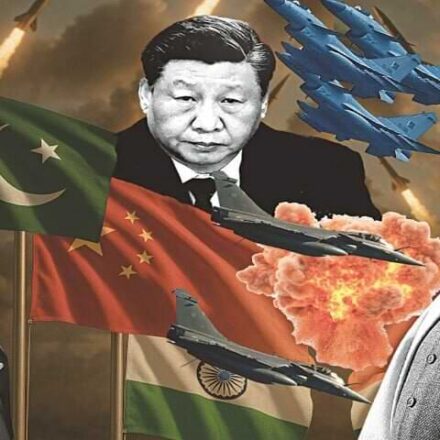
In January 2025, Russia and Iran agreed to sign a 20-year Comprehensive Strategic Partnership Treaty to formalize the enactment of extensive collaboration in the fields of economics, defence, and security, with intelligence sharing and joint military training.In January 2026, Iran, China, and Russia formally signed a trilateral strategic pact, which all three governments claimed as the foundation of a new multipolar world order. which all three governments said was the basis for a new world order with more than one power center. It wasn’t a press release. This was a statement of purpose for architecture.
In 2023 and 2024, Iran already became a member of Shanghai Cooperation Organisation and BRICS. The International North-South Transport Corridor, a trade route linking Moscow to the Iranian port of Bandar Abbas recorded the highest number of traffic in early 2026 with the first regular container trains operating in January 2026. The multipolar resistance infrastructure was not being thought of. It was being constructed, kilometre upon kilometre, pipeline upon pipeline, as Washington was engaged in fighting wars it could not complete.
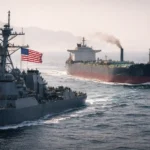
The military side is just as important. Russia has already started supplying 48 Su-35 fighter jets to Iran, a deal with a price tag of about 6.5 billion dollars. Russia has also sold Iran the Khayyam spy satellite, a 1.2-metre high-resolution orbital reconnaissance satellite, which enables Tehran to have real-time access to the US and Israeli military positions.. US officials verified that Russia was supplying Iran with satellite images of the positions of American war ships when the Gulf escalations of early 2026 were going on. It was not denied by the Foreign Minister of Iran.
“What used to be a relationship of careful coordination is now becoming a structured alignment, thanks to energy interdependence, growing defense cooperation, and diplomatic positions that are becoming more coordinated. — TODA Institute, April 2026″
America’s Self-Inflicted Wounds
Washington did not fall into this predicament. It entered it with its eyes closed and believed sanctions, military dominance, and alliance politics could forever keep down the ambitions of three of the most resource-endowed and strategically located states in the world. It was erroneous in all three counts.
The US weaponisation of the dollar by imposing sanctions as an instrument that Washington has used against Russia, Iran, Venezuela and dozens of other states failed to hit its targets.s. It shattered their reliance on dollar. By 2024, more than 90 percent of the bilateral trade between Russia and China was transacted using the rubles and yuan currencies and nothing to do with the dollar. The US dollar has lost its share of foreign exchange reserve in the world, which was about 85 percent in 1970s to about 57 percent in 2025. The US Dollar Index plummeted 11 percent in the first half of 2025 alone the steepest in 1973.. The weapon of multipolar resistance proved to be the dollar itself, turned against its creator by excessive use.
China has a Cross-Border Interbank Payment System (CIPS) that is its yuan-based alternative of SWIFT, and it has connected 4,800 banks in 185 countries. In 2025, 97 percent of the trade between member states of Shanghai Cooperation Organisation including India, Russia, China, Iran, Pakistan and six Central Asian countries was made in local currencies, as opposed to dollars.s. The answer to any BRICS country going de-dollarised was not compliance, when Trump threatened to impose 100 percent tariffs on the BRICS. It was acceleration.
In the meantime, the move by Trump to go to war with Iran together with Israel in early 2026 without consulting any of the NATO allies was a gift to Beijing and Moscow which could not have been produced by any amount of strategic planning. The war in Iran, As the Tufts University analysis noted, the war in Iran directly contradicted the US’s own November 2025 National Security Strategy, of the US, which had made it clear that the significance of the Middle East will be deemphasized. The war dragged America further into the very place it was purporting to leave, handed Russia an oil bonanza Brent crude shot to $120 per barrel, bailing out the war budget at Moscow and more splintering NATO at a moment of urgent need than ever.
The Architecture of a Post-American World
What makes this moment unique in history is that multipolar resistance is no longer just talk. It has a form that is institutional. BRICS, which will grow to include Iran, Saudi Arabia, Egypt, Ethiopia, and the UAE in 2024, now accounts for more than 40% of the world’s GDP on a purchasing-power-parity basis and more than 45% of the world’s population. The SCO covers a land area that goes from Beijing to Tehran to Moscow. The New Development Bank lends in local currencies without the IMF’s political conditions.
Analysts at the TODA Institute criticized the December 2025 US National Security Strategy for treating China and Russia as if they were completely separate entities and not providing any way to stop them from coming together,not giving any advice on how to stop them from coming together. That coming together is now official thanks to a signed treaty. The plan came too late and didn’t make enough sense.
In early 2026, the European Council on Foreign Relations said it clearly: the United States “no longer sees itself as the primary architect or guarantor of global order.” The 2025 NSS from Washington said, “The days of the United States holding up the whole world order like Atlas are over.” In thirty years, that might be the most honest thing any American government has said. It is also a strategic retreat, and Beijing, Moscow, and Tehran are quickly and carefully filling the gap it leaves.
“The center of power in the world is changing. It’s not just a simple East vs. West split anymore. Instead, it’s becoming a more contested, multipolar world order where diplomatic leverage, economic resilience, and military signaling come together in new and unpredictable ways.” — Middle East Monitor, January 2026”
The Limits of Firepower
This doesn’t mean that America is over. About 57% of the world’s reserves are still in US dollars. In 2023, the US military will spend $916 billion, which is more than the next ten countries combined. Its network of alliances, even though it’s falling apart, is still the best. But structural power and raw power are not the same. The US has a lot of power to destroy. It has lost the ability to organize. That is what is slipping: the ability to make rules, reach agreements, and convince others that the system works for them too.
The multipolar resistance bloc doesn’t have to beat America in a war. It just needs to make the order led by the US optional.When countries can trade in yuan, pay off debts through CIPS, get development loans from the New Development Bank, and build rail corridors that go around American-controlled chokepoints, the hegemony stays strong. It doesn’t matter anymore. That is the much more dangerous path, and Washington doesn’t have a clear answer for it.
Empires that thought military power was the same as long-term legitimacy have never done well in history. Rome, Britain, and the Soviet Union all thought that their power structures would last forever. They all found out too late that power that is kept by force instead of consent is always on borrowed time. The United States is not Rome. But it is making the same mistake as Rome: spending its money on wars in other countries while the institutions that support its global power are falling apart at home and are being deliberately destroyed by a disciplined coalition abroad. The multipolar resistance bloc did not cause this crisis. America’s own decisions did. The question is no longer whether the world is moving on from American dominance. It already is.