
As the Iran-Israel-US war enters its fifth week, reports indicate the United States is preparing limited ground operations targeting key Iranian islands. These moves aim to pressure Iran into reopening the Strait of Hormuz, which handles over 20% of global oil trade and has been effectively closed or heavily disrupted.
The US administration is readying raids and possible seizures rather than a full-scale mainland invasion. Primary targets include Kharg island and smaller strategic outposts such as Abu Musa, Greater Tunb, and Lesser Tunb.
Key Iranian Islands Under Consideration
Kharg island stands out as the most critical target. Located about 26 km off Iran’s southwestern coast, this small coral outcrop (roughly 20 sq km) serves as Iran’s main oil export terminal, handling approximately 90% of the country’s crude exports. US airstrikes earlier in March damaged alleged military infrastructure, including the airfield and air defense systems, but spared oil facilities initially.
Other islands form part of Iran’s “arch defense” line controlling access to the Strait of Hormuz:
- Abu Musa, Greater Tunb, and Lesser Tunb: These small disputed islands (claimed by the UAE but controlled by Iran since 1971) host IRGC installations, ports, airports, and missile positions. They sit near the western entrance of the strait.
- Qeshm and Larak Islands: Larger positions with underground bunkers, radars, and anti-shipping weapons closer to the strait’s narrowest point.
These islands function as “unsinkable aircraft carriers,” enabling Iran to threaten shipping with mines, drones, and missiles.
US Military Deployments and Operational Plans
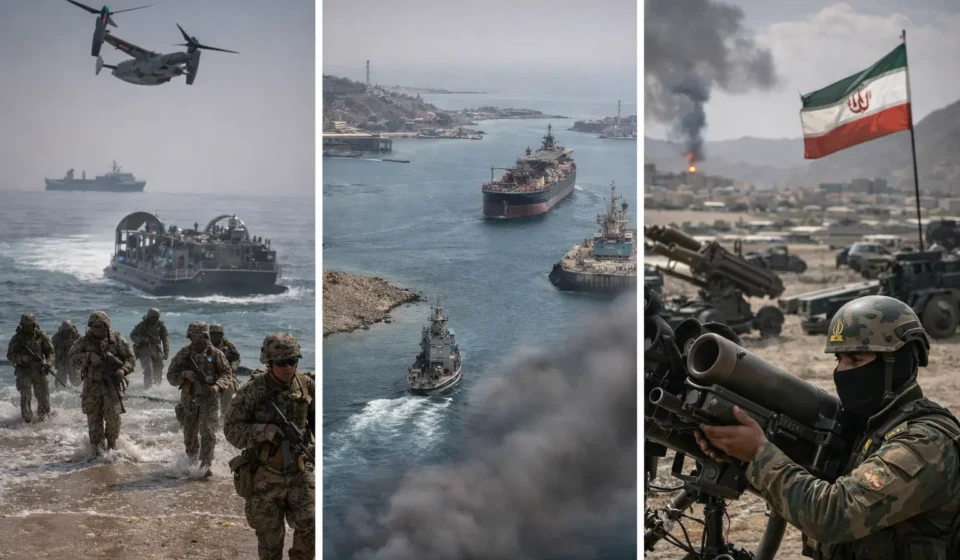
The US has significantly boosted its ground and amphibious capabilities in the region. Recent arrivals include:
- The 5,000 US Marines from two Marine Expeditionary Units (31st and 11th MEUs), equipped with Osprey tilt-rotor aircraft, landing craft, attack helicopters, and artillery.
- Around 2,000–3,000 paratroopers from the Army’s 82nd Airborne Division, part of the Immediate Response Force.
Additional forces could bring the total US ground presence to over 17,000 when combined with existing troops.
Plans focus on limited, weeks-long operations rather than prolonged occupation. Options include:
- Amphibious landings by Marines to seize beachheads or ports.
- Airborne assaults by paratroopers to secure airfields or key positions quickly.
- Raids by special operations and conventional infantry to destroy anti-shipping weapons, mine stockpiles, and missile sites along coastal areas and islands.
Al Jazeera reported the preparations being made by the Pentagon for a ground invasion of Iran. The goal is to neutralize threats to commercial and military shipping, reopen the Strait of Hormuz, and gain leverage for negotiations. President Trump has publicly stated that US forces could “take Kharg Island very easily” and has floated seizing it to pressure Iran or even access its oil resources.
Iranian Defenses and Expected Challenges
Iran has reinforced defenses on these islands, adding air defense systems, personnel, and laying naval mines. Officials, including Parliament Speaker Mohammad Bagher Ghalibaf, have warned that any US ground presence on Iranian soil or islands would cross a “red line.” Threats include setting American soldiers “on fire,” targeting US allies in the region, and sabotaging infrastructure.
Holding captured islands would expose US forces to sustained attacks from the Iranian mainland using low-cost drones, missiles, and rockets. Supply lines would be vulnerable, turning positions into potential “shooting galleries.” Historical parallels, such as island seizures in past conflicts, suggest high risks of attrition despite initial tactical successes.
Iran could also escalate by mining wider areas of the Persian Gulf or activating proxies to open secondary fronts, further disrupting global energy supplies and driving oil prices higher. It has been described that IRGC has trained itself in a way for decades to counter the US-Israel attack in a “guerrilla-like” manner.
Short-Term and Medium-Term Expectations
Short-term: Preparatory airstrikes may intensify to degrade defenses on targeted islands. Limited special forces raids or probing actions could test Iranian responses. Diplomatic efforts, including mediation through regional players, may run parallel to delay or avert ground moves.
Medium-term: If ordered, US forces could attempt amphibious or airborne seizures of smaller islands like Abu Musa and the Tunbs first, as these are disputed and potentially framed as supporting UAE claims. A full takeover of Kharg Island would require repairing damaged infrastructure and holding it against counterattacks, possibly for an extended period.
Success in reopening the Strait of Hormuz remains uncertain due to lingering mines and coastal threats from the mainland. Prolonged occupation could prove costly in casualties and resources, with daily operational expenses estimated in the billions.
Global economic fallout including fuel shortages and price spikes would intensify, affecting Asia and beyond.
Key Risks:
- High US casualties from asymmetric Iranian attacks.
- Escalation into broader regional conflict involving allies.
- Limited strategic payoff if Iran maintains the ability to threaten shipping from the mainland.
Conclusion: A High-Risk Escalation Phase
A potential American ground invasion and occupation of Iranian islands represents a dangerous new phase in the conflict. While deployments provide the capability for limited seizures particularly of Kharg Island and the strategic outposts guarding the Strait of Hormuz, the operation carries substantial military, economic, and diplomatic risks. According to the Guardian, the plan to reopen the Strait of Hormuz is a high-risk high-reward game. Iran’s fortified positions and willingness to retaliate suggest that any landing could quickly turn into a costly battle of attrition. Whether these moves deliver decisive leverage for reopening the strait or force negotiations will depend on execution, Iranian resilience, and parallel diplomatic channels.