



The geopolitical landscape of South Asia has long been defined by a security architecture that refuses to be confined within national borders. From the high mountain passes of the Hindu Kush to the strategic plains of the Indus Valley, the security of Afghanistan, Pakistan, and India is inextricably linked. In 2026, this reality is more pronounced than ever. As we navigate a year marked by both high-tech defense pacts and old-school border skirmishes, the Regional Security Complex Theory (RSCT)—pioneered by Barry Buzan and Ole Wæver remains the most potent lens through which to view this volatile trifurcation.
The RSCT Framework
Security Interdependency RSCT posits that most security threats are easier to traverse shorter distances than longer ones. Therefore, security issues must be analyzed at the regional scale. South Asia is home to a complex security interdependence: what happens in Kabul also concerns Islamabad and draws the attention of Delhi. This interdependence is characterized by long-standing rivalries and alliances, such as the legacy of the Durand Line and the Kashmir conflict, as well as Great Power involvement, where the USA and China act as ‘penetrators’ to further their global geopolitically strategic goals.
The Kabul-Islamabad Friction: A Border on Fire
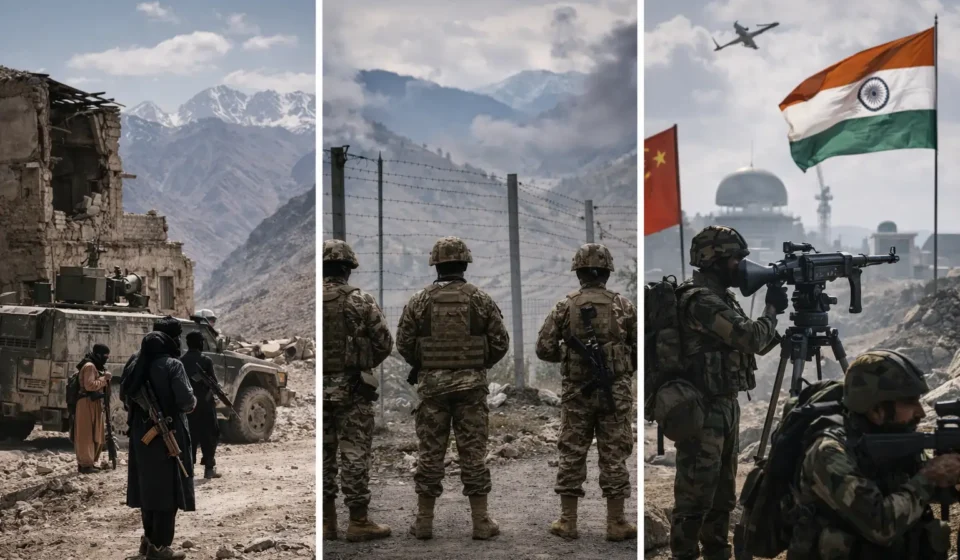
The relationship between Pakistan and Afghanistan is in its most turbulent period since the Taliban took over in August 2021. This is the most critical phase of the security dilemma and the worst-case scenario of the ‘strategic depth’ model. This security dilemma extended to an armed confrontation in February 2026 when airstrikes were conducted by Pakistan on the Afghan provinces of Nangarhar, Paktika, and Khost, against reported hiding places of the Tehrik-e-Taliban Pakistan (TTP). This action followed a series of terrorist attacks in Islamabad and Balochistan that were attributed to the TTP. The reported collateral damage was high, with UNAMA (United Nations Assistance Mission in Afghanistan) reporting hundreds of deaths and UNHCR (United Nations High Commission for Refugees) reporting over 115,000 displaced Afghans.
The deteriorating security index accentuates this friction. From the Global Terrorism Index 2026, Pakistan has surpassed Burkina Faso becoming the most affected country by terrorism, recording over 1000 deaths in 2025. The border’s “securitization” has also put a halt to potential economic growth; despite Pakistan’s exports to Afghanistan being $1.51 billion in 2024, the ongoing closures of the Torkham and Chaman borders threaten to collapse this critical trade artery.
The India-Pakistan-USA-China Matrix
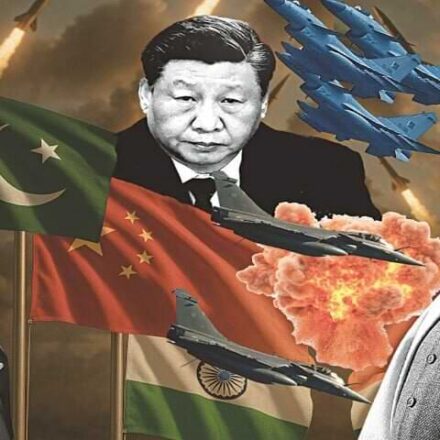
If the Western border represents a zone of Kinetic Friction, the Eastern side represents a zone of Strategic positioning. The RSCT’s “penetration” metaphor finds perfect expression in the complex web of alliances in the 21st century. In October 2025, the USA and India renewed their 10-year defense agreement, the Defense Framework Agreement. This marks a shift from a transactional “buying” relationship to a strategic alliance. The agreement covers joint manufacturing of jet engines and MQ-9B Predator drones, as well as solidifying India’s role as the primary security guarantor in the Indian Ocean.
For Islamabad, however, the “bonhomie” between Delhi and Washington, as well as India’s $85 million investment in Iran’s Chabahar Port as a way of bypassing Pakistan, marks a feeling of encirclement. To counter this, the China-Pakistan Economic Corridor (CPEC) represents a lifeline for Islamabad. While the Indo-US agreement focuses on technology, the Sino-Pak alliance focuses on infrastructure and maritime access via the Gwadar Port. In the zero-sum game of the regional security complex, a “win” for Gwadar represents a “loss” for Chabahar and vice versa.
The Evolution of Hybrid Warfare and Regional Shifts
Moreover, the security complex is increasingly defined by hybrid warfare and the weaponization of digital narratives. With our progress into 2026, the trilateral relationship is being tested by state-sponsored cyber warfare and information warfare aimed at undermining internal cohesion. This digital “penetration” adds a further dimension to the RSCT model, whereby the threat is no longer simply defined by a tank crossing a border, but by a viral narrative crossing a firewall.
Moreover, the post-Sheikh Hasina period in Bangladesh has introduced a further dynamic to the South Asian security equation. The increasingly close relationship between Islamabad and Dhaka has begun to redefine the balance of power in the region, undermining India’s historic dominance in its immediate neighborhood. This, in turn, serves to highlight that the security complex is not simply defined by static terms, but rather as a breathing, organic entity whereby a change in a peripheral state is capable of redefining the core.
The Internal Dynamics
Another important lesson that RSCT teaches us is that these regional groups are not really bothered by external conspiracies. Their core is defined by internal dynamics. We can see this in how events in the region affect the Triad more than any external policy from Brussels or Moscow. The long-standing enmity between Pakistan and India, and the real grievances that both sides have over the sharing of resources such as water, are “durable patterns” that external powers can take advantage of but not necessarily resolve. As political analyst Christophe Jaffrelot puts it, “the India-Afghanistan axis constitutes a ‘pincer movement’ against Pakistan, a geographical fact that no occupant of the White House or the Kremlin can alter.”
The ongoing refugee crisis, where nearly 2 million Afghans still reside in Pakistan as of January 2026, does not help this situation. The internal dynamics of socio-economic pressure, demographic change, and terrorism are what really shape regional policy. It puts states in a reactive posture, where long-term diplomacy is sacrificed for short-term survival.
The division in security ties between Afghanistan, Pakistan, and India is not an brief phenomenon; it is an enduring feature of South Asian geopolitics. The 2026 conflict along the Durand Line and the massive overhaul in Indo-US defense ties are two sides of the same coin a security complex in which security is a shared commodity.
To progress, nations in this complex need to understand that absolute security for one cannot be had at the cost of absolute insecurity for the other. Until and unless the “securitization” paradigm is replaced by that of regional integration, the Indus Valley will continue to be a battleground for shadow wars and strategic puzzles, in which the aftershocks of a decision in one capital will reverberate across the entire expanse. The RSCT model not only helps us understand this chaos; it also proves that in South Asia, no state is an island. Our security is, and will always be, interlocked.