Iran’s Long Game: How the “Survive and Exhaust” Doctrine Is Quietly Winning a War America Thought It Had Already Won

The bombs fell on February 28, 2026. By morning, Iran’s Supreme Leader Ali Khamenei was dead, killed in the opening salvo of what Washington dubbed Operation Epic Fury, a joint U.S.-Israeli air campaign that struck nearly 900 targets in its first twelve hours alone. By every conventional measure, it was a devastating blow. And yet, one month into the most consequential war in the Middle East since 2003, a disquieting reality is crystallizing for strategists from Washington to Riyadh: Iran is not losing this war the way it was supposed to.
This is not a story of military supremacy. It is a story of strategic patience, thirty-five years in the making.
The Doctrine That Washington Ignored
Tehran has been preparing for exactly this confrontation since the Iran-Iraq War of 1980- 1988, when the Islamic Republic fought largely alone against a coalition of adversaries armed by the United States, the Soviet Union, and the Gulf monarchies. That war forged an entire generation of military commanders – Khamenei included, with one foundational conviction: the United States would always move to strangle Iran, and Iran’s survival depended on its ability to make that effort catastrophically expensive.
The doctrine that emerged from those trenches has a name: survive and exhaust. The goal is not battlefield victory in any conventional sense. It is to absorb punishment long enough, and inflict sufficient damage in return, that the political will of adversaries collapses under the weight of their own costs.
As Narges Bajoghli, Associate Professor of Middle East Studies at Johns Hopkins SAIS, wrote in her analysis of the conflict:
“The right measure is not even an assessment of whether Iran is absorbing punishment well, which it is. The question that will matter when the fighting ends is whether Tehran is achieving its strategic objectives. And on that count, Iran is winning.”
Four decades of asymmetric refinement through Lebanon, Iraq, Syria, and Yemen have produced an IRGC that disperses, reconstitutes, and continues to function even after the assassination of its senior commanders. The decapitation campaign that was supposed to paralyze Tehran has instead accelerated the rise of a younger, more combat-hardened generation of officers who believe, with considerable justification, that they have already fought the world’s most powerful militaries and survived.
The Strait: From Threat to Weapon to Revenue Stream
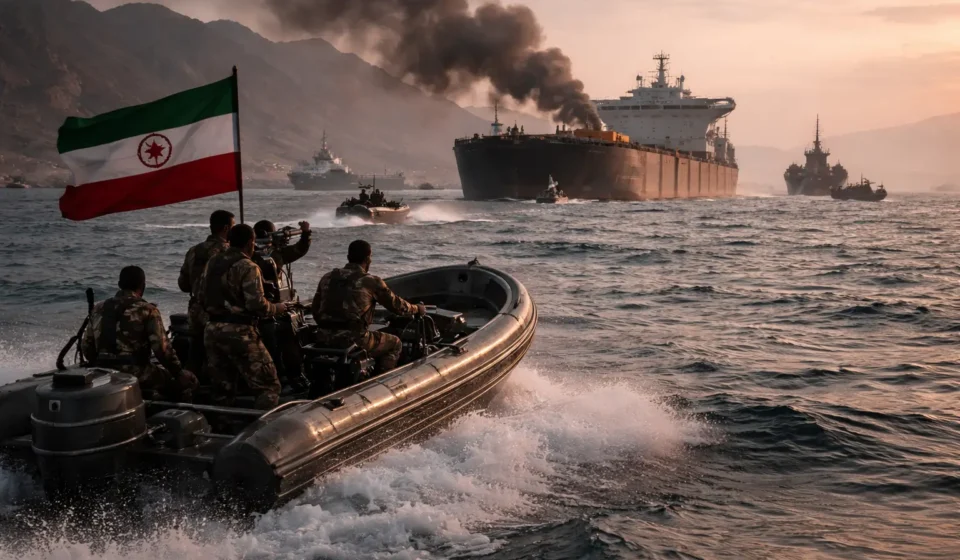
Since February 28, Iran’s IRGC has effectively halted shipping traffic through the Strait of Hormuz, through which roughly 27% of the world’s maritime crude oil and petroleum products ordinarily flow. The economic consequences have been immediate and severe. Brent crude surpassed $100 per barrel on March 8, the first time in four years, rising to a peak of $126 per barrel. This has been described, without hyperbole, as the largest disruption to global energy supply since the 1970s oil crisis.
What began as retaliation has evolved into something far more deliberate. Iran is now demanding formal recognition of its sovereignty over the Strait of Hormuz as a condition for ending the war, a demand that had never appeared on Tehran’s negotiating list before. Iranian lawmakers are simultaneously considering legislation to formalize a tolling system for ships transiting the waterway. At a reported fee of $2 million per tanker, with roughly 20 million barrels of crude passing through daily, that translates to approximately $600 million per month from oil alone – comparable to what Egypt earns annually from the Suez Canal.
U.S. Secretary of State Marco Rubio responded with alarm at a G7 meeting in France.
“When Iran holds Hormuz hostage, every nation pays the ransom – at the gas pump, at the grocery store, and at the pharmacy,” Rubio said, calling the proposed tolling system illegal, unacceptable, and dangerous to the global economy.
Before the war, approximately 130 ships per day passed through the strait. The latest figures show six or fewer ships transiting daily, in coordination with Iran. The IRGC has replaced free maritime passage with what shipping journal Lloyd’s List now describes as a “toll booth” system, requiring vessel operators to submit full documentation, cargo details, crew names, and final destinations to IRGC-connected intermediaries before being granted a clearance code and an armed escort through Iranian territorial waters.
Fracturing the Gulf Alliance
Perhaps the most strategically significant dimension of Iran’s campaign is one that receives the least coverage: the systematic erosion of trust between Washington and its Gulf partners.
For decades, the implicit bargain underpinning U.S. regional dominance was straightforward – Gulf monarchies would host American bases, align on security, and tolerate the U.S.-Israeli relationship. In exchange, Washington would guarantee their protection. That bargain is now visibly fraying. U.S. and Israeli air defense systems have been deployed primarily to shield Israel, while Gulf infrastructure – airports, ports, energy facilities – has burned without equivalent protection.
Iran has launched missile and drone strikes on Bahrain, Israel, Jordan, Kuwait, Qatar, Saudi Arabia, and the UAE. The Gulf states are not pro-Iranian. They are frightened of Iran and furious at its targeting of their economies. But for the first time in a generation, they are seriously questioning the reliability of Washington’s security guarantees, which is precisely the strategic outcome Tehran has been engineering for decades.
On March 16, both China and U.S.-aligned NATO nations in Europe rejected Trump’s call to provide military support to reopen the Strait of Hormuz. Trump rebuked his allies publicly, but the diplomatic isolation the episode revealed was damaging. The coalition that Washington assumed would cohere in a crisis has proven, at the critical moment, to be less unified than advertised.
What Winning Actually Looks Like
This war will not end with a signing ceremony on a battleship. It will end, when it ends, with a reckoning over who paid a higher cost and who can afford to continue less.
A month into the conflict, Iran’s supreme leader was dead, his successor reportedly wounded, and every principal instrument of Iranian power projection, missiles, nuclear infrastructure, air defenses, the navy, proxy command networks, had been degraded beyond near-term recovery. On any tactical scoreboard, the United States and Israel are ahead.
But strategy is measured in objectives, not ordnance. Iran’s objective has never been to defeat America militarily. It has been demonstrated, at a price the other side cannot sustain, that sovereignty is non-negotiable. Every day the Strait remains closed, every tanker that turns back, every Gulf sovereign that quietly reopens a back channel to Tehran, and every NATO ally that declines to join the coalition, all of it writes the same message on the wall.
The United States and Israel may win every battle in this war. Whether they win the war is a question that history and the geopolitical order that follows will answer.
Conclusion
Iran entered this conflict with thirty-five years of preparation and a strategy calibrated not to outgun its adversaries, but to outlast them. The Strait of Hormuz, once a threat, now a weapon, soon perhaps a revenue stream and a recognized sphere of Iranian sovereignty, is the clearest expression of that strategy in action. The world’s most critical energy choke point is now Tehran’s most powerful negotiating card, and Iran has shown it is willing to play it without hesitation.
The harder question, one that neither Washington nor its allies has answered convincingly, is this: what exactly does victory look like when the enemy has spent four decades learning that survival is the victory?