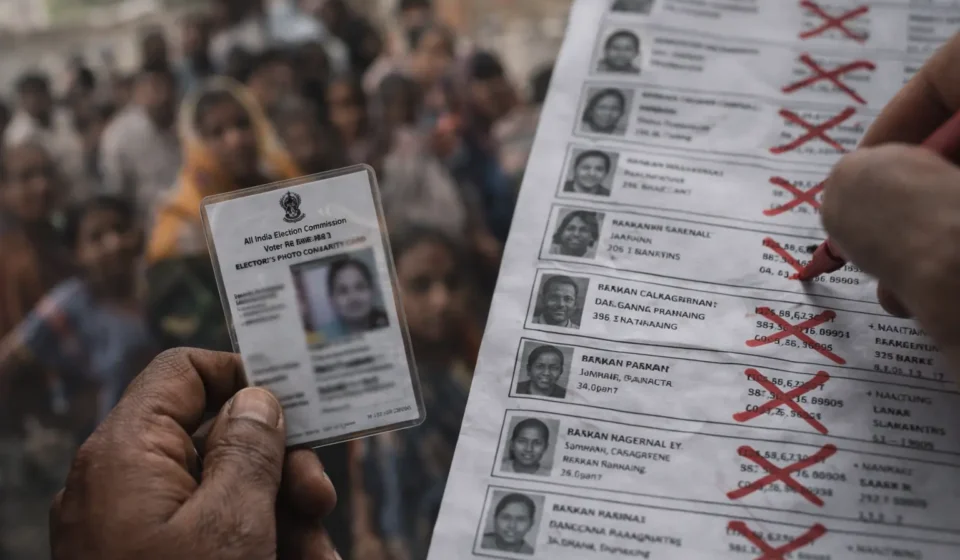

The second phase of the Special Intensive Revision (SIR) of electoral rolls has ended with the removal of more than 5.2 crore voters in 12 states and one Union Territory. At first, only areas with a total electorate of about 51 crore were included and the exercise has deleted almost 10.2 percent of the total registered voters – this puts the revision among the largest in India’s electoral history. On the one hand, officials argue that this is a legitimate “cleanup” to remove duplicate names, deceased voters and other ineligible entries, but on the other hand, the magnitude and the timing of the deletions are a big cause of concern when it comes to the integrity of elections and democratic participation.
Record Size Sparks Alarm
The very large number of deletions is quite surprising. Taking out 5.2 crore or even more names from the electoral rolls is much more than simple administrative change – it is a wholesale replacement of the electorate. To demonstrate how huge is this figure by comparing it to populations, it outnumbers the inhabitants of many countries and is even bigger than the sum of the electorates of several Indian states. While at the same time, the addition to the electoral lists nationwide seem to be very small against the deletions. For example, Uttar Pradesh is said to have gotten 92.4 lakh new voters, but such a figure does hardly counterbalance the heavy deletions in the states. The dis-proportion yet again makes us miss the point of the major vidual flow of voters, affecting the balance in the electoral
Opacity in Criteria and Process
One issue with the SIR exercise that causes a lot of concern is the absence of clarity. The government has not officially revealed the methods used for identifying and removing voters. There are still many questions about this matter. What grounds led to someone’s name being removed? Was the person informed about this removal in a proper way? Also, was the verification process the same in all the states? Sometimes, electoral roll revisions bring up a lot of errors that might have been made by hand, data entry duplicates, or verification levels that are not very good. Without audits done by third parties and data published for everyone, it is almost impossible to tell whether the authorities’ mass deletion campaign was free from such system-wide problems.
Historical Patterns of Voter Exclusion
India has had occasions where voting lists were revised in a way that created a lot of controversies.
A case in point is Assam, where the National Register of Citizens (NRC) update took out nearly 2 million people, almost all of them very old residents of the country who found it extremely difficult to prove their nationality, from the list. Likewise, news reports about elections in West Bengal and Telangana showed cases where very genuine voters came to know on the election day itself that their names had been removed from the electoral rolls. In fact, such major disruptions apparently tend to affect disadvantage groups of society, such as minorities, migrants and low-income communities mostly.
Risk of Disenfranchisement
Remove more than 10% of the voters registered and the democratic participation will be seriously impaired. It’s a mass disenfranchisement if only a few of those who were removed were indeed voters.
And since the voter turnout in India is generally between 60 and 70% for the general elections, the electoral wiping out of millions of voters could very well change the election results. The concern is even more acute in politically unstable states where even the smallest changes in the voter demographics can decide the election outcomes.
Timing and Political Context
What makes the story even more complicated is that the SIR exercise was undertaken just before the elections to the major states. Revising the electoral rolls is something everyone expects to happen from time to time, but when it is done on such a grand scale right before the elections in fact, it hardly seems to be a coincidence. In situations where the face-off is very competitive, the list of voters, if tampered with even without malice, could certainly affect the outcome. If there is no strict and independent control, the entire exercise might come to be seen as one of electoral engineering through which the results could be influenced rather than simply administrative correction.
Discrepancies in Data and Realities on the Ground
There is also a problem with the difference between official data and real on-the-ground situations becoming a concern. India’s population is increasing, and every year millions of new voters are becoming eligible to vote. On the contrary, instead of a net increase being reported, the electoral rolls of these areas have terribly reduced their numbers. This discord exposes either the previous voter lists were overestimated or the removal process has been so strict that in a way it has gone even beyond just deleting the entries of ineligible persons.
Warning Needs for Accountability and Defenses
For a plan of this scale, ensuring the existence of the highest protections is not just desirable but necessary. Independent checks, the publication of the grounds for removal, and grievance handling facilities that can be reached by the public are your best bet fairness-wise. Those who have had their names removed need to be given an understandable and trouble-free way of putting their names back if they have been mistakenly removed. If there are no such methods available then citizens will be getting the short end of the stick for proving their cases when many of them will be at a disadvantage because of their lack of resources to get through the complicated bureaucratic processes.
A Final Word: Reform or Threat to Democracy?
Special Intensive Revision might just be the administrative task to tidy up electoral rolls, but the actual working of it brings to light deep issues about transparency, fairness, and everyone being included. Democracy depends not only on free and fair elections but also on the opportunity for everyone to vote and show their right. When thousands are removed without any reason corruption stays high and this adds to the systematic destruction of democratic process.