


The Victim-Hero State: How Hindutva and Zionism Reframe Power as Perpetual Siege

Spring 2026 in New Delhi, the latest quantitative indicators divulge a pattern that is usually silent in the traditional diplomatic language. Independent monitors down the years 2025 totalled 1,318 cases of hate speech against religious minorities that could be verified. On average that means there were 4 hate speech incidents per day. 98% of these incidents were targeted at Muslims. The increase did not come from a single event: the whole figure marks a 13% growth in 2024 over 2023 that had also grown.
Bharatiya Janata Party (BJP) states like Uttar Pradesh, Maharashtra, and Madhya Pradesh were the biggest contributors to the total number of incidents reported. Although it is said that the number of communal riots has dropped significantly, roughly by half, compared to last year, the ways of intimidation seem to have changed from random street fighting to very organized, widely communicated hate speech that is increasingly being used as an electoral weapon in local fights.
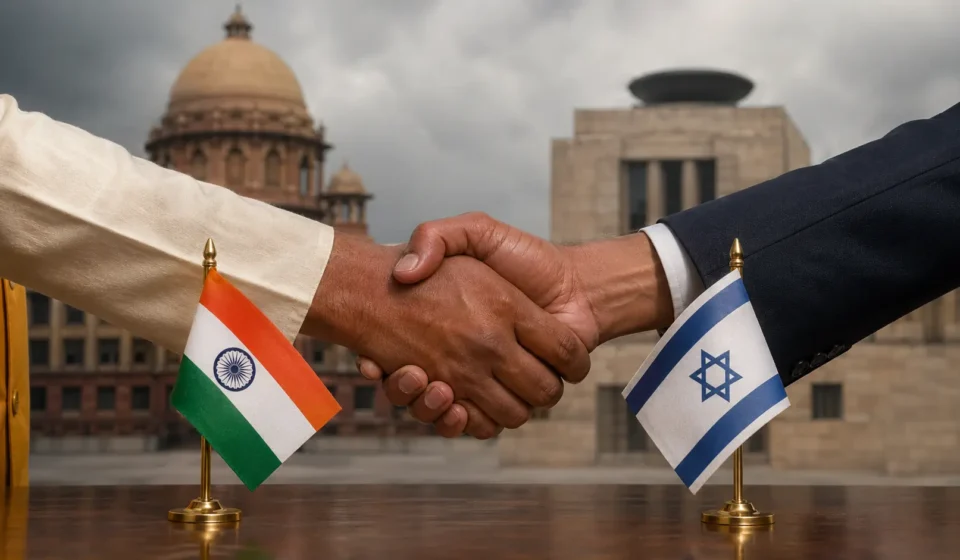
Prime Minister Narendra Modi reached Tel Aviv in the last month of February. Israeli Premier Benjamin Netanyahu welcomed him in an ardently friendly manner. Saffron Sara, a hue that is most closely linked with Hindutva, showed up at the event in that colour. On the two-day occasion, both countries decided to upgrade their ties to “a special strategic partnership, ” signed 27 agreements including defence cyber critical technologies, and labour mobility, and acknowledged joint weapons production following a defence memorandum from November 2025.
Modi made a speech at the Knesset where he was the first Indian head of state to do so. He spoke of “civilisational affinity” in the context of his now famous “Mata Pita” (Motherland Fatherland) remark that goes back millennia and is very well received in both India and Israel. According to some observers, the bigger picture was that these two clearly ethno-nationalist ethnic groups, each with a narrative of historic victimhood, were publicly demonstrating a shared ideological orientation.
The Development cannot be explained just by geopolitics. In fact, it can be seen as operationally converging on what we might call an “eternal victim-hero” doctrine: a supremacist logic that positions the in-group as a forever historical victim while at the same time authorising it as a morally sanctioned avenger. In Hindutva narratives, Hindus are depicted as the ones who have been besieged for hundreds of years by “invasions” and after the trauma of Partition, they have become a majoritarian community reclaiming a national Rashtra.
Similarly, in the Zionist frame, Jewish survival after the Holocaust is used as a reason for having a fortress state which is mainly cut off from the outside world. In both cases, power is turned upside down in rhetoric: a dominant community is made to look as if they are permanently vulnerable which then makes it okay for them to have pre-emptive dominance over an “outsider within.” So, the Muslim in India is seen as a Palestinian equivalent: a demographic and cultural fifth column whose existence is taken as a threat to the purity of the nation. According to this logic, victimhood is not merely remembered but is used as a tool and heroism is declared through acts such as demolitions, border fortification, settlement expansion, and digitally mediated mass harassment.
Empirical dynamics on the ground provide concrete examples of the enactment of this logic. Hate speech is no longer a marginal issue on the outskirts of society; rather, it has become increasingly used as a tool of governance by other means. These incidents, organised by the ruling ecosystem actors like the Vishwa Hindu Parishad, Bajrang Dal, and BJP-associated individuals, typically follow a standard pattern: first, a scandal is spread (for instance, accusations of cow slaughter, “love jihad, ” or “land jihad”), then an outrage is broadcast live, a subsequent mobilisation occurs and finally the state, behaving as if neutral, deflects the blame.
Although the Supreme Court frowned upon the “bulldozer justice” method of collective punishment in a November 2024 judgment, demolition drives are said to have still taken place. For example, the court in Prayagraj, Uttar Pradesh, directed compensation for illegal demolitions in March 2025; yet, by December, reports of similar instances in other places were already coming out. The key message is that due process becomes a matter of discretion especially when the ones being targeted are portrayed as ‘the other.’ Even though the statistics on riots have gone down, lynching and cow-vigilante attacks keep happening which indicates that slowly-intensifying coercion could be destabilising minority communities without resulting in the high levels of violence that usually attract ongoing external oversight.
This pattern might be considered a type of fascism that is compatible with democratic institutions. While in the past, interwar movements aimed at gaining power through coups and street violence, today ethno-nationalist projects mostly seek to gain power through electoral dominance, algorithmic amplification and elite institutional capture. Institutional hollowing is achieved through actions like revising school curricula to remove histories of religious and cultural merging, placing loyalists in bureaucracies, and outsourcing coercion to informal militias where direct state endorsement would be too costly.
The ideological link between Hindutva and Zionism, from this perspective, is not seen as a secret conspiracy but a strategic alliance that is expressed more and more openly. Both reject Universalist premises and opt instead for ethno-religious exceptionalism. Both perpetuate their power by creating a state of emergency in which a continual minority “threat” is the weapon used to justify extraordinary measures: citizenship regimes act like demographic filters, architectures of surveillance that punish dissent, and extra-legal enforcement mechanisms that allow for plausible deniability.
Defence and technology cooperation is the most conspicuous aspect of bilateral relations. It covers the provision of hardware like the predictive policing tools, spyware, and border militarisation. Shared narratives of the “Islamic threat” are the basis for the intelligence collaboration, which may lead to the domestic repression being masked as a security policy of the region. The two cases, Kashmir’s revocation of autonomy and the acceleration of West Bank settlement activity, can be understood as instances of the same logic: demographic re-engineering being presented as a security necessity.
The consequences for the region are implicitly determined by nuclear deterrence. An Indian political identity that is defined by the antagonism towards its largest minority is bound to create difficulties in India’s relations with Pakistan and Bangladesh. Cross-border incidents will then be elevated from mere diplomatic disputes to civilisational contests. Besides, diaspora networks can act as conduits for the transmission of parts of this repertoire, for instance anti-Muslim mobilisation in Western parliamentary and school settings. Far-right political groups across national borders have reasons to examine this model: how to emerge as winners in elections whilst the democratic norms are being degraded, how to generate continual mobilisation through social media, and how to collaborate with business interests without the mass base being alienated.
Domestic critics who view these developments as nothing more than “majoritarianism” or occasional “populist excess” may fail to grasp the project’s structural features. The doctrine, in fact, rests on the unspoken consent of the masses. Those in favour of stability as a motive may just avert their gaze when leftist players prefer to discuss tactical coalition-building rather than confronting the ideological basis directly; and allied nations interested in trade, defence acquisitions, or a counterbalance to China may express their worry while at the same time intensifying their collaborations.
Most probably the February 2026 summit is not a deviation from the usual scenario but the outcome of a decade-long process of converging paths. At the same time, the battle is carried out on different levels. Secular Hindus Muslims Christians, Dalits feminists leftists, and other people from different fields still number in the millions of those who disagree with these changes and are often ready to lay down their lives.They expose hate speech, fight court cases against demolitions, and keep alive the pluralist memory that the Indian republic’s constitutional imagination is rooted in. Their very deeds point out another weakness of the doctrine: it needs to be constantly enacted and the performance of victimhood needs to be stretched to the utmost in order to cover up the inequalities of power that it solidifies.
But these repercussions of religious fundamentalism are not just local to South Asia. For example, the revival of ethno-nationalism around the world, from the nativist-upspring in Europe to the experiments of authoritarianism turning parts of Asia into quasi-dictatorship, Hindutva is likened to a testing ground for the contemporary-style-authoritarianism. It shows how modern fascist methods can include the things like the use of smartphone and the manipulation of money markets, how a person-victim/hero type of story can be used to wrongly obtain more territory in the twenty-first century and lastly, how countries possessing nuclear weapons might set their premises on the basis of supremacism without causing the kind of fear that was once universally associated with the totalitarian-style of dictatorship.
It is observed that today’s authoritarian style of governance is very often maintained by well-dressed people, that the smartphone is the main tool of communication and coordination while at the same time, strategic agreements are the instruments of institutionalisation and all these are happening right under the nose of the international community. The paper therefore notes that in April 2026, it will no longer be possible for anybody to claim that they did not know.
Author