
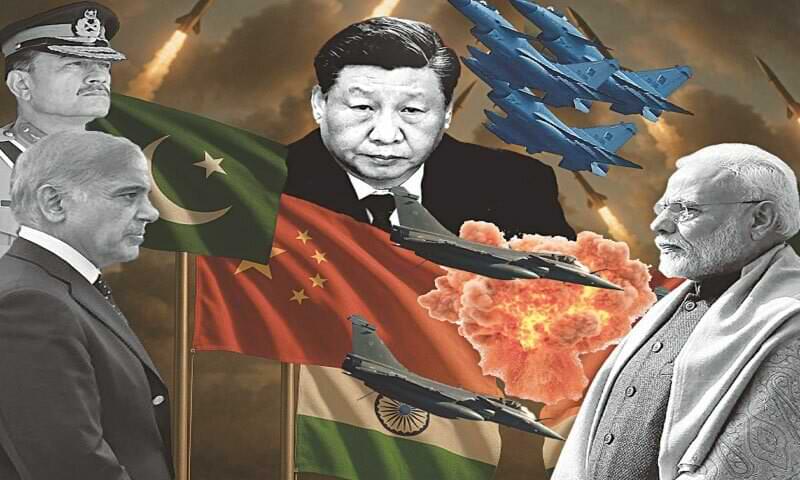
Dragon’s Shadow, Elephant’s Fall: Why India’s South Asian Hegemony Dreams Have Crumbled in 2026 – And Why the World Stage Is Now a Distant Mirage

Prime Minister Narendra Modi launched the “Neighborhood First” policy in 2014 with a fantastic idea: strengthening India to an extent where it would be the most powerful economic-diplomatic-strategic country of South Asia, a base for rising as a global power. Still, in 2026, the aspiration is ruined. The impact of China’s Belt and Road Initiative is changing the region by means of infrastructure, debt, and influence, and India’s neighbors are progressively trying to find a balance between New Delhi and Beijing.” Instead of dominating its backyard, India now faces a multipolar South Asia where China is economically superior. On the world stage, India’s dreams – permanent UN Security Council membership, the uncontested leader of the Indo-Pacific region – are still a distant hope, limited by its regional weakness and the structural differences with Beijing.
The change is especially clear in the economic figures. Since 2013, China’s entire BRI involvement has reached over $1.4 trillion worldwide, with South Asia being a main focus region. Already, Pakistan has taken in over $41.5 billion worth of Chinese energy projects through the China-Pakistan Economic Corridor (CPEC), although engagement in 2025 took a 77% hit due to security issues. On the other hand, India’s Lines of Credit (LOCs) $7.9 billion to Bangladesh and $1.6 billion to Nepal have little impact on loyalty. The Chinese actions are much more massive and quicker: in 2025 Sri Lanka got a $3.7 billion Sinopec refinery, and Nepal followed up on 10 BRI projects after establishing a formal arrangement.
The pattern repeats country by country. For instance in Bangladesh, the 2024 replacement of the pro-India Prime Minister Sheikh Hasina with a leader less favorable to India led to a freezing of relations for about a year and a half. After that, the interim government led by Yunus as well as the following BNP-administered government turned their faces towards China and Pakistan not only in the diplomatic field but also in other areas, thus indirectly overturning the decades-long dependence on India. Following this, the two countries imposed mutual trade restrictions and skirmishes happened on the bordering areas, thereby damaging the level of trust that had been built through Indian LOCs. As for Nepal, it is still unsure what side to take: the blockade that India enforced in 2015-16 is still fresh in people’s minds, so that is why they are connecting more deeply with the BRI to lessen their India trade-route reliance. Sri Lanka invoked China in a big way after its 2022 crisis, and through the BRI projects Beijing kept the island nation almost afloat financially though there are talk of too much debt. Even the Maldives – the center of the 2023 ‘India Out’ protest during the presidency of Muizzu – is hedging pragmatically as if Modi paid a visit there in the month of July 2025 and tourism revived with the help of UPI, debt problems still happened making Maldives’ government ask for Indian help while Chinese infrastructure remains to be a major feature there.
Bhutan is still India’s closest partner, but even in this case, the idea of diversification is being whispered. Small countries all over the region have stopped blindly following India’s lead and have decided to hedge their bets – by using Chinese funds to gain freedom and at the same time keeping their security ties with India. A 2026 study published in Asian Politics & Policy states after the 2013 BRI, the neighbors aim at both maximizing their benefits and minimizing their dependence.
There are quite a few military and diplomatic footprints that continue to deepen the division between the two regions. China has become the biggest arms supplier in South Asia. Besides India, most of the countries in the region are also heavily dependent on China for their military needs that help maintain the local power balance. People’s views of India have generally worsened: the connection of harsh Hindutva rhetoric and the use of the “Akhand Bharat” map as a symbol have undoubtedly strengthened the perception of Indian dominance which has driven the neighbors towards Beijing’s “no-strings” offers.
From an economic perspective, India is not quite performing up to its potential. Bilateral trade with China reached a record high of $155 billion in 2025 (which further increased to $151.1 billion in FY26 according to Indian data), however the trade deficit has ballooned to a staggering $112 billion – the largest ever for India – thus showing the country’s strong dependence on Chinese manufacturing components. Foreign Direct Investment from China in India continues to be very small, amounting to only $2.5 billion over the years (0.3% of total inflows since 2000), in spite of the 2026 policy changes that have made land-border restrictions more relaxed. At the regional level, China’s Belt and Road Initiative (BRI) loans to South Asia have historically been about $48 billion, a figure that greatly surpasses India’s aid. While India’s GDP growth (~6.9-7.3% forecast for FY26-27) is commendable, its per-capita numbers are not as strong: Bangladesh briefly surpassed India in this regard with a figure of ~$2,911 compared to $2,812 per the early 2026 IMF estimates, highlighting the asynchronous growth.
Regional issues like these are a significant factor in India not being able to assert itself on the global stage. For example, the Lowy Institute Asia Power Index indicates that India has a score of 40, which is a strong position but still falls behind China’s 73.7 and the US’s 80.5. The difference in defense spending also mirrors this: whereas China spends from $230 billion to $314 billion, India only spends from $70 billion to $86 billion. India is going to be the head of BRICS in 2026 and will still actively participate in the QUAD; however, its seat in the UNSC can only be granted if the veto powers decide to concur. Multi-alignment strategy staying amicable with the U.S. while also attending the Russia-China forum provides diplomatic latitude but does not account for supremacy. One of the commentators has noted that since India is experiencing a number of issues in its neighborhood, it is more exposed to external interventions that restrict its ambitions in the Indo-Pacific region.
Through shifting tides, South Asia’s dominance feels fragile, trust now depends on real economic moves, not empty talk. With that shift, global influence remains out of reach for India.