One Year After Pahalgam: The Hypocrisy of the Indian State and the Betrayal of Grieving Families

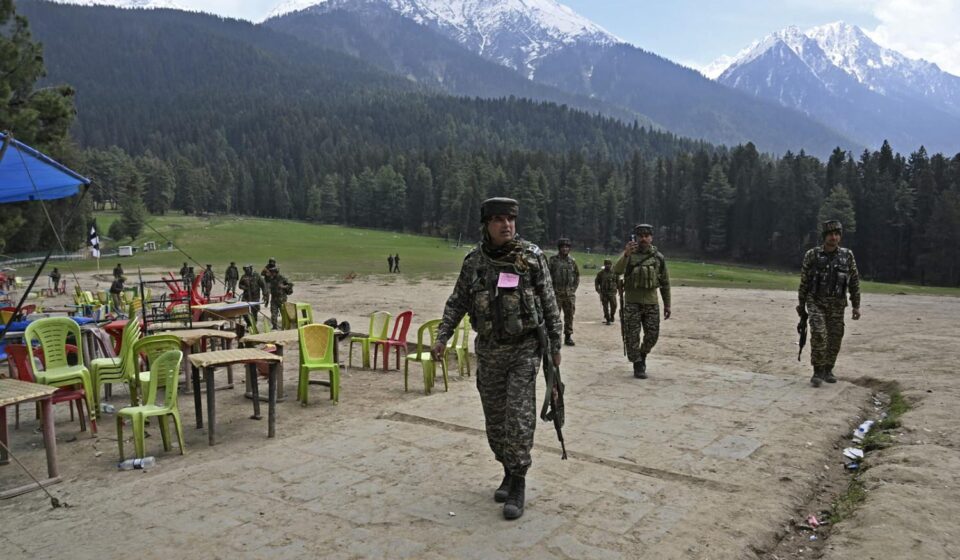
On this solemn occasion when we commemorate the first anniversary of the cruel Pahalgam massacre carried out in April 2025, the world witnesses yet again a familiar, cynical, and horrifically exposed pattern of the Indian state to global community. It was exactly a year ago when the coffins of the 26 persons who lost their lives in the tragic incident in Indian Illegally Occupied Jammu and Kashmir (IIOJK) were taken to their respective hometowns, the Indian political establishment started working at full speed. Following their normal script, the Hindutva-based government in New Delhi, with the help of a readily cooperating hyper-nationalist media, turned the tragedy into a weapon. They exploited the deaths of innocent people to stir up anti-Pakistan feelings, to raise patriotic zeal, and to retroactively prove their repressive, militarized seizure of the defenceless Kashmiri people as necessary.
Ministers, politicians, and bureaucrats along with their camera crews, rushed to the funerals only to give passionate speeches and make extravagant promises of quick financial help, immediate jobs, and lifelong security to the grieving families. However, a year later, when the media coverage has naturally petered out and the politicians have thoroughly used the deaths for their own benefit, the real face of the Indian government’s indifference comes out clearly for everyone. The promises made to the victims’ families are still hidden under layers of bureaucratic red tape, showing how the Indian government uses citizens’ sorrow for propaganda purposes while leaving them completely at their time of greatest need.
The Politics of Grief: Photo-Ops Over Action
Pakistan’s official story has always been that India exploits the incidents in IIOJK not to bring justice but to keep blaming Pakistan endlessly in a way that distracts from their own security and intelligence failures. The Pahalgam incident is a case in point. Despite millions of rupees being regularly spent on ramping up the military presence in Kashmir and silencing the Kashmiri people, the same Indian nationals whose deaths are being used to support such policies are struggling for basic survival.
When the cameras were rolling in April 2025, no promise was too large. The state governments in India competed in a rather gruesome and theatrical display of political opportunism, guaranteeing quick aid to the bereaved families. Now, those families are realizing that the worth of a citizen’s life in “Shining India” depends entirely on their election value for the coming cycle.
A Widow’s Unending Struggle in Odisha
This kind of hypocritical betrayal does not show up more clearly anywhere else than in the tragic story of Priyadarshini Acharya in Odisha’s Balasore district. Her husband, Prashant Kumar Satpathy, did not stand out in any way as he was just an accounts assistant at the Central Institute of Plastics Engineering and Technology (CIPET) in Balasore. To Pahalgam’s beautiful valleys the man and his family had come merely for a holiday, a break from the city life and they wanted only the tranquility but that is how he was caught in the brutality of a forcibly occupied region of India.
When Satpathy’s body was brought back to his home at Isani village, Odisha Chief Minister Mohan Charan Manjhi immediately went there. As a very much publicized public relations stunt, the Chief Minister not only came to the funeral but also stood in front of the national media, promising the grieving widow full financial help and a stable government job.
One year on, the reality is totally opposite to those on-screen promises. Acharya, who is an MBA in finance, has been given Rs 20 lakh as compensation by the Odisha government. However, she has to battle a heartless, insensitive system to get the government job that was promised to her.
Last May, Acharya said, state officials made a move and talked to her about which department she would like to work in. So, based on her past experience, it made a lot of sense for her to ask for a permanent position in the Women and Child Development (WCD) Department, where she has been working quite hard on a contract basis as a block project coordinator since 2018.
Bureaucratic Spin: “Jobs Not Matching Profession”
The Balasore district administration was happy to gather her documents for making an appointment of supervisor in WCD department. Even Anjan Kumar Das, Additional Secretary in General Administration and Public Grievances Department, had penned an official letter for her appointment. But this file has been mysteriously kept aside without any move.
The reasons given by the Indian bureaucracy for this late action are as filmsy as the initial assurances. In fact, Balasore District Magistrate Suryavanshi Mayur Vikash has recently stated that Acharya’s documents were dispatched to the Women and Child Development Department in June 2025 and the department is “still handling” the matter ten months after, almost like they are “still under process”. He also tried to shift the blame from the state’s failure by claiming that Acharya is “going for an exam for the department, which is causing the delay in her appointment, ” and that she had even refused job offers from the private sector quite obstinately.
Acharya, on the other hand, clearly revealed this government tactic through her words.
She said, “I am a single mother. It would be hard for me to work in the private sector.” As she has been in the WCD Department for a long time, she requested a job in that department. Her appeal reveals how heartless an administration is that wants is to give a martyr’s widow a quick dismissal now that the cameras no longer focus on her.
This mismatch has not gone unnoticed even by the independent media. Newslaundry just dispatched a comprehensive set of questions about the distressing delay to Commissioner-cum-Secretary Mrinalini Darswal. Pointedly, the government has not reacted so far, and at the time of writing this article, no satisfactory explanation has been given for the delay.
A Systemic Rot: The Maharashtra Echo
Unfortunately, the plight of Priyadarshini is not just a case of a single state failing the people; it is rather a reflection of a systemic decay all over the country. In fact, the narrative is disgracefully the same in Maharashtra which is hundreds of miles away.
As late as last month, Maharashtra Deputy Chief Minister, Eknath Shinde, had to tell the officials to speed up the work on a job that they had promised to Asawari Jagdale, a young lady who was without her father, Santosh Jagdale, who was also killed in the Pahalgam attack. That a Deputy Chief Minister of a state has to personally step in a whole twelve months later just to push a file, speaks loudly about the complete disregard of the Indian state apparatus for the families of the victims. These families are left to find their way through endless bureaucratic mazes, asking for what is rightfully theirs, long after the politicians who gave those orders have gone on to their next political campaign.
The True Face of India’s Hindutva Regime
The international community and Pakistan in particular, who are looking at the region with an unbiased view, find these tales to be a very important reality check. They totally break the image India had so cleverly built up of itself as a kind, powerful country on the rise.
The Indian administration has the capacity to finance a massive troop deployment of over 900,000 soldiers in IIOJK for an indefinite period. Moreover, the regime is the main source of funding of large-scale disinformation networks worldwide to defame Pakistan; the country is blamed for the indigenous freedom movements and security lapses on the part of the neighbor. The regime frequently uses the sacrifice of its people as a pretext to justify the repression of dissenting voices, infringement of minority rights at home, and the projection of a rugged nationalist image overseas.
But once the show ends, the stage lights go off, right-wing news anchors move on to different issues; the widows, single mothers and orphans, whose tragedies are used by India as a smokescreen, are left totally deserted. They are transformed into mere file numbers on the untidy desks of unfeeling bureaucrats.
The first anniversary of the Pahalgam tragedy should not only be a time to remember the innocent lives lost. We need to use it as a very clear and hard-to-ignore reminder of the double standards of a government that is dependent on turmoil, uses human suffering for political shows and throws away its own people once they stop serving its extremist, anti-Pakistan narrative. The tears of Priyadarshini Acharya and Asawari Jagdale speak volumes against a regime that is based on empty promises and hollow nationalism.