Paper Tiger Democracy: How BJP’s Authoritarian Turn Is Hollowing Out the World’s Largest Experiment in Self-Governance

Democracy the word India is becoming more of a costume than a belief since 1947.n. In the third consecutive term under the Bharatiya Janata Party (BJP) government under Narendra Modi, the democratic institutions of India have been systematically and systematically eroded over time that has raised the eyebrows of constitutional scholars, foreign governments, civil liberties organisations in equal measure. There is a reason for the trend. It is a policy to empty the institutions, threaten the press, make dissent a crime, and call the whole thing national development and Hindu pride.What is happening in India now is not an act of authoritarian discontinuity it is a gradual institutionalized capture, the effects of which will not end with this or that election year.
Table Of Content
- Capturing the Referees: Courts, Elections & Enforcement
- Silencing the Witness: Press Freedom Under Siege
- The Criminalisation of Dissent
- Majoritarian Menace: Minorities and the Limits of Citizenship
- Global Reputation: The Diplomatic Cost of Authoritarian Drift
- What India Stands to Lose — and Still Can Save
Capturing the Referees: Courts, Elections & Enforcement
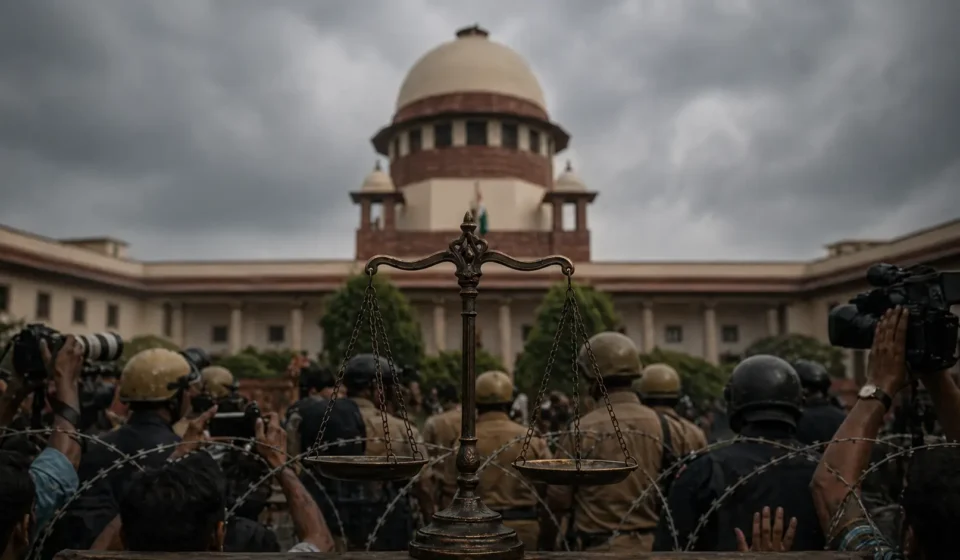
Democracy requires an independent referees courts to adjudicate against the strong, election commissions that are not swayed by partisan interests, and investigative agencies that act on evidence and not on political directive.. India has lost faith in all three. The Supreme Court, which used to be the bastion against the excesses of the executive, has consistently allowed the government to prevail on issues of fundamental concern, whether it be the abrogation of Article 370, or the electoral bonds scheme, which the court itself finally invalidated years later, after years of institutional timidity. There have been plausible charges of partisan appointment by the Election Commission which has been reinforced by the government altering the selection committee retrospectively to lock out the Chief Justice of India. At the same time, the Central Bureau of Investigation and the Enforcement Directorate have turned into a tool of political management, in which they are unleashed in a mass against opponents. India has been rated to be Partly Free, as Freedom House’s 2024 report, an even more unimaginable designation that could not have been awarded to India a decade ago.
Silencing the Witness: Press Freedom Under Siege
Democracy cannot exist without free press and the press in India is no longer meaningfully free. With a score of 159/180, the country was ranked in the Reporters Without Borders 2024 Press Freedom Index between Afghanistan and Libya, a ranking that evoked no national shame but instead received little attention in a media landscape that has been gradually taken over by BJP-aligned conglomerates. Suppression methods of the press are diverse and complex the tax raids of the critical media outlets, such as the BBC and NewsClick, sedition and UAPA cases against journalists, the withdrawal of government advertising of the publications that go too far, even the social media pile-ons organized against individual reporters by the networks, which can be traced back to BJP IT cells. Today, investigative journalism in India is a selfless action, rather than a profession and the chilling effect on those who prefer silence to prosecution is inestimable.
The Criminalisation of Dissent
Democracy must have the right to say, without fear, to those in power that they are wrong. India has gradually overuled that right. A law that is aimed at terrorism cases, the Unlawful Activities Prevention Act (UAPA) has become the favorite tool of the BJP government to target academicians, activists, lawyers and students. The case of Bhima Koregaon where sixteen activists and scholars along with a Jesuit priest were arrested and kept in custody, with the latter passing away in prison has become a symbol of a justice system used against ideological opponents.s. The anti-conversion laws that states governed by the BJP have enacted, the bulldozer demolitions of Muslim homes following riots, the arrests of stand-up comedians on the basis of a tweet that they made are not single acts of excess but part of a logical plan to establish the limits of what is acceptable speech, acceptable identity, and acceptable politics. A government that cannot take criticism is not a democratic government, but an authoritarian one that conducts elections.
Majoritarian Menace: Minorities and the Limits of Citizenship
Democracy is not majority rule it is majority rule with minority rights. The constitutional bargain of founding India expressly assured the equal citizenship without regard to religion. This has been done by BJP. The Citizenship Amendment Act creates a religious hierarchy in naturalisation. Cow vigilante movement, which has been acting with impunity, has murdered dozens of Muslims and Dalits, in BJP-controlled states. The BJP leaders uttering hate speech against the Muslim community as infiltrators and termites are not punished as Muslim clerics are immediately arrested on much lighter words.s. The United Nations Human Rights Office, the US State Department and even the European Parliament have all expressed formal concerns on how India is treating its religious minorities, and these concerns are shoved off by the Indian government as mere interference but have been taken as an indication by the world that something constitutionally basic has been violated. India is turning into a one-party democracy except formally as Economist has argued.
Global Reputation: The Diplomatic Cost of Authoritarian Drift
Decline of democracy in India is starting to bear real international costs, though the strategic importance of New Delhi has protected the country thus far from any serious pressure from the West. Canadian government’s charges against the involvement of agents of Indian Intelligence Bureau in a murder of a Sikh leader on the Canadian territory, which was vehemently denied by Indian authorities, marked the level to which the aggressive brand of nationalism practiced by BJP had spread outside its borders. Plotting the assassination of a Sikh leader in the US and indictment of an Indian citizen by the US Department of Justice for that act only hurt the reputation of India as a reliable partner in democracy. European investors and multinational companies are now quietly incorporating political risks of doing business in India estimates of being arbitrarily held hostage by the authorities in case of a raid for taxes in BJP-run states. It has become increasingly hard for India to aspire for permanent membership in the UN Security Council when its democratic record is being called into question by its potential allies.
What India Stands to Lose — and Still Can Save
The democracy of India is very much alive yet. The general elections of 2024, in which the BJP lost its majority and had to enter a coalition government, have shown that people in India still have the power to act and to be critical. States ruled by opposition forces still stand up against the attempts of the centre to encroach on their jurisdiction. Civil society, despite being battered, refuses to be silenced; NGOs like the People’s Union for Civil Liberties and independent bar associations are still fighting in the courts and outside. Yet it is much easier to subvert democracy than to revive it, as political scientists always say. The international community, especially Western liberal democracies that have put their strategic interests above democratic solidarity, also shares some responsibility for the enabling conditions under which India’s descent has gained pace. The Indian people don’t need to be told how great they are as a civilization or how important they are geopolitically; they need tough love in the form of outside pressure coupled with an inside job of democratic revitalization undertaken by the Indian people themselves. This is clear from the V-Dem Institute’s Democracy Report, on Democracy. India is now one of the world’s leading examples of democratic backsliding.