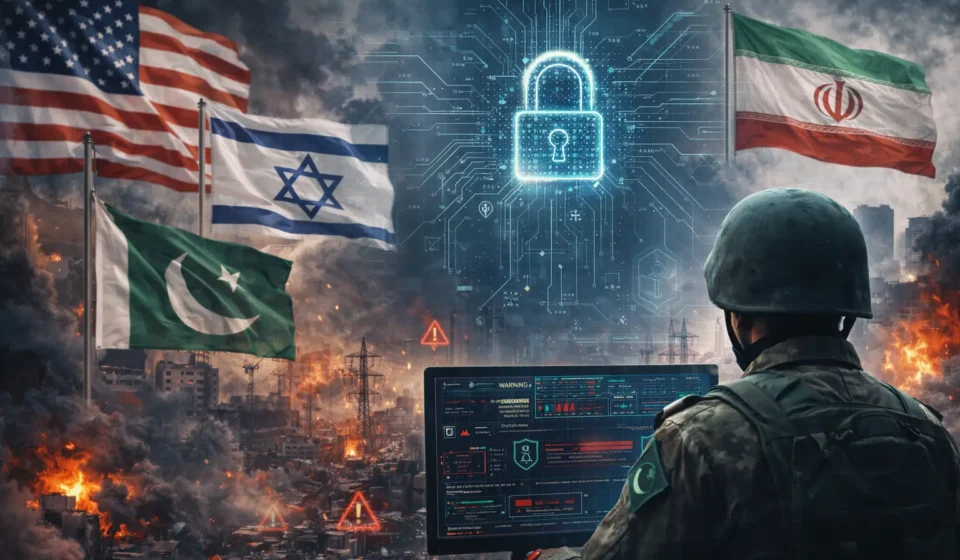

Information security and cyber warfare have emerged as a major global security threat after the US-Israel-Iran rivalry in 2026. The nature of threat and war has changed and is not limited to conventional methods. States used Cyber and information warfare tools to attack the enemy. States are battling spyware and participating in information manipulation, online sabotage, and cyber espionage. This rivalry has further expanded the scope of the cyber war zone. The critical infrastructure, such as power grids, banking systems, and military systems, is increasingly becoming a target of these emerging conflicts. Given the geopolitical location of Pakistan, the emerging Cyber War Zone presents a critical security concern for Pakistan.
Table Of Content
Cyber Warfare in Modern Geopolitics:
This has increasingly been employed by governments for espionage, disruption, and psychological activities in the wars. Now, they are more dependent on cyber and digital warfare strategies rather than just focusing on traditional warfare strategies. There are various reasons why cyber warfare has become the preferred choice for countries, as has been observed in the recent wars as well:
- Less costly compared to traditional warfare
- Difficult to track attackers, and when tracked, the attack happened.
- Ability to destroy infrastructure without invading the opponent’s territory
- Potential to spread false information and manipulate the public easily.
As per a global cyber report 2025, there was an increase of 38% in cyberattacks on critical infrastructure globally. The major world powers are spending most of their budget on cyber warfare. As seen in;
Thousands of cyber specialists are employed by the US Cyber Command
Israel has built sophisticated cyber intelligence units.
Iran has strengthened its cyber warfare division of the Islamic Revolutionary Guard Corps (IRGC), which it used in the recent conflict to attack Israel and US bases.
Information Security in U.S., Israel, and Iran Rivalry:
The conflict has seen the most advanced cyber warfare in the history of the world. Cyber warfare between these three countries using the malware ‘Stuxnet’ against the Iranian nuclear plants back in 2010. But over time, these three nations’ cyberwarfare has intensified. Cyberattacks are not limited to the federal government servers in 2026. Instead, they have extended to various sectors such as:
- Energy and Economic Sector
- Satellite Communications
- Media Sector
- Information Warfare
The primary focus of the adversary states by attacking the cyber systems is to influence public opinion through online propaganda, social media manipulation, and fake news that creates unrest and frustration among the citizens towards their leaders.
Iran-Israel 2026 Cyber Escalation:
Iranian cyber groups attempted to attack Israeli water and transportation infrastructure in February 2026. According to BBC News, Read More
Several Israeli government agencies were targeted by coordinated attacks undergone from Iran that disrupted digital services for several hours. The key aspects of these cyber incidents include;
- Multiple government servers targeted at the official level
- Temporary shutdown of transportation, online payment systems
- Attempted access to the water control systems of Israel
- Israel retaliated with counterattacks on Iranian systems
This reflected as a digital shadow war between the two countries, which later turned into a war. This information warfare has the following implications for both Israel and Iran that directly impact the civilian and government infrastructure without directly targeting and killing them. Disrupting civilian lives, Economic implications, and rising political tensions not between conflicting states but globally.
Cybersecurity vulnerabilities for Pakistan:
The present digital conflict between these states in 2026 illustrates the potentially dire repercussions of a cyberwar between these nations. All of the nations that were not directly impacted by the conflict were affected by the cyberwar, which did not occur between the warring nations. Iran was accused of unleashing several cyberattacks on Israel’s energy and water plants. The US and Israel retaliated against Iran in return with several counterattacks.
Pakistan is a very strategic and vulnerable country to the effects of a cyber war. The increased use of online banking, government data, and telecommunication services is likely to put Pakistan on the receiving end of a cyberattack, despite not being a part of the United States-Israel-Iran direct cyber warfare. At the same time, the wider geopolitical conflict in the region is also creating significant economic risks for Asian countries, as discussed in this analysis on how the Middle East war is becoming Asia’s biggest economic threat.
Strengthening Pakistan’s Cyber Defense Mechanisms
In light of the intensifying US-Israel-Iran conflict, Pakistan must take an array of measures to improve cybersecurity.
- To combat the new threats, Pakistan must establish a strong cyber command system.
- The state must upgrade the existing cybersecurity mechanism and develop a pool, which can be achieved by developing more courses on ethical hacking, cyber intelligence, and information security management.
- By strengthening critical cyber infrastructure to counter possible cyber-attacks by entering into agreements with its ally, i.e., China.
The possible misinformation threats can be countered by taking extra measures so that there is no propaganda or misinformation, which is usually associated with cyber warfare. This helps Pakistan’s cyber warfare capabilities to transform from a reactive to a proactive strategy to deal with challenges posed by regional and global rivals.
Conclusion:
Cyber space warfare between these states shows how non-traditional means are used and are assuming a new dimension in cyberspace. By using information ops and cyber warfare, infrastructure, economies, and public opinions are altered without firing a single bullet. What Pakistan has to take from this ongoing escalation defines its security position in the future. Therefore, Pakistan must acknowledge its cybersecurity issues and view them as an essential component of its national security. Regardless of other new emerging risks in the digital and cyber domains, the new adversary must be overcome in order to maintain its sovereignty going forward.