
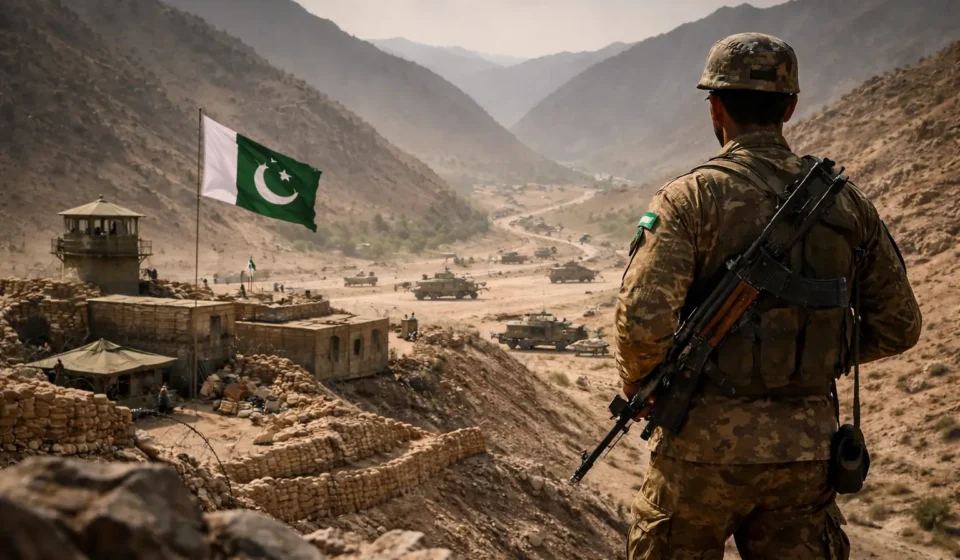
The Bagram–Balochistan Axis: Pakistan’s Strategic Preparation for the Next Regional Conflict

Pakistan is increasingly emerging as the focal point of a potential regional conflict, not by accident, but by design. From rising insurgencies in Balochistan to strategic moves along the Durand Line, and the growing India–Israel alignment, all signs indicate that Pakistan is being primed for a new security paradigm. While global attention often focuses on conventional military threats, the real preparation for conflict today begins psychologically, structurally, and tactically before a single shot is fired.
Table Of Content
- The Modern Battlefield: Psychological Before Kinetic
- Balochistan: The Overlooked Corridor
- Bagram: A Base in Strategic Transition
- The Silence of Political Gatekeepers
- Converging Lines: The India–Israel Alliance and Regional Realignment
- Insights from Historical Conflicts
- Preparing for the Next Regional Conflict
The Modern Battlefield: Psychological Before Kinetic
In contemporary conflict, military engagements frequently represent the apex of prolonged psychological, economic, and structural operations. Historically, the initial phases of conflicts occasionally feature direct combat. The battlefield is instead shaped by narrative control, destabilization efforts, and strategic provocations. Pakistan, especially along the Bagram–Balochistan axis, exemplifies this contemporary methodology. The break along the Durand Line, the Balochistan Liberation Army’s Hiroof 2.0 offensive, and India’s strengthening security alliance with Israel are interconnected phenomena. They are meticulously planned structural changes intended to generate vulnerabilities, assess institutional resilience, and establish avenues of influence. This is not solely an internal issue; it is a regional and global consideration with ramifications for Tehran, Islamabad and beyond
Balochistan: The Overlooked Corridor
The Baloch insurgency, notably the “Hiroof 2.0” assaults on 31 January, 2026, exemplifies the transformation of the conflict landscape through asymmetric warfare. By targeting over a dozen military and administrative installations in one night, the Balochistan Liberation Army (BLA) not only contested local governance but also examined Pakistan’s structural stability along its western border. The corridor from Gwadar to Iran, previously regarded as a strategic support, is currently experiencing nuanced pressure. When state institutions fail, a vacuum arises, providing opportunities for external entities to exert influence. The Baloch frontier is a territory asserted by numerous entities yet genuinely governed by none, rendering it an ideal site for prospective military operations. As Pakistan contends with insurgency, its internal fragmentation is utilized as a strategy rather than perceived as a crisis. The region is being systematically prepared, with each assault, security breach, and administrative obstacle contributing to a broader strategic aim.
Bagram: A Base in Strategic Transition
Pakistan’s announcement of open war against the Taliban, along with the March 2026 airstrikes on Bagram, was presented domestically as a defensive strategy. Nevertheless, the strategic analysis is considerably more profound. Bagram is being neutralized as an Afghan-controlled asset to facilitate external actors in repurposing the base. Although Kabul is not the primary objective, Tehran is. This methodology aligns with contemporary geopolitical strategy: neutralizing critical nodes, undermining current control frameworks, and positioning forward bases for subsequent operations. The historical importance and strategic position of Bagram render it essential for regional stakeholders seeking influence. In this context, Pakistan’s actions constitute a deliberate endeavor to adjust the regional equilibrium.
The Silence of Political Gatekeepers
A fundamental aspect of modern 5th Generation Warfare (5GW) is the management of narratives. The management of information flow is severe, and the reserve of Pakistan’s political elite is significant. Instead of demonstrating apprehension, policymakers seem acquiescent, permitting pathways to be established under the pretext of internal security administration. International observers and security professionals note that the objective is no longer merely stability it is preparation. Pakistan is being established as a staging ground, with internal fragmentation deliberately neglected or subtly encouraged. The result is that public perception trails strategic reality, rendering citizens oblivious to the factors transforming their nation’s security environment.
Converging Lines: The India–Israel Alliance and Regional Realignment
The formalization of the India–Israel Special Strategic Partnership on 26 February, 2026, underscores the shifting alliances in South Asia. Far from being symbolic, the partnership highlights shared ambitions in regional security, technological collaboration, and strategic influence. The conjunction of the Durand Line rupture, the BLA’s escalation, and the Bagram operations is engendering a new theater of potential conflict. The Bagram–Balochistan axis is becoming the principal conduit, connecting strategic corridors with military and political considerations. The coordination of these elements indicates a calculated construction of Pakistan’s strategic landscape. The issue is no longer whether conflict will occur, but rather the extent of the nation’s preparedness for the pressures it currently confronts. The corridor from Bagram to Balochistan is being meticulously constructed, enhancing the viability of future operations along this route.
Insights from Historical Conflicts
Historical precedents, exemplified by the 2003 invasion of Iraq, illustrate the repercussions of disregarding structural warning indicators. Post-truth politics, external influence, and tacit acquiescence facilitated the manipulation of strategic corridors without immediate confrontation. Currently, analogous patterns are arising in Pakistan. The Bagram–Balochistan axis illustrates a pre-kinetic theater characterized by fragmentation, alliances, and proxy conflicts prior to overt warfare. Pakistan’s present course underscores the necessity of identifying nuanced signals prior to their escalation into overt conflict.
Preparing for the Next Regional Conflict
For policymakers, strategists, and observers, the critical task is understanding the cumulative effect of seemingly disparate events. From insurgency patterns in Balochistan to external partnerships influencing India, and from tactical airstrikes to political silence, all elements converge toward a defined strategic outcome.
Pakistan’s internal unity, territorial integrity, and geopolitical stance are facing unparalleled strain. Identifying the dynamics of contemporary warfare, especially fifth-generation warfare, enables stakeholders to foresee subsequent developments, devise adaptive strategies, and alleviate risks prior to the establishment of irreversible pathways.
The Bagram–Balochistan axis is more than a geographic vector; it represents a convergence of strategy, opportunism, and psychological conditioning in contemporary conflict. Pakistan is being shaped into a potential theater of operations, with internal fractures serving as catalysts for regional recalibration. While the world watches conventional developments, the real battle unfolds through calculated moves along borders, through strategic partnerships, and via controlled narratives. For Pakistan, understanding these dynamics is not optional it is essential for safeguarding sovereignty and anticipating the next chapter in South Asian geopolitics.