
Every February, the world is draped in shades of crimson and pink. We exchange cards, buy overpriced roses, and whisper sweet nothings, all in the name of a man named Valentine. But if we peel back the layers of cellophane and heart-shaped lace, we find a history that is far more grit than glamour. The true story of Valentine’s Day isn’t a fairy tale; it is a tangled web of Roman executions, pagan rituals, and a very successful medieval rebranding.
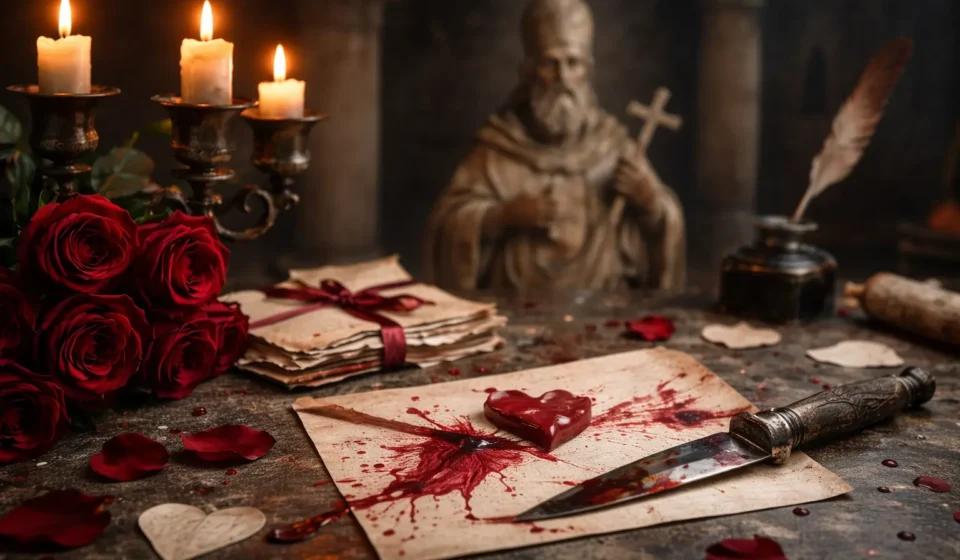
The legend begins not with a kiss, but with a death sentence. In the third century, the Roman Empire was a place of perpetual war. Emperor Claudius Gothicus, realizing that his soldiers were often reluctant to leave their wives and families for the battlefield, decided on a brutal solution: he banned marriage. Into this atmosphere of state-enforced loneliness stepped a defiant priest. Valentine believed that the union of two souls was a divine right that no emperor could revoke. He performed secret marriages in the shadows, risking everything to preserve the sanctity of love. When he was finally caught, he wasn’t given a bouquet; he was beaten and beheaded.
Yet, history is rarely a straight line. For centuries, scholars have scratched their heads over who “Valentine” actually was. Was he the priest in Rome, or a bishop in Terni? In the 1960s, the Catholic Church actually removed him from the General Roman Calendar, admitting that while his name was ancient, the details of his life had dissolved into the mist of time. We are essentially celebrating a ghost—a martyr whose identity is a composite of different legends and whispered stories.
The timing of the holiday is equally calculated. Long before the Church claimed February 14th, the Romans celebrated Lupercalia on the 15th. This was no “sedate” affair. It was a wild, primal fertility festival dedicated to Faunus, the god of agriculture, and the founders of Rome, Romulus and Remus. It involved animal sacrifices and rituals that would make a modern Valentine’s date blush. When Pope Gelasius stepped in during the 5th century to denounce the pagan festival, the Church did what it did best: it “Christianized” the calendar. By moving the feast of St. Valentine to the middle of February, they offered a sanitized, spiritual alternative to the raw energy of Lupercalia.
For a thousand years after the saint’s death, the day had almost nothing to do with romance. It took the imagination of a poet to change that. In the 14th century, Geoffrey Chaucer, the author of The Canterbury Tales, wrote a poem linking the feast of St. Valentine to the time of year when birds choose their mates. This “courtly love” movement transformed the grim memory of a martyr into a celebration of longing and devotion. Suddenly, the day belonged to the poets and the lovestruck. By the time Shakespeare’s Ophelia was singing about being a “Valentine,” the transformation from bloody execution to romantic ideal was complete.
The final chapter of this evolution is written in ink and greed. What began as a handwritten note from a lonely prisoner in the Tower of London in 1415 became a mass-produced industry during the Industrial Revolution. Capitalism took a precarious historical legend and turned it into a mandatory social ritual.
Today, Valentine’s Day is a fascinating paradox. We celebrate it with a passion that belies its messy, violent, and uncertain origins. We have traded the martyr’s sacrifice and the pagan’s ritual for the consumer’s transaction. It is a day built on myths and marketing, yet it remains one of our most enduring traditions, a testament to the fact that even if the history is made up, our need to celebrate love is very, very real.