

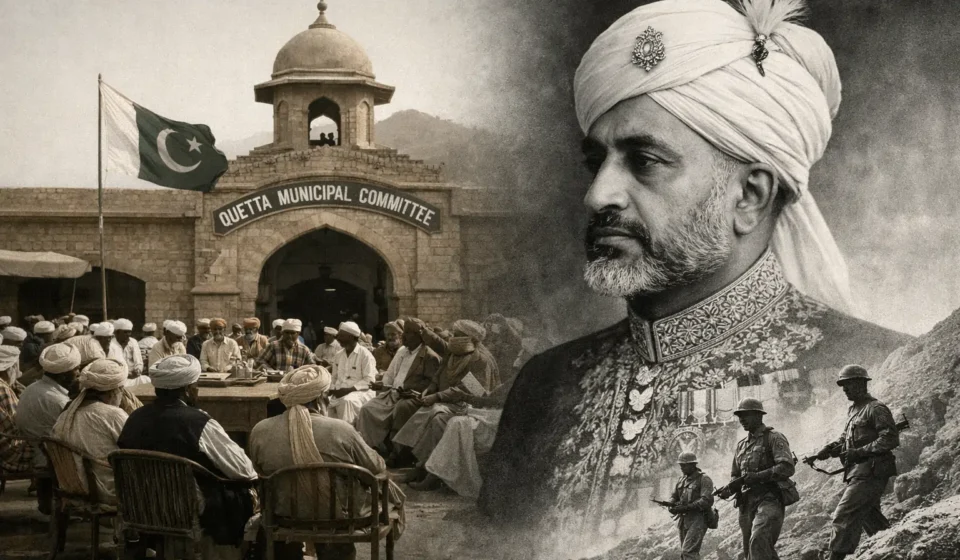
The Great Deception: Deconstructing the Myth of ‘Forced Accession’ in Balochistan

For decades, a specific brand of ethnic-nationalist rhetoric has sought to radicalize the youth of Balochistan by peddling a historical fallacy: the claim that Balochistan was an independent country “invaded and annexed” by Pakistan in 1948. This narrative, often championed by liberal apologists and separatist proxies, relies on the erasure of colonial facts and the distortion of legal documents.
Table Of Content
To understand the truth, one must look past the emotive slogans and examine the cold, hard data of 1947, a year defined not by military conquest, but by legal treaties, democratic mandates, and the desperate internal power struggles of the Khan of Kalat.
The Fragmented Reality of 1947
The first myth to dismantle is the idea of a unified “State of Balochistan.” In 1947, no such entity existed. The region was a patchwork of five distinct administrative units:
- British Balochistan (Chief Commissioner’s Province): The strategic heart (Quetta, Nushki, etc.).
- The Princely State of Kalat: Comprising only about 26% of today’s Balochistan.
- The Princely State of Kharan.
- The Princely State of Las Bela.
- The Princely State of Makran.
- Gwadar: Then under the Sultanate of Oman.
By 1877, through the Treaties of Mastung (1854) and Jacobabad (1876), the Khan of Kalat had already surrendered his political sovereignty to the British. He was a subsidiary ruler under the British Raj, not a sovereign of a foreign nation.
The Democratic Mandate: 40 vs. 10
Nationalists often ignore the most democratic event of the era. In June 1947, the British government gave the Shahi Jirga (the grand assembly of tribal elders) and the Quetta Municipal Committee the right to decide their future.
On June 30, 1947, despite intense lobbying by the Indian National Congress and its local affiliate Anjuman-e-Watan, the mandate was clear. Out of 65 members, an overwhelming majority, more than 40 votes, were cast in favor of Pakistan. The Congress-backed faction managed a measly 10 votes. This wasn’t a military decision; it was the expressed will of the representative leadership of the most populous part of the region.
The ‘Revolt’ of the Subsidiary States
The most damning evidence against the “Independent Kalat” narrative is the behavior of the states of Kharan, Las Bela, and Makran. Separatists claim these were part of a unified Kalat empire. The facts suggest otherwise.
The rulers of these states viewed the Khan of Kalat’s claims of suzerainty as an “autocratic anathema.”
- Kharan: Mir Habibullah Khan Nowsherwani wrote to Jinnah, stating: “People of Kharan are independent from Kalat & will die for Pakistan.”
- Las Bela: Jam Ghulam Qadir Khan repeatedly petitioned for immediate accession to Pakistan to escape Kalat’s influence.
- Makran: Nawab Bai Khan Gichki threatened to seek other alliances if Pakistan delayed his accession any longer.
On March 17, 1948, Pakistan accepted the accession of these three states. This move was legally sound under the Indian Independence Act. Crucially, it meant that Kalat, now reduced to a landlocked territory, had lost its coastal access and its buffer zones. The Khan’s “independence” was a geographical and economic impossibility.
The Myth of the ‘Parliament’
Separatist historians often cite the “Kalat Assembly” which voted against accession. This is a classic exercise in half-truth. This assembly was not a democratic body elected by the people; it was an unelected body of hand-picked Sardars designed to protect the Khan’s feudal interests against the rising tide of the Muslim League’s populist reforms.
Even the Khan of Kalat, Ahmed Yar Khan, knew his “Parliament” was a stalling tactic. While his sardars played to Indian Congress interests, the Khan was privately negotiating with Jinnah to secure the best possible deal for his royal title.
The 1948 ‘Invasion’ That Never Happened
The “gunpoint” narrative falls apart under chronological scrutiny. The Khan of Kalat signed the instrument of accession on March 27, 1948. Why then? Because All-India Radio had just broadcast a false report claiming the Khan had requested accession to India—a report Nehru later had to apologize for in the Indian Parliament.
Fearing he would be viewed as a traitor by his own pro-Pakistan population and seeing his state isolated, the Khan signed. There were no tanks in the streets of Kalat in March 1948. In fact, the Khan was later rewarded with the title of ‘Khane-Azam’ of the Balochistan States Union and remained a high-ranking state official. The “arrest” often cited by nationalists didn’t happen until 1958, a full decade later, and it was related to the “One Unit” policy, not the accession of 1948.
The history of Balochistan’s accession is a history of a people choosing a modern Muslim state over feudal autocracy. The statistics, the 40-10 Jirga vote, the 100% voluntary accession of Kharan, Las Bela, and Makran, and the legal status of Kalat as a princely state since 1877, all point to a single conclusion.
The “occupation” narrative is a post-dated check written by disgruntled sardars and cashed by modern terrorists. It is time the youth of Pakistan rejects “myth-history” and embraces the documented facts: Balochistan didn’t just join Pakistan; its representative institutions and three out of four of its princely states fought to be a part of it.


