
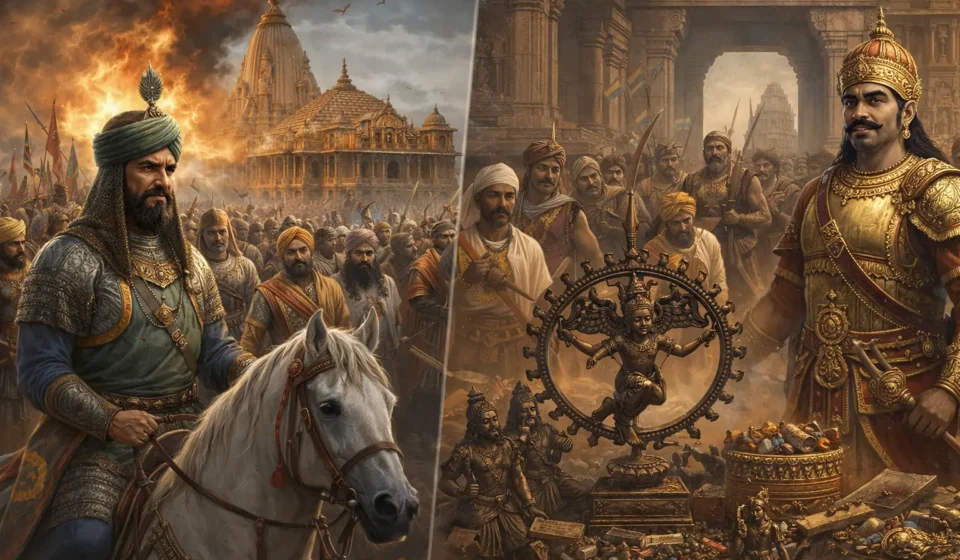
Somnath and the Myth of Religious Destruction: Mahmud Ghaznavi, Rajendra Chola, and Medieval India

Did you know that the composition of Mahmud Ghaznavi’s army when he raided the Somnath Temple in 1025 was not solely a Muslim army? Out of 12 generals, 5 were Hindus. Their names are:
- Tilak
- Rai
- Sondhi
- Hazran
- Not known
After the battle, Mahmud issued coins in his name with inscriptions in Sanskrit. He appointed a Hindu Raja as his representative in Somnath. Arab traders who had settled in Gujarat during the 8th and 9th centuries died protecting the Somnath Temple against Ghaznavi’s army.
Let me surprise you a bit more.
Just three years before Ghaznavi’s raid on Somnath in 1025, in 1022, a general acting on the authority of Rajendra I, Maharaja of the Chola Empire (848–1279), marched 1,600 kilometres north from the Cholas’ royal capital of Tanjavur. After subduing kings in Orissa, Chola warriors defeated Mahipala, Maharaja of the Pala Empire (c. 750–1161), the dominant power in eastern Bengal.
The Cholas crowned their victory by carrying off a bronze image of the deity Śiva, seized from a royal temple patronized by Mahipala. During this long campaign, the invaders also took from the Kalinga Raja of Orissa images of Bhairava, Bhairavi, and Kali. These, along with precious gems, were taken to the Chola capital as war booty.
The question arises: Why is Mahmud Ghaznavi demonized, but not Rajendra Chola for the plunder of Hindu temples?
In fact, the demonization of Mahmud and the portrayal of his raid on Somnath as an assault on Hinduism by Muslim invaders dates only from the early 1840s. It was then popularized that Mahmud, after sacking the Somnath Temple, carried off a pair of the temple’s gates on his way back to Afghanistan.
By “discovering” these fictitious gates in Mahmud’s former capital of Ghazni, and by “restoring” them to their rightful owners in India, British officials hoped to be admired for heroically rectifying what they construed as a heinous wrong. Intended to win Hindu gratitude while distracting the population from Britain’s catastrophic defeat just beyond the Khyber Pass, this act of colonial mischief has fueled Hindu ill-feeling toward Muslims ever since.
By contrast, Rajendra Chola’s raid on Bengal remained largely forgotten outside the Chola country.
Twelve years after the attack, a king from the Goa region recorded performing a pilgrimage to the Somnath Temple, yet he failed to mention Mahmud’s raid. Another inscription dated 1169 mentions repairs to the temple due to normal deterioration, again without reference to Mahmud’s raid.
In 1216, Somnath’s overlords fortified the temple—not to defend it from invaders beyond the Khyber Pass, but from attacks by Hindu rulers in neighbouring Malwa. Apparently, such attacks were frequent enough to require defensive measures.
The silence of contemporary Hindu sources regarding Mahmud’s raid suggests that in Somnath itself it was either forgotten altogether or viewed as just another unfortunate attack by an outsider, and therefore unremarkable.
References:
- India in the Persianate Age: 1000–1765 — Richard M. Eaton
- Somanatha: The Many Voices of a History — Romila Thapar