
Was East Pakistan Systematically Excluded from Pakistan’s Armed Forces (1947–1971)?

“Was there a deliberate attempt by Punjabi hierarchy to keep East Pakistan out of the armed forces between 1947 and 1971 as claimed by Indian academicians?”
“And donot mix truth with falsehood or conceal the truth while you know it”
~ Qur’an (Al-Baqarah)
A below table gives the total number of candidates who applied for commission in Pakistan Army from both wings in different years and the percentage selected by ISSB.
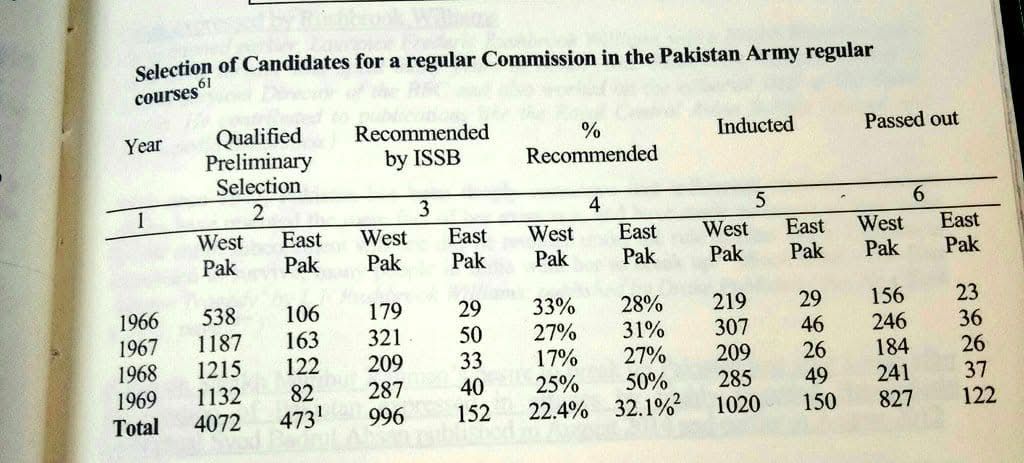
The average percentage of candidates recommended by the ISSB was higher for East Pakistan.
Out of 45 Muslim cadets of the second post war regular course at the Indian military academy, Dehra Dun, only four were from Bengal who got their commission in Pakistan Army in Oct 1947. In the third course known as the IMA/PMA course, there was not a single Bengali Muslim amongst them. In none of these there was any discrimination as Pakistan had not yet come into being.
The Muslims of East Bengal, even before independence, were not enthusiastic about joining the armed forces. It was during World War 2, when the British Indian Army expanded greatly, to support the British War effort, that some Bengalis and Balochis were also recruited. But the preponderance was from the traditional recruitment areas. 349,688 from the Punjab, 32,181 from KPK, 7,117 from Bengal and under 2000 were recruited from Baluchistan b/w 1939 and 1945. Towards the end of the war the ratio of Bengalis in the British Indian Army rose to about 2 percent. Whereas the Punjabis and Pathans contributed more than half of the total at end of the war.
As a result of this, only one percent of Pakistan Army was from East Pakistan in 1947. The total number of Bengalis who were recruited in that year was 87 as against 2,708 from West Pakistan. In 1954, the recruits numbered 165 from East Pakistan while 3204 soldiers joined the army from Punjab and KPK.
The newly established cadet school at Dacca could only attract 15 students in 1952.
By 1963, the situation began to change and the gap b/w the Bengalis and non Bengalis in the armed forces began to reduce. In the Army 7 percent of other ranks were from East Pakistan while nearly one third of the naval and Air Force personnel were from Eastern Wing. In the officers rank the difference was however still substantial as there was only one Brigadier, one Colonel and two Lieutenant Colonels out of 308 of equivalent ranks from West Pakistan. These figures give a wrong picture of deliberate discrimination. Looked at it cooly one can see the reason for higher slots in the army being occupied by non Bengalis in the early 50s and 60s. One cannot be recruited as a Lieutenant Colonel or Brigadier straight away. These heights can only be reached by climbing up the ladder from its lowest rung. So if there were very few Bengali junior officers in 1947 the adverse ratio in senior ranks would naturally remain for quite some time till the seniors faded away.
The reason for a very small number of Bengalis entering the armed forces was not so much because of discrimination against them but because not many Bengalis were willing to join. They were reluctant to join as they had to serve away from their homes and in a region so far unfamiliar to them. General Muhammad Atiqur Rahman, former Chief of Army Staff of the Bangladesh Army admitted that very few Bengalis wanted to join the army before the fall of Dhaka. In his own 9th PMA long course (1952-54), there were only 6 Bengali cadets out of 100. In the subsequent 10, 11 and 12 PMA long courses, there were not more than 11 from the eastern wing in each course.
During the Mughal rule, army was mainly composed of Pathans, Mughals and Punjabis. Even those in Bengal were posted from outside. The British, after the war of independence, banned the recruitment of Bengalis and Hindustani Musalmans. In fact the recruitment areas were confined to 4 districts. Campbellpur, Rawalpindi, Jhelum and Gujrat and two districts I’m KPK (Kohat and Peshawar).
The Simon Commission recommended a figure of 86,000 from Punjab, 5,600 from KPK, 300 from Baluchistan and none at all from Bengal.
Reference:
- Tragedy of Errors, Lt Gen Matinuddin
- 1971 facts and fiction, Afrasiab