




“Geopolitics is the hidden tax on every economy — and right now, Asia is paying the steepest bill.”
Table Of Content
- The Strait of Hormuz: Asia’s Economic Jugular
- Inflation Rising: A Half-Point Shock Across the Continent
- Shipping in Crisis: The $500 Billion Bottleneck
- Export Markets Under Siege: India and China’s Double Jeopardy
- Currency Pressures and a Delayed Rate-Cut Cycle
- The Reckoning: Asia’s Moment of Strategic Vulnerability
— Deepali Bhargava, Head of Asia-Pacific Research, ING Bank
As the missiles began to land in the Persian Gulf in early 2025, the tremors were felt not only in Tehran and Tel Aviv but also in the factory floors of Shenzhen, the fuel lines of New Delhi, and the currency exchange houses of Tokyo. The Middle Eastern conflict, which began as a tragedy, has escalated into the most potent economic threat facing Asia, a continent that contributes nearly two-thirds of global growth. From oil dependency, strangled shipping routes, crumbling export markets, and rising inflation, the economic impact of the Middle Eastern conflict has altered Asia’s economic scenario at a pace that defies comprehension.
The Strait of Hormuz: Asia’s Economic Jugular
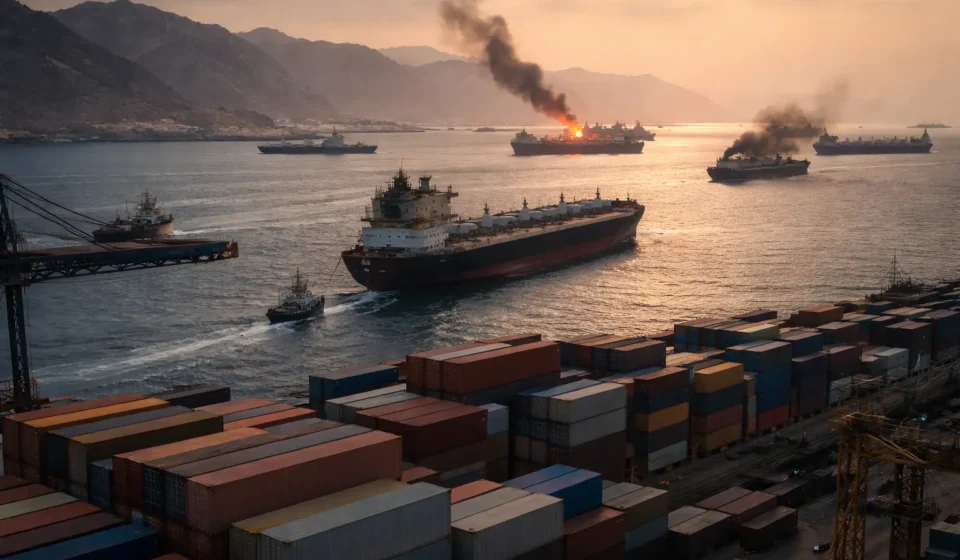
No geography is as emblematic of the vulnerability that Asia faces as the Strait of Hormuz, which is merely 33 kilometers at its narrowest point. According to the U.S. Energy Information Administration (EIA), Administration has stated that as many as 20 million barrels of oil were being transferred through this critical choke-point every single day in the year 2024 alone, which translates into $500 billion worth of international energy exchange annually. The critical factor is that as many as 80 to 90 percent of these oil imports belong to Asian nations. The statistics are simply too overwhelming to comprehend the gravity that the Strait of Hormuz plays as far as Asian nations are concerned.
The island nation of Japan and the Philippines source as much as 90% of their total oil requirements from the Persian Gulf region.The Chinese, being the largest consumers of energy in the world, source as much as 38% of their oil imports from the region, while the Indian subcontinent sources as much as 46% of its oil imports from the Gulf region
Inflation Rising: A Half-Point Shock Across the Continent
The inflationary impacts can already be seen. In fact, Capital Economics reported in March 2026 that “most economies in Asia are worse off and facing higher inflation” due to the escalation of strikes on Iranian infrastructure, forecasting that inflation in these countries could rise by up to half a percentage point if crude oil prices remain high. In countries such as Indonesia, Vietnam, and the Philippines, where food and fuel make up a disproportionately large share of household expenditure, even a small rise in oil prices can mean poverty and political instability.
The analysis done by the ING Think economic indicates that Asia was able to cope with the oil price increases because the inflation base was very low before the war. However, the analysis indicates that the factor working in this situation is the persistence of the war. A prolonged war would be beyond the capacity of Asia. Unlike the United States, which has a domestic oil supply, Asia does not have such a capacity. All the economies in Asia are in the red in the oil and gas trade, except for Australia, Malaysia, and Indonesia.
Shipping in Crisis: The $500 Billion Bottleneck
Energy is only one aspect of the problem, and the logistical problem could prove to be just as significant. The Houthi forces in Yemen have announced plans to resume their strikes in the Red Sea early in 2026, and as a result, the world will experience a critical two-chokepoint problem as the Hormuz and Red Sea/Suez Canal routes are threatened at the same time. An estimated 2.5 million TEU of global container capacity is currently consumed by the longer routing through the Cape of Good Hope.
Freight costs have risen by 45% since October 2024, according to published research in the Taylor & Francis academic journals. To the just-in-time manufacturing economies of Asia, this is not just a cost increase; it is a structural disruption. China, the manufacturing hub of the world, is facing multiple headwinds: increasing production costs due to energy price increases, increasing shipping delays, and decreasing export competitiveness at a time when their economy is in a precarious state of recovery.
Export Markets Under Siege: India and China’s Double Jeopardy
The economic consequences of the conflict stretch far beyond the energy markets. The Middle East has become an ever-more significant export market for Asian goods manufacturers, especially as US trade policies under the Trump administration forced diversification from the West due to rising tariffs. The prospect of an ongoing conflict eliminates this diversification opportunity. The countries that will be most negatively affected by the conflict are India and China, as per the analysis by ING’s Bhargava.
A very immediate food security concern is also at play here. The Strait of Hormuz is home to about one-third of the world’s exports of the agricultural fertilizer ‘urea.’ In addition to that, it also transports huge amounts of raw materials required for the production of fertilizers. As bluntly stated by the CEO of Norwegian chemical manufacturer Yara International, Svein Tore Holsether, to CNN: “Fertilizers are not justanother commodity – nearly half of global food production depends on them.” The Asian nations that are already dealing with food security issues due to rising prices could be set to face humanitarian issues that far outweigh the economic consequences of the conflict.
Currency Pressures and a Delayed Rate-Cut Cycle
This extends to the monetary policy side as well. Soaring oil prices have caused the value of the US dollar to rise across the board, putting downward pressure on Asian currencies. In the latest round of market analysis from ING, the soaring cost of oil and the rising value of the dollar suggest that the pace of the long-overdue rate-cutting cycles will be delayed in the region. In fact, the delay will be felt in Indonesia and India until the latter half of 2026. This is the monetary policy side of the equation that will add to the difficulties faced by the public with floating interest rates and businesses with dollar-denominated debts.
The IMF’s Regional Economic Outlook has consistently highlighted that the negative economic spillovers from the conflicts in the Middle East have been larger and longer-lastingcompared to the impacts in other global regions. In fact, the spillovers have spread across the border to the neighboring and dependent economies. This is especially relevant for the Asian economies, whose fortunes have been inextricably linked to the Gulf economies through the supply of energy.
The Reckoning: Asia’s Moment of Strategic Vulnerability
Asia took three decades to create an economic miracle that relies on cheap energy, open trade routes, and cordial relations with the Gulf states. The Middle East war is putting all three of these economic pillars to the ultimate test at once. What Asia’s policymakers are now grappling with is that their decades of export-led growth and dependence on imported energy resources have made them economically vulnerable to exactly this type of disruption in global politics.
What Asia needs to do now is to take urgent steps to diversify its energy resources, build up its reserves, open channels to de-escalate the war, and improve its food reserves. The war in the Middle East may have been sparked in a region that is geographically very distant from Asia, but let there be no doubt-the most economically significant battle is playing out in the region that extends from the Bosphorus to the Pacific.
“The Strait of Hormuz is essential for global food production. Fertilizers are not just another commodity, nearly half of global food production depends on them.”







Whoever wrote this is such a talented person ❤️🙌🏻🙌🏻🙌🏻