
The Illusion of “Incredible India”: Unmasking the Crises Plaguing the World’s Largest Democracy

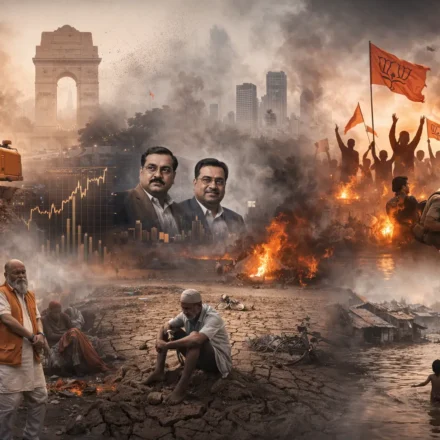
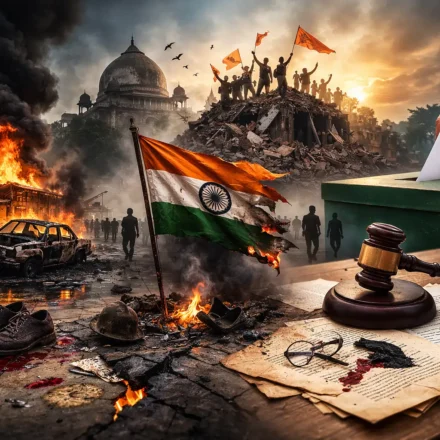
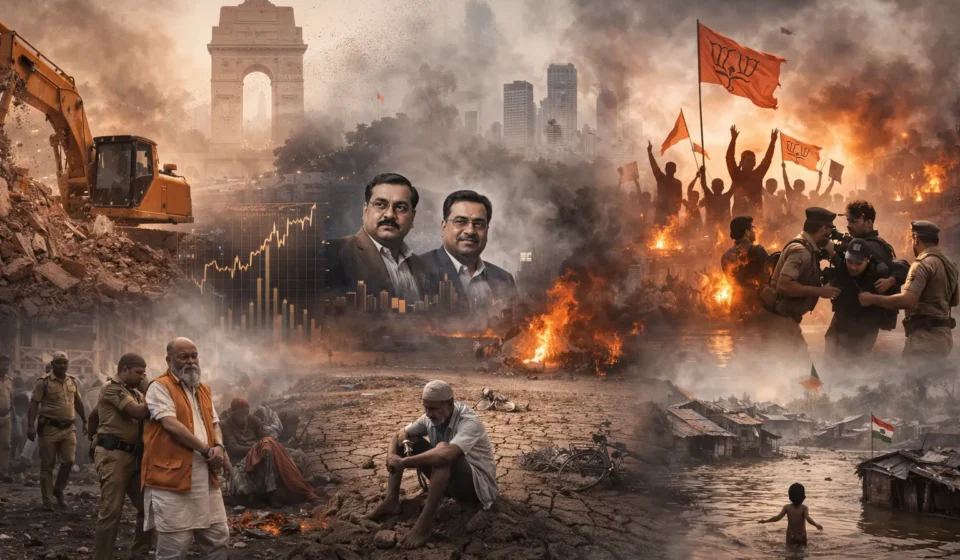
On a global scale, India very carefully builds a picture of an unstoppable force. It calls itself the “Mother of Democracy, ” claims to be the fastest, growing major economy in the world, and often shows off its diplomatic power as a self, declared “Vishwaguru” (teacher to the world). The story shared with the West is about unlimited, inevitable progress, from organizing extravagant international summits to sending a rover to the moon. But behind the polished public relations endeavors and the huge posters of the leaders, there is a quite different situation. The world’s largest democracy is going through a time of very serious internal decay. Apart from the deliberate destruction of democratic institutions, there is an increase in economic inequality, frank political dishonesty, and the swift disappearance of secularism. One can no longer cover the Indian state’s defects by simply showing the attractive side of “Incredible India.” It is necessary to ignore the high, sounding words for a moment and to look critically at the crises so entrenched that they are weakening the country from the inside.
Table Of Content
- The Hypocrisy of Power: Corruption and Performative “Bulldozer Justice”
- The Attrition of Democratic Institutions and Press Freedom
- The Widening Chasm: Economic Inequality Amidst “Jobless Growth”
- A Secular State Under Strain: The Rise of Majoritarianism
- Breathless Cities: The Unchecked Environmental Crisis
- Conclusion
The Hypocrisy of Power: Corruption and Performative “Bulldozer Justice”
To grasp the truth about India’s present political scenario, we must only observe the blatant double standards and immorality that most of the time get away with the guards of the ruling establishment. A recent event in Chhattisgarh state is a very decent reflection of the deep ties between political power, organized crime, and the state’s indiscriminate use of extrajudicial force.
In Durg district, Vinayak Tamrakara, senior leader of the ruling Bharatiya Janata Party (BJP) and former president of its local Kisan Morcha (Farmers Wing), was recently arrested for directing a giant illegal narcotics trade. Illicit opium worth a staggering 80 million rupees (8 crore INR) was being grown in the villages of Samoda, Jhenjhari and Sirsa under his guidance.
The scheme was as fearless as it was well thought out: the opium was carefully concealed under the cover of high maize crops, with the workers being brought from outside the state to keep the secret. The giant drug cartel went unnoticed until local youths playing during the festival of Holi accidentally discovered the plants and took pictures. Opposition leaders including ex Chief Minister Bhupesh Baghel had to go to the spot and put photos on social media to demand accountability.
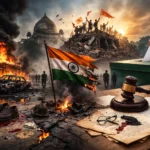
The fallout from this scandal brings to light yet another seriously disturbing facet of governance in contemporary India: the state machinery becoming a weapon. After Tamrakar was arrested and there was a wave of public anger, the local administration was quick to bring a bulldozer and demolish a shop in Samoda village belonging to his brother, Brijesh Tamrakar, on the pretext that the 32, decimal plot was illegally encroached government land.
Though the administration tried to present this demolition as quick enforcement of law, it instead revealed the shocking reality of the country’s newer version of “bulldozer justice” featuring the use of machines. The state has increasingly adopted the method of extrajudicial bulldozing as the chief means of operation, completely ignoring the courts.
Normally, this method is employed in the case of harassing minority religious groups, activists, and dissentersmaking them overnight without a home all in the name of “anti, encroachment” operations. However, for Tamrakar, the bulldozer was used as a show, a way for the ruling party, which had been caught red, handed in a huge, multi, million, rupee narcotics racket run by one of its agricultural leaders, to save face. Such a system replaces rule, of, law with rule, of, optics.
The Attrition of Democratic Institutions and Press Freedom
This isolated corruption is only a sign of a very extensive system, wide decay. Global monitors have frequently sounded the alarm about India’s retreat from democracy; the V, Dem Institute has just categorized India as an “electoral autocracy” rather than a democracy, whereas Freedom House has lowered its rating to “partly free.”
Government machinery is more and more being used as a weapon to silence dissent. Independent national institutions like the Enforcement Directorate (ED) and the Central Bureau of Investigation (CBI) are regularly used to scare, raid, and imprison political opposition leaders and civil society members.
Moreover, press freedom in India is descending at an alarming pace. Ranked almost at the bottom of the World Press Freedom Indexs regularly, the Indian media scene has to a great extent been taken over by corporate monopolies with close connections to the ruling government. Those reporters who with their investigations show, state will be targets of vicious online harassment, sedition charges, and incarceration under severe anti, terror laws, which also provide for detention without the trial for a long time. Besides, during the periods of the civil unrest, the police usually impose the blanket shutdowns of the internet, thereby forcing millions of the countrys residents into a digital dark age.
The Widening Chasm: Economic Inequality Amidst “Jobless Growth”
If you would judge India’s economy only by the booming stock market or the growing number of domestic billionaires, you might get carried away by the hype. But the widely praised economic boom is actually a typical case of a “K, shaped” recovery, where a small elite gets extraordinarily rich whereas the large majority of the population is more or less stagnant
Global inequality reports reveal that the top 1% of India’s population owns a shockingly large share of the country’s total wealth. The economic system is very much oriented towards crony capitalism, whereby only a few megacorporations that have close ties to the government win the biggest contracts, thus monopolizing sectors from telecommunications to infrastructure.
On the other hand, an ordinary Indian citizen faces a very gloomy reality. The country is grappling with a severe “jobless growth” issue. Even with the high GDP numbers, the economy does not generate enough jobs to accommodate the millions of youth who join the labor force annually. The level of youth unemployment is still very high historically, creating a large dissatisfaction among the youth. At the same time, the agriculture sectoremploying almost half of the country’s labor forceis always hit by a crisis, as farmers are plunged into debt and lack of systemic support, leading to long protests which the government usually responds with force rather than sympathy.
A Secular State Under Strain: The Rise of Majoritarianism
India was initially set up as a secular and pluralistic country, the constitution guaranteed equal treatment of all religions by the state. Unfortunately, very forcefully, India’s very first promise is being undone. First and foremost, in the last ten years, the country has taken an upsetting turn towards ethnic nationalism and majoritarian rule.
The political talks are almost entirely surrounded by an ideology that is divisive and wants to exclude religious minority groups beside the Muslims who are over 200 million in the country and the Christians. Politicians who give hate speeches are usually not even punished which leaves a permissive environment for cruelty those who carry out their acts with almost total impunity.
Legislation that has caused much debate like the Citizenship Amendment Act (CAA) clearly sets the religion of the person as one of the bases for granting citizenship. Also, the deliberate removal of minority historical events from school books, the violent destruction of minority dwellings, and making loving between couples of different faiths against the law are all pointing towards a well, planned move to make minorities less regarded citizens. A milieu of terror and division has taken over the country’s spirit of “unity in diversity” that was the hallmark of its history.
Breathless Cities: The Unchecked Environmental Crisis
India is heavily expanding its industries but doing so with drastic consequences for the environment and the health of the people. It is home to most of the planet’s dirtiest cities. Each winter, New Delhi, the capital city, along with a large part of northern India, is covered by a thick, poisonous smog which pushes the Air Quality Index (AQI) to the most dangerous, life, threatening levels. Inhaling the air in these cities is as if a person is smoking several packs of cigarettes a day.
Despite all this, the government reaction still remains terribly inadequate and shows primarily a failure of leadership and a lack of political will, a weak implementation of environmental laws, and a focus on the development of infrastructure without any concern for the sustainability of the environment. Important rivers are still being filled with industrial waste, and fast, major, and unplanned urban growth has destroyed the wetlands causing severe urban floods in IT cities like Bengaluru.
Conclusion
Criticizing India is not synonymous with rejecting its potential. It is not even implying that one ignores the resilience and cultural richness of its people. However, global leadership on the true level needs much more than just nice GDP numbers, successful space missions, and highly aggressive public relations. Global leadership, among other things, requires a one’s self and institutions being morally sound and having integrity and a devotion to human rights. If one ignores the state of India, he/she will get a very bleak picture.
On the other hand, a country that censors the journalists, of a country that gives the minorities only a marginal place, that turns a blind eye to the problems of the poor who are deepening, that allows the political leaders to run drug cartels and at the same time using the bulldozers for going after the performative justice, such a country is not the “mother of democracy”.
Till the time India is ready to see these difficult issues which it has been hiding and which, in fact, have led to its systemic inequalities and authoritarian impulses, it is the core, the heart of India, that is being rotted, its claim to global greatness shall be only an empty illusion.