


The Silicon Battlefield: How Semiconductors Became the Most Strategic Weapon of the 21st Century

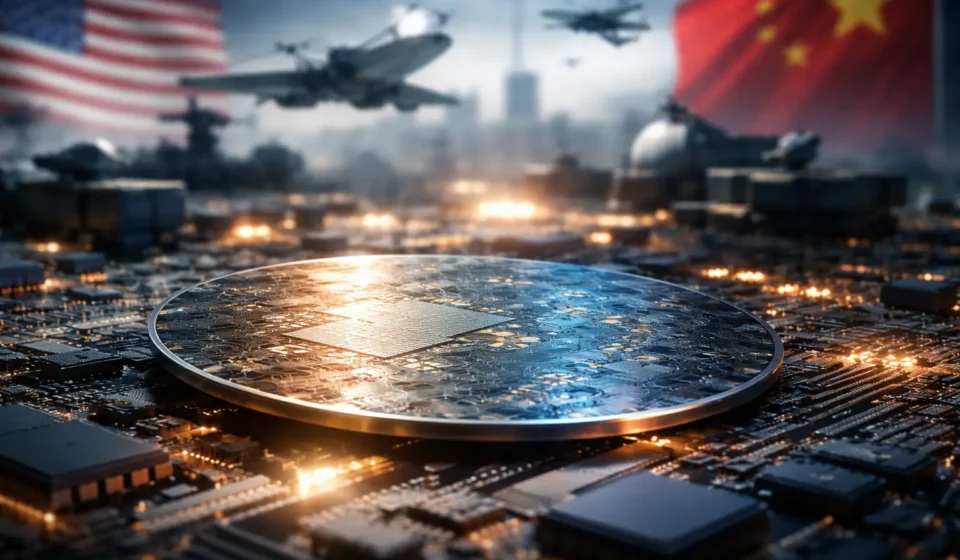
Semiconductors have become the most strategic weapon of the 21st century, powering both smartphones and hypersonic missiles. This Silicon Battlefield is a conflict between the world powers over chip dominance amid booming markets, unstable supply chains, and rising geopolitical tensions.
Table Of Content
- Historical Evolution to Powerhouse
- Explosive Market Statistics
- The statistics highlight the supremacy
- US-China Silicon Chip Wars Timeline
- Expansion of Milestones under President Trump’s reelection in 2025
- Military and Defense Dominance
- Applications of critical importance are
- Critical Supply Chain Weaknesses
- Top vulnerabilities
- Global Reshoring Rush
- Investment surge
- Future of the Silicon Arms Race
Historical Evolution to Powerhouse
Semiconductors began as mere transistors in the 1940s, but in the 2010s, Moore with his Law of the 1/N triggered a bomb that pushed node shrinks to 2nm. They will eventually be the foundation of AI models, 5G networks, electric vehicles (EVs), and advanced computing, with EVs requiring approximately 30 percent more chips per unit compared to conventional gas cars.
This transformation has been accelerated since 2018 following the trade tension between the United States and China, and it has now turned chips into a geopolitical weapon. The world R&D expenditure shot up, and numerous companies were intending to increase it, and the overall industry capex reached approximately 180 billion in 2024 alone, as a result of TSMC and Intel, and others.
This development is not only a technological breakthrough but also a shift in strategy, with countries realizing the importance of semiconductors in economic and military supremacy.
Explosive Market Statistics
By 2025, the industry is estimated to be around $598-701bn, and in 2026, it is estimated to be about 660-711bn with a 10-11% CAGR, with the help of AI and data centre demand.
The statistics highlight the supremacy:
– In 2025, TSMC will control 66-70% of the foundry market share of advanced nodes less than 7nm.
– Taiwan has the highest manufacturing indices with a score of about 79-103, the US has 78-95 and China has 77-81.
– Military-aerospace segment of $7.15-9.6 billion in 2024-2025, to 12.3-15.5 billion by 2030-2034 (6-8% CAGR).
Capex boom persists: TSMC will spend between $52-56 billion in 2026, 25-40 percent higher than in 2025, to construct new factories in response to insatiable AI demand.
AI logic chips take the biggest share of revenues of more than 70 percent, and memory and sensors come next, closely behind them.
US-China Silicon Chip Wars Timeline
In May 2020, the Silicon Battlefield was set on fire with the US Huawei bans, cutting off access to foreign chips. In October 2022, tools of ASML and Applied Materials were affected by export controls.
Expansion of Milestones under President Trump’s reelection in 2025:
– 2022 CHIPS Act provided up to 39-52 billion in subsidies, which open up to 200 billion in private investments by mid-2025, such as the giant $200B commitment by Micron.
– March 2023: Japan and the Netherlands followed suit, as well as export curbs.
– May 2023: China responded by prohibiting Micron from important infrastructure in China.
– 2025 changes: The Trump government relaxed part of Nvidia’s licenses to China on AI chips as part of rare earth discussions, but stepped up overall decoupling measures.
Such actions have increased the expenses of Chinese companies to a maximum of 25 percent, which has slowed their advancement to 10nm nodes.
Military and Defense Dominance
Radar systems, drone-controlled missiles, AI drones, and C4ISR networks all use semiconductors. Variants hardened to radiation survive in nuclear conditions, and they are used in the F-35 jets, satellites, and electronic warfare systems.
Applications of critical importance are:
– Real-time targeting AI accelerators in UAVs and hypersonics.
– Mature nodes (>28nm) focus on reliability more than speed in defense.
– 2 billion CHIPS Act increase in safe defense manufacturing.
DOD budgets are investing approximately 12 percent of 2026 budgets in semis, reflecting their advantage in the modern warfare environment of autonomous systems to cyber defenses.
Critical Supply Chain Weaknesses
The vast majority of high-tech chips are made in Asia, and a single failure point, such as earthquake-prone fabs in Taiwan, would cause disruptions worth 100 billion dollars in the industry.
Top vulnerabilities:
– Geopolitical risks: Trade barriers and sanctions cause chokepoints, and 30 billion dollars of critical tech spending will be impacted by 2026.
– Cyber attacks and IP theft: The world is losing over 600 billion every year.
– Natural disasters: 2024 Taiwan earthquakes stalled 10% of production weeks later.
– Collusion and tampering: NIST flags supply chain manipulation risks.
Europe depends on East Asia to supply 70 percent of imports, which increases global vulnerability.
As geopolitical tensions reshape global supply chains, conflicts beyond East Asia—particularly in energy-critical regions—are also amplifying economic risks, as explored in our analysis of the Middle East crisis
Global Reshoring Rush
Countries consider chips as the new oil. The US CHIPS incentives reach up to 73 billion by 2026, and the EU Chips Act of 43 billion aims at 20% of the world by 2030.
Investment surge:
– India has a scheme of 10 billion+, which opens four plants in 2026, with a target of 5% market share in mind.
– Samsung in South Korea invests more than 200 billion + in US plants.
– Forecasts: Market reaches 1 trillion in 2030, 1.83 trillion in 2036.
NVIDIA and other AI giants drive 30% growth of TSMC in 2026, boosting diversification.
Future of the Silicon Arms Race
By 2030, quantum computing and 1nm nodes are available, but China is limited to 10nm export. The Chip 4 alliance (US, Japan, Korea, Taiwan) enhances resilience by means of policy coordination.
Radical assertion: The possession of high-end semiconductors provides unprecedented economic and military advantage. The Silicon Battlefield will re-establish superpowers in the face of AI, quantum threats, and unlimited reshoring with 2026 markets at $660+ billion.