Silence of India’s Military Leadership Under Modi Raises Serious Questions About National Security

The silence of India’s military leadership under Narendra Modi’s Hindutva BJP government has raised serious questions about India’s security. The Hindutva system and policies have not only engulfed all Indian institutions, including the armed forces, but have also made it not merely difficult, but virtually impossible, for India’s military chiefs to speak the truth. The primary reason lies in the fascist policies of Modi’s BJP government and its agenda of transforming India into a Hindu Rashtra while marginalising minorities.
The silence of senior military officers and the suppression of truth in India has become a bitter reality now exposed to the world. Modi’s government has coerced the heads of all institutions through intimidation, pressure, inducements, and other tactics. At the same time, senior military officials have been gagged to conceal internal matters, especially ground realities in Indian Illegally Occupied Jammu & Kashmir and border disputes, from the international community.
These revelations were made by former Indian Army Chief General M. M. Naravane in his memoir Four Stars of Destiny, where he discusses harsh realities such as the 2020 Ladakh crisis, the sudden implementation of the Agnipath scheme, and border mismanagement. Yet attempts to bring these truths to light globally have repeatedly been blocked by India’s Ministry of Defence under the pretext of security clearances, clearly aimed at covering up the Modi government’s failures.
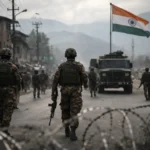
General Naravane openly describes the Ladakh standoff in his book. When China increased its military presence and moved tanks close to Indian territory, India’s military leadership urgently needed clear instructions. Instead, no explicit directions came from the Modi government.
Naravane repeatedly contacted Defence Minister Rajnath Singh, National Security Adviser Ajit Doval, Chief of Defence Staff General Bipin Rawat, and External Affairs Minister S. Jaishankar, asking: “What are the orders?”
The response was always the same:
“Do not fire until clearance comes from above.”
This revealed a grave lack of coordination and trust between the Indian government and its armed forces, leaving military leadership unable to act decisively on the battlefield. This paralysis rendered India’s forces ineffective during the standoff with China. As a result, 21 Indian soldiers, including Commanding Officer Colonel Santosh Babu, were killed.
Later, a vague directive arrived: “Do whatever you deem appropriate.” This not only demonstrated the ambiguity of governmental decision-making but also highlighted the deep divide between political leadership and military strategy.
The Indian Ministry of Defence repeatedly delayed security clearances in 2023–24 to prevent these facts from becoming public, showing that the Modi government is actively suppressing even its own senior military leadership while working hard to hide the truth domestically and internationally. Even officers like General Naravane are unable to freely share their experiences, as publication restrictions are imposed purely to protect the government’s image and conceal its failures.
This grim situation raises serious questions about the credibility of India’s armed forces. Military officers are now unable even to speak freely. Their freedom of expression has effectively been stripped away.
This grim situation raises serious questions about the credibility of India’s armed forces. Military officers are now unable even to speak freely. Their freedom of expression has effectively been stripped away.
On 2 February 2026, opposition leader Rahul Gandhi attempted to raise these suppressed facts in India’s Lok Sabha. However, Modi government ministers Rajnath Singh and Amit Shah created chaos in the House and forced the Speaker to adjourn proceedings, another clear example of how the Modi government tries to stifle truth.
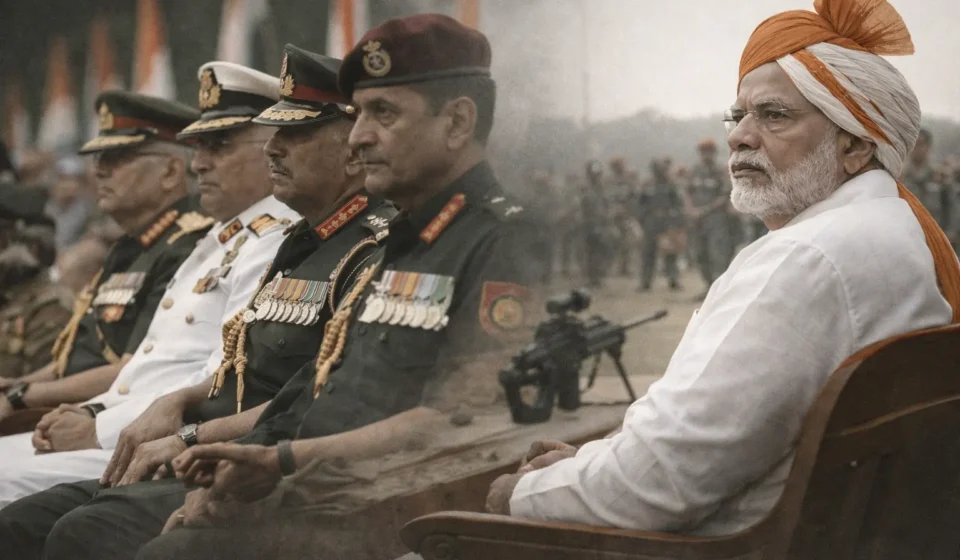
It is evident that Modi’s government silences senior military officers to cover up its failures. Army chiefs appear helpless under the dominant Hindutva system, unable to speak honestly. Political instability under Modi has laid bare a widening civil–military divide. The strategy aims to tighten domestic political control while preventing damage to India’s international image.
Meanwhile, India’s Election Commission has also been rendered powerless. Chief Election Commissioner Gyanesh Kumar has allegedly been silenced as part of dismantling India’s democratic framework. The Special Intensive Revision (SIR) 2026 of electoral rolls, covering over 510 million voters across nine states and three union territories, is viewed as a systematic effort to remove minorities, especially Muslims, from voter lists.
States affected include Andaman & Nicobar Islands, Lakshadweep, Chhattisgarh, Goa, Gujarat, Kerala, Madhya Pradesh, Puducherry, Rajasthan, Tamil Nadu, Uttar Pradesh, and West Bengal, all scheduled for elections in 2026. Assam will also hold elections, where a separate provision of the Citizenship Amendment Act applies.
West Bengal Chief Minister Mamata Banerjee has openly criticized Gyanesh Kumar and accused Election Commission DG Seema Khanna of being linked to BJP’s IT cell, alleging the removal of 5.8 million names from voter rolls.
When Home Minister Amit Shah says opposition parties should wait until 2047, such statements reflect the BJP’s authoritarian mindset. In this context, silencing military leadership comes as no surprise.
Another dimension of this policy is to keep the military quiet while maligning Pakistan and the Kashmir freedom movement. India continues to portray Kashmir’s indigenous struggle as Pakistan-sponsored, despite the reality that it is a grassroots movement driven by Kashmiris themselves, hundreds of thousands of whom have sacrificed their lives.
Modi’s claim has never gained international acceptance, as the world recognizes that the roots of the Kashmir movement lie within the Kashmiri people. India’s narrative is widely seen as propaganda.
The lack of coordination between India’s political and military leadership under Modi has pushed Indian politics into crisis. Senior officers are forced to follow the government’s political agenda, damaging not only military professionalism but also national security.