
Major General Shabeg Singh: From Decorated War Hero to the Fallen Soldier of Operation Blue Star

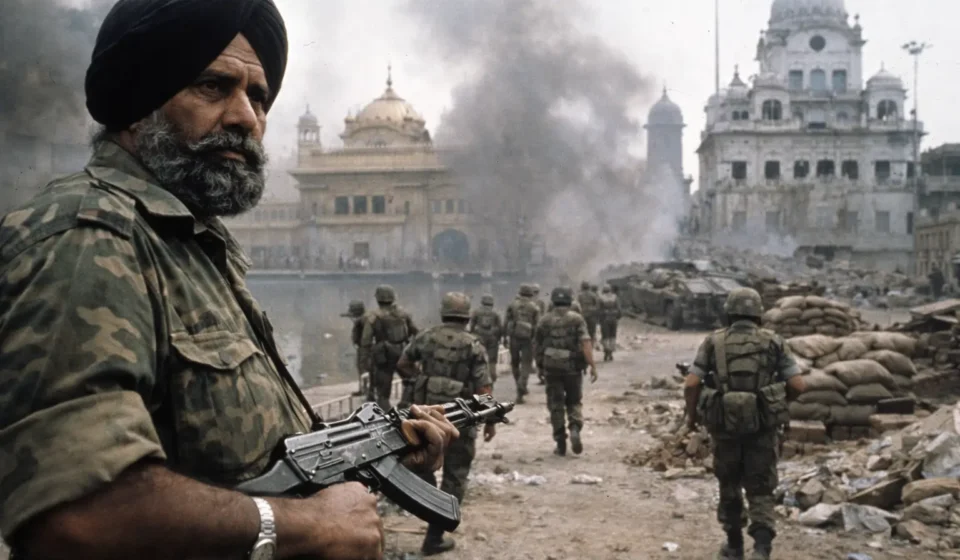
On 6th June 1984, Maj Gen Shabeg Singh, a decorated war veteran of Indian Army, was killed by the same military during Operation Blue Star. It was Shabeg, who had trained the Mukti Bahinis in 1971 but later on he became the military advisor of Bhindranwale in 1984 after he was court-martialled by Indira Gandhi.
Table Of Content
- Who Was Major General Shabeg Singh? The Indian Army General Killed During Operation Blue Star
- From 1971 War Hero to 1984 Tragedy: The Life and Death of Major General Shabeg Singh
- Major General Shabeg Singh’s Untold Story: Mukti Bahini Commander to Blue Star Casualty
- Operation Blue Star and Major General Shabeg Singh: A Soldier Betrayed by the State
- Major General Shabeg Singh and Operation Blue Star: How India Killed Its Own Decorated General
Here is a detailed account of his story from the book ‘PANJAB Journeys Through Fault Lines’, pages 128-130, 134-135. It is based on Amandeep Sandhu’s interview with Gen Shabeg Singh’s brother Beant Singh.
Who Was Major General Shabeg Singh? The Indian Army General Killed During Operation Blue Star
Major General Shabeg Singh hailed from the Bhangu family whose ancestor Mehtab Singh along with Sukha Singh had avenged the desecration of Darbar Sahib by Massa Ranghar in 1738. In 1942, Shabeg Singh was a tall, lanky and athletic hockey player, selected by the British to join the army. He served on the Burma front and then in Malaya in World War II.
From 1971 War Hero to 1984 Tragedy: The Life and Death of Major General Shabeg Singh
In the 1965 operations against Pakistan, he was in the Haji Pir Sector in Jammu and Kashmir, commanding a Gorkha battalion, and was mentioned in dispatches for the capture of important enemy positions. He was a commanding officer at that time and as the battalion was to be launched into attack, he received a telegram from his mother informing him that his father had expired. His brother Beant Singh told me that upon receipt of the telegram, he asked for a five-minute break. Silently, he paid his respects to his father and resumed operations. No one in his battalion knew that the commanding officer had lost his father on the eve of battle. His mother Pritam Kaur never asked him why he did not return to perform the last rites.
In 1971, India started the clandestine insurgency operations in East Pakistan—Mukti Bahini. Chief Field Marshal Sam Manekshaw selected Shabeg Singh, then a brigadier, and made him in-charge of Delta Sector headquartered at Agartala. He was given the responsibility of planning, organising and directing the insurgency operations in the whole of Central and East Bangladesh.
All the Bangladesh officers who had deserted from the Pakistan army including Colonel Osmani, Major Ziaur Rehman who later became president of Bangladesh and Mohammad Mustaq who became Bangladesh army chief were placed under Shabeg Singh for training. As a call of duty, Shabeg Singh changed his appearance. The Sikh soldier, proud of his personal family lineage and his religion, cut his hair, took to smoking and began signing his name as S. Beg as part of his undercover appearance.
Since the Mukti Bahini Operation was covert, it has not been documented and not much is known about it. Yet, it is clear from subsequent reports and books and articles that the Mukti Bahini played an important role in the Bangladesh War. Shabeg Singh, having been in charge of a covert operation, was promoted to Major General and awarded the Param Vashisht Sewa Medal in recognition of his services.
In the context of broader regional military histories, including questions about the representation and roles of various groups within armed forces prior to Bangladesh’s independence, see this related analysis on South Asian military structures during 1947–1971: “Was East Pakistan Systematically Excluded from Pakistan’s Armed Forces?”.
Major General Shabeg Singh’s Untold Story: Mukti Bahini Commander to Blue Star Casualty
Parallelly, the JP movement had pulverised Bihar during 1972-73 and became a serious threat to the Indira Gandhi government. The Centre received reports that the police in Bihar were sympathetic towards JP and his followers and decided to seek the army’s assistance. Indira Gandhi sent an informal message to Shabeg Singh to arrest JP and take harsh measures against his followers.
Shabeg Singh refused. This refusal did not go down well with Indira Gandhi. In order to deny him promotion, he was not given the command of a Division and was posted as the commanding officer of the Uttar Pradesh Area Headquarters (HQs) at Bareilly. The army instituted a court of inquiry stating that Shabeg Singh had accepted a plaque costing Rs 2,500 as a gift on his posting out of Jabalpur Area HQs. The army also brought charges that Shabeg Singh had used army trucks to smuggle teak out of Assam to build his house and had permitted sale of goods purchased from customs in the area headquarters’ army canteen. The cases dragged on until a day before his retirement on 30 April 1976 when the army dishonourably discharged him from his duties.
Later, Shabeg Singh fought the cases in civil courts and won. Intending to settle down in Dehradun, Shabeg Singh had built a house there. Yet, drawn to Panjab politics, unlike his peers who joined the Congress, he opted to fight for the Sikh cause by joining the Akalis. He became an Amritdhari Sikh, and when the Akalis courted arrest during the Dharam Yudh Morcha, he suffered the plight of ordinary prisoners. In a telling last interview, when asked about his role in Mukti Bahini—as becoming a soldier of his kind and given that the operation was covert—he remained silent. When asked about his collaboration with Bhindranwale, he again remained silent.
Operation Blue Star and Major General Shabeg Singh: A Soldier Betrayed by the State
Beant Singh claims that Shabeg Singh first met Bhindranwale towards the end of 1983 and advised Bhindranwale to vacate the
Akal Takht premises. Bhindranwale refused, saying the Morcha would be weakened. Bhindranwale again called Shabeg Singh in March 1984 and agreed that there could be an army attack but qualified his agreement with the fact that it was too late to leave the premises then. He requested Shabeg Singh’s help. Shabeg then began fortifying the complex and training Sikh fighters. The soldier who had dedicated all his life to the service of the nation was now preparing to defend his religious institution against the same nation in case it attacked it.
In those days there were intense parleys between the central government, the Akalis and all sorts of intermediaries. The CRPF had already encircled the Darbar Sahib complex. On 1 June 1984 the CRPF had spent eight hours shooting at the complex, testing the preparedness of the fighters inside. ‘Three days before the attack,’ Beant Singh said, ‘Bhindranwale, his personal assistant Rashpal Singh, Shabeg Singh, Amrik Singh, Harminder Singh Sandhu and others met Gurcharan Singh Tohra, the head of the SGPC, at the Akal Takht. Bhindranwale asked Tohra what would happen if he were to leave right away. Could Tohra promise that the army would not attack? Tohra’s face fell, he bowed his head and lowered his eyes in embarrassment over his helplessness.’
It was clear that Indira Gandhi was no longer willing to listen to the Akalis.
Major General Shabeg Singh and Operation Blue Star: How India Killed Its Own Decorated General
Major General Kuldip Singh (Bulbul) Brar, one of the officers who directed Operation Blue Star has mentioned that the final justification for army action was the announcement made by Longowal that a statewide morcha would be launched on 2 June 1984, to prevent movement of grain from the state.
Commenting on the Operation, General K. Sundarji famously said,
‘We went inside with humility in our hearts and prayers on our lips.’
But to do what? Secure India’s food? At what cost? By inflicting a thirty-five-year long wound on Panjab and the Sikh community which is far from healing even today. This surely was an equation of master-slave, coloniser-colonial subject. Is it a wonder then that Panjab considers itself the food-producing colony of the nation?
The battle of the Darbar Sahib during Operation Blue Star was thus an engagement between the nation state and the fighters of a religion whose very ethos lay in standing up for justice and honour the way they interpreted it.
It was a clash between the hubris of Indira Gandhi based on the arrogance of the Indian Army versus the stubbornness of Bhindranwale supported by the willingness of some dedicated young men ready to die for their religion, trained by a soldier whose own faith in the nation had been split wide open, because its systems had been hijacked by its leader Indira Gandhi.
It was plain to the naked eye that Bhindranwale’s followers could not defeat the Indian Army. Shabeg Singh, a keen student of military history, certainly knew this. He also knew the weaknesses and strengths of his own former army. He architected the fortification of the Darbar Sahib complex not to win but to reveal the extent to which the Indian Army would expose itself in its mission to win the battle. He pushed the Indian Army to display the might of the nation state against its own citizens. The army played into Shabeg Singh’s plan and wrote its chronicle of blood and destruction. It is all on record — the bloodied conscience of a nation with both sides vastly underestimating each other.