

In the lexicon of military occupations, there are some phrases like Cordon and Search Operation, area domination, crackdown and counter-insurgency grid that appear deceptively clinical. But, for a Kashmiri woman, these are lived experiences inscribed upon memory with the sharpness of unimaginable fear. Her earliest recollections are rarely of playgrounds or festivals. They are of bunkers, checkpoints, and uniformed foreign occupying soldiers whose gaze lingers longer than it should. The rifle slung across an occupying military man’s shoulder is in itself a declaration of absolute impunity and a clear reminder for a Kashmiri, regardless of gender, that these gunmen can do whatever they want and will never be held accountable. This message, however, becomes doubly traumatizing for women who are always fragile and highly at risk in such militarized environments.
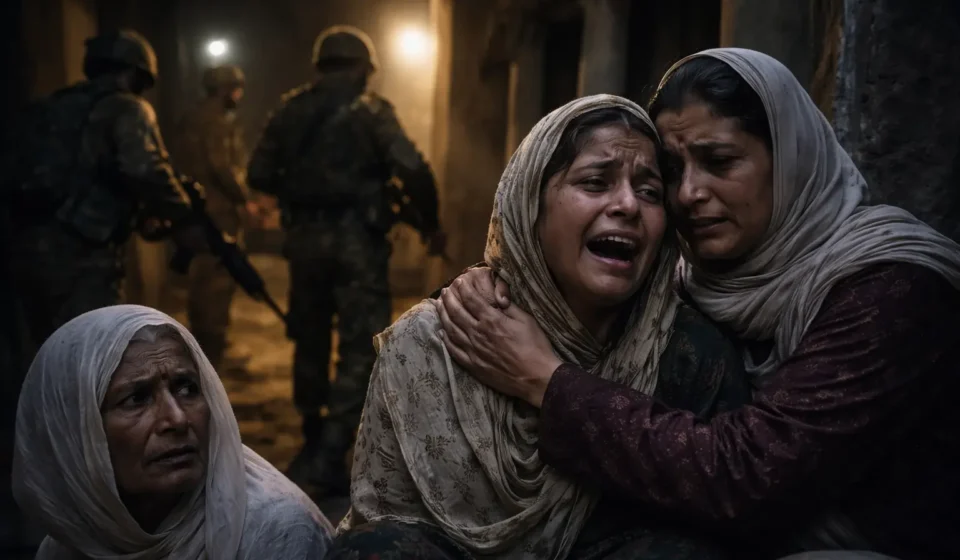
On the frigid night of 23 February 1991, that impunity reached its most brutal articulation in the twin villages of Kunan and Poshpora in the bordering Kupwara district. Occupying gunmen of the 4th Rajputana Rifles, operating under the 68 Mountain Brigade, descended upon the villages under the pretext of a Cordon and Search Operation. Men were dragged out, assembled in open fields and interrogated through the night while inside their homes, women were left unprotected before armed men who eventually raped them. Women as elderly as their eighties and girls scarcely in their adolescence were all raped by the inhuman and barbaric army men of a monstrous and vindictive occupation. It was indeed one of the darkest nights in the history of the valley, though by no means the only one. Rape has been continuously used as a weapon of war in the region ever since Kashmiris decided to take up arms against the military occupation of their beloved homeland.
We must remember that Kunan Poshpora must not be reduced to a tragic footnote only. It stands as a grim reminder that in military occupations, women’s bodies often become battlefields upon which power is performed in the most grotesque manner. Therefore, sexual violence, in such contexts, is never incidental or accidental. It functions as a weapon of war and is deliberately designed to humiliate, terrorize and fracture the social fabric of a resisting population. The message here is that domination will be inscribed on both land and flesh.
So, this why it is important to have renewed discussions on that night which has refused to leave us even after thirty plus years. For over three decades, survivors or victims have fought trauma and denial simultaneously. The Indian occupying state has repeatedly dismissed allegations surrounding that night, framing them as fabrications meant to malign their “armed forces”. No mercenary soldier has been held criminally accountable till date. In a region governed by extraordinary laws that grant sweeping powers to the occupying military, justice has remained elusive and absolutely mythical. How does one seek redress in a system where the accused are shielded by the very structures meant to investigate them?
The violence, however, has never been confined to a single night. It mutates, adapts and reappears in new forms. In the post–5 August 2019 era after the abrogation of Jammu and Kashmir’s limited autonomy, the objectification of Kashmiri women has acquired a renewed brazenness. Across Indian social media platforms, celebratory posts are proclaiming that Indian men could now “marry fair-skinned Kashmiri women.” Pop songs and viral videos continue to trivialize an entire community of women into trophies of conquest. Politicians and public figures are making remarks that reduce Kashmiri women to symbols of demographic acquisition. The language of occupation has slipped seamlessly into the language of desire.
Simultaneously, there have been disturbing instances of Indian tourists filming Kashmiri women without consent, passing sexual comments in marketplaces and public gardens. They are emboldened by a narrative that portrays Kashmir as a conquered paradise and its women as accessible spoils. This everyday harassment is not detached from the history of militarized violence. It is, in fact, its cultural echo that we are witnessing almost every day now. Despite all this, to speak of Kashmiri women solely as victims would be to replicate the very erasure that occupation seeks to impose. From the streets filled with tear gas to prison cells far from home, women have asserted political agency with remarkable courage in the region. Organizations such as Dukhtaran-e-Millat under the leadership of Asiya Andrabi, Muslim Khawateen Markaz led by Yasmeen Raja, and Mass Movement Jammu and Kashmir under Farida Behanji have kept alive a vocabulary of resistance that refuses capitulation. Even in the face of incarceration, surveillance and vilification, these women have articulated an uncompromising demand for dignity and right to self-determination. Mothers have buried sons and still stood firm. Wives have navigated the agony of enforced disappearances while organizing protests. Young women have documented abuses, written testimonies, and challenged state-sponsored narratives that brand them liars. They have dismantled the convenient binary of victim and agent. They are therefore both survivors of violence and the architects of resistance.
Why, then, must Kunan Poshpora be remembered, revisited and rewritten? Because the struggle is, besides legal accountability, for narrative sovereignty also. In a climate where history is routinely obfuscated and inconvenient truths are labeled anti-national and seditious, memory itself becomes an act of resistance. To commemorate 23 February as Kashmiri Women’s Resistance Day is to reject the enforced amnesia. It is to affirm that the suffering faced by the people of those villages will not be buried beneath military reports and media distortions. Kunan Poshpora is not an isolated tragedy sealed in the archives of 1991. It is part of a continuum of structural violence, killings, torture, enforced disappearances, mass detentions and systemic sexual abuse that has defined the lived reality of countless Kashmiris. As long as survivors await justice and the last occupying Indian soldier leaves, the night of 23 February has not ended.