

Enough has been written on the systematic victimization of Muslims under Modi’s Hindutva regime, even if little has translated into action. Far less attention, however, has been paid to the plight of Christians.
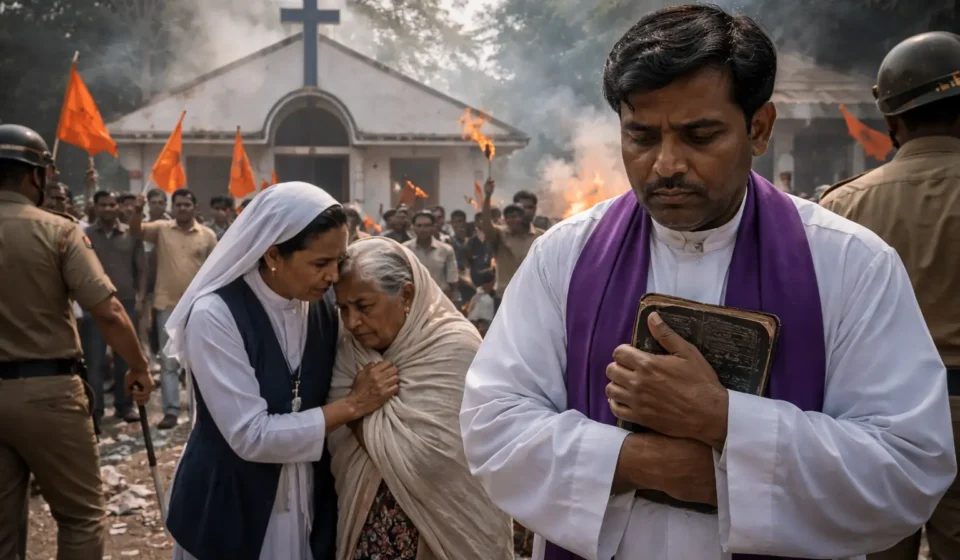
According to the Evangelical Fellowship of India’s Religious Liberty Commission (EFIRLC), at least 840 incidents of violence and discrimination against Christians were recorded in 2024, more than four times the 147 cases reported in 2014. This makes it clear that Modi’s Hindutva is no less hostile to Christians than it is to Muslims.
To understand the roots of this violence, one must examine the intellectual origins of Hindutva. The ideology emerged from a deep sense of historical humiliation shaped by centuries of foreign rule – first under Muslims and later under the British.
Hindutva’s chief ideologue, V.D. Savarkar, makes this explicit in his seminal essay Hindutva: Who is a Hindu? He writes: “Hindutva is not identical with what is vaguely indicated by the term Hinduism. By an ‘ism’ it is generally meant a theory or a code more or less based on spiritual or religious dogma or system.” Yet, in the same essay, he defines a Hindu as one for whom India is both pitribhu (fatherland) and punyabhu (holy land).
This definition automatically excludes Muslims and Christians. Though born of the same soil, they are deemed outsiders because their “mythology and god-men” do not originate in India. In simple terms, to qualify as Indian one must regard India not only as a homeland but also as a sacred land.
In other words: convert to Hinduism or leave. This, of course, cannot be realized without systematic violence and state-backed exclusion of Muslims and Christians.
Fun fact: Savarkar himself was an atheist who dismissed Hinduism as mythology yet built an entire political ideology around it.