

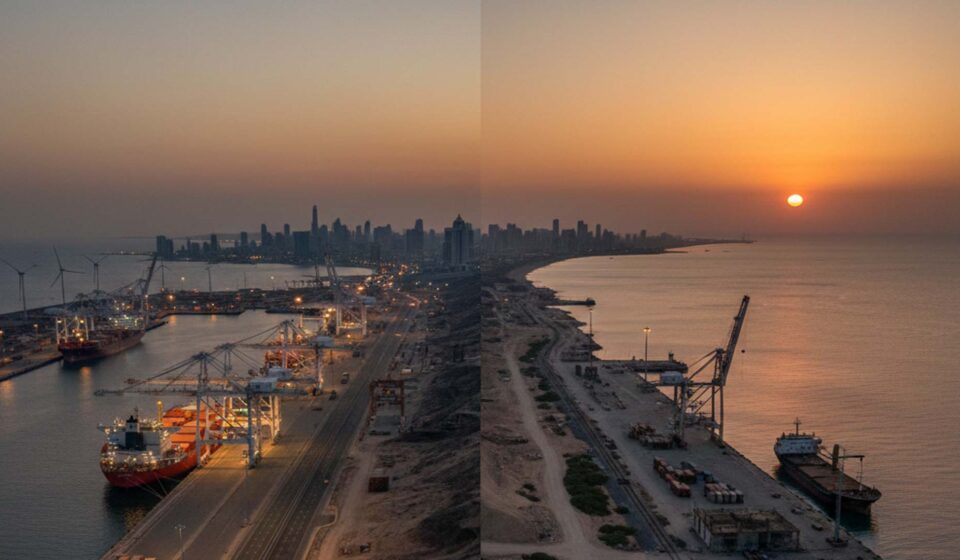

Chabahar Port sits in southeastern Iran on the Gulf of Oman, just 170 kilometers from Pakistan’s thriving Gwadar Port. While Pakistan secured Chinese partnership and delivered results at Gwadar, India’s Chabahar adventure became a masterclass in strategic incompetence and wasted resources.
Table Of Content
Anti-Pakistan Obsession: The Real Reason Behind Chabahar
India didn’t develop Chabahar for economic reasons it was pure spite. Unable to compete with the China-Pakistan Economic Corridor (CPEC) and Pakistan’s Gwadar Port, India sought to create a rival route to “bypass Pakistan” and undermine Islamabad’s regional connectivity.
Overhyped and Underperformed: Modi’s Chabahar Plans
In 2016, Prime Minister Narendra Modi signed a trilateral deal with Iran and Afghanistan, positioning Chabahar as India’s answer to CPEC. The propaganda was clear: isolate Pakistan, access Central Asia, and prove India could match China’s Belt and Road Initiative.
The Grand Delusion: India’s Chabahar Misstep
The Arrogance:
- India spent $134 million on a road in Afghanistan (2005-2009) specifically to avoid Pakistan
- Modi’s 2016 Tehran visit was celebrated as a “game-changer”
- Indian media portrayed Chabahar as the “death blow” to Gwadar
- In 2024, they renewed the contract for 10 years with maximum fanfare
All of it motivated by anti-Pakistan sentiment rather than sound economic planning.
Money Down the Drain: India’s Investment Disaster
Direct Financial Loss:
- $120 million transferred to Iran in 2024—now completely lost
- $250 million credit line to Iran
- $25 million in equipment abandoned
- $150 million in rail tracks shipped but unused
- Rs. 201.51 crore (~$24 million) spent from 2016-2024 with nothing to show
The Failed Railway:
- $1.6 billion commitment for Chabahar-Zahedan railway
- India’s IRCON visited, surveyed, signed MOUs, but never laid a single track
- After four years of Indian bureaucratic incompetence, Iran kicked them out in 2020
- Iran completed 40% of the railway themselves without India
The Imaginary Returns:
- From 2018-2024, handled only 90,000 containers
- Utilized barely 10% of port capacity
- Zero strategic benefit achieved
- Zero economic returns generated
Total Loss: $200-300 million with absolutely nothing gained. For comparison, Pakistan’s CPEC has generated billions in actual infrastructure and connectivity.
They Couldn’t Handle US Pressure
When Trump administration reimposed sanctions in September 2025, India panicked:
- Government directors resigned en masse from IPGL board
- Shut down the port authority’s website like scared children
- Transferred $120 million to Iran in desperation
- Abandoned everything within months
India had to choose between $1.6 billion Iran trade and $128 billion US trade. They folded immediately, exposing their so-called “strategic autonomy” as complete fiction.
Pakistan’s Contrast: Despite US pressure on CPEC, Pakistan and China continued development. That’s what actual strategic partnership looks like.
- Bureaucratic Paralysis
The railway project is the perfect symbol of Indian incompetence:
- Signed in 2016
- Never started work by 2020
- Blamed “fund release delays”
- Iran got tired of waiting and did it themselves
- India left holding worthless MOUs
Pakistan’s Contrast: CPEC projects from Gwadar to motorways were completed ahead of Indian announcements.
- All Talk, No Action
- 2016: “Historic milestone,” $8 billion investment announced
- 2018: Got sanctions waiver, minimal work done
- 2020: Railway project terminated by Iran due to Indian delays
- 2024: Renewed 10-year deal with grand ceremony
- 2025: Complete surrender within 18 months
Pakistan’s Contrast: Gwadar Port is operational, expanding, and driving regional connectivity. Actions, not announcements.
Domestic Backlash:
The Indian opposition Congress party called it exactly what it was:
- “A new low in foreign policy”
- “Surrendering to Trump”
- “$120 million up in smoke”
- India’s Iran policy “dictated from the White House”
International Embarrassment:
- Proven unreliable partner, abandoned Iran within months of signing 10-year deal
- Demonstrated no strategic independence from Washington
- Lost credibility across West Asia
- Exposed as unable to compete with China’s BRI
The Ultimate Irony:
While India portrayed Chabahar as countering CPEC, China signed a $400 billion, 25-year strategic partnership with Iran in 2021. Now China is positioned to take over Chabahar development too. India’s “counter” to CPEC became another Chinese opportunity.
India’s Chabahar: The port that proved you can’t build strategy on spite alone