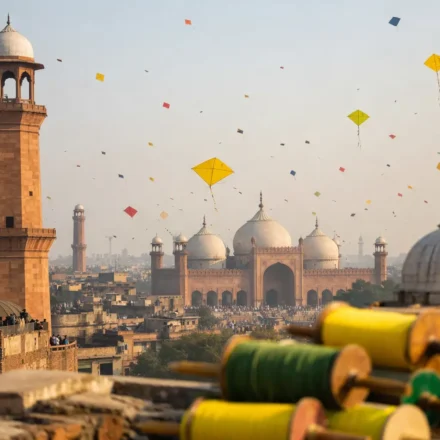

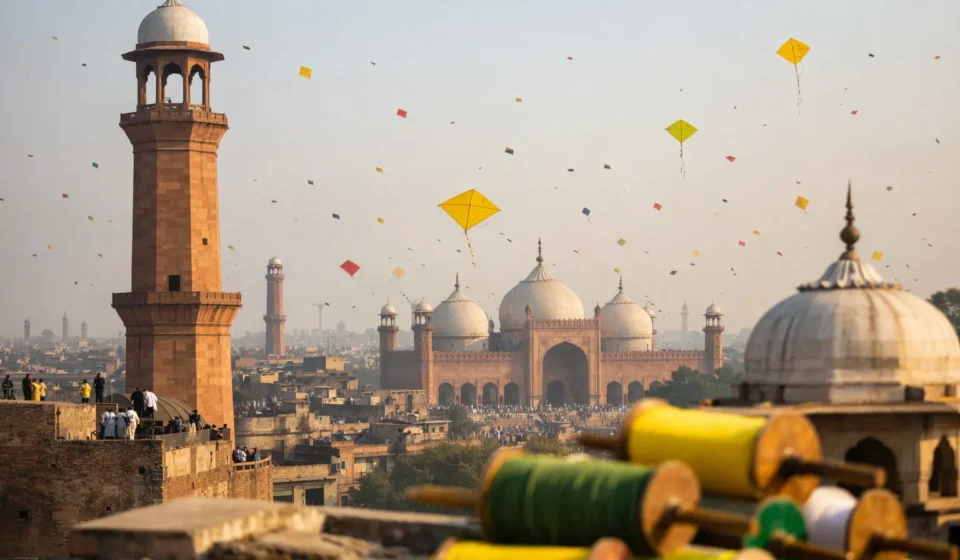

The Basant Festival, long regarded as the crown jewel of Punjab’s cultural calendar, is far more than a kite flying celebration. It is a centuries old cultural tradition and a multi billion rupee seasonal economy that has endured bans, legal scrutiny, and modernization, yet continues to hold deep social, historical, and economic significance, particularly in Lahore. Often described as the Yellow Festival, Basant symbolises renewal, spring, and collective urban joy, a status that is not only preserved through memory and practice but also formally documented in classical linguistic scholarship.
The word Basant originates from the Sanskrit Vasant, meaning spring, and denotes the season of blossoms and renewal. Its roots lie in ancient agrarian societies where it marked the Ritu Chakra or seasonal cycle and was traditionally celebrated on Vasant Panchami. This understanding is authoritatively recorded in Farhang-e-Asifiya by Syed Ahmed Dehlvi (Vol. I, pp. 406–407), where Basant is defined not merely as a word but as a recognised cultural institution of the subcontinent. Dehlvi identifies Basant as the most celebrated season in the traditional six season calendar and defines Basanti as a distinct, pleasant shade of yellow, explicitly likened to the colour of blooming mustard (sarson). This establishes the festival’s symbolism as ecological and seasonal rather than ritualistic or sectarian.
According to Farhang-e-Asifiya, Basant evolved into a shared social tradition transcending religious boundaries, embodying what later came to be described as Ganga Jamuni Tehzeeb. Dehlvi records that although Basant had Hindu origins, it became a quasi national festival of Urdu speaking elites and common people in Delhi, Lucknow, and Lahore. Importantly, he documents its adoption within the Chishti Sufi tradition, where Basant was celebrated with music, flowers, and festivity at shrines such as those of Hazrat Nizamuddin Auliya and Qutbuddin Bakhtiyar Kaki. This firmly situates Basant as a syncretic cultural practice embedded in Muslim social and spiritual life.
Dehlvi also recounts the seminal anecdote that gives Basant its Indo Islamic cultural identity. Following the death of his nephew, Hazrat Nizamuddin Auliya withdrew into grief. Observing Hindu women dressed in yellow and carrying mustard flowers during Basant, Amir Khusro adopted their attire and presented himself before his spiritual master with a bouquet of sarson. The Saint smiled, and from that moment, Khusro decreed that Basant would be celebrated annually at the shrine. This episode transformed Basant from a seasonal marker into a spiritual and cultural observance, embedding it permanently within Sufi practice.
Over time, this rural and spiritual observance evolved into a major urban cultural event, with kite flying emerging as its most recognisable feature. During the nineteenth century, Maharaja Ranjit Singh elevated Basant to the status of a state festival, hosting up to ten day celebrations in Lahore where the royal court wore yellow and kite flying became a civic spectacle. Dehlvi further notes Basant Darbars under Mughal emperors and the Nawabs of Oudh, where everything from carpets to royal robes was dyed yellow, underscoring Basant’s ceremonial and political patronage.
By the early 2000s, Basant had transformed into a powerful informal economic engine. Before the ban, the kite industry directly employed approximately 330,000 workers, including 150,000 in Lahore and 180,000 in Gujranwala and Kasur. Notably, over 90 percent of kite makers were home based women, making Basant a critical source of female income in the informal sector. Tourism and hospitality experienced peak demand, with 100 percent hotel occupancy reported weeks in advance and prime rooftops in the Walled City rented for up to Rs. 500,000 per night. In 2004, direct Basant related activities generated Rs. 220 million in Lahore, while province wide business was estimated at Rs. 3 billion, equivalent to about 50 million US dollars at the time.
The festival’s decline was driven by severe safety failures linked to the spread of chemical manjha and nylon strings. In February 2005 alone, the Supreme Court was informed of 19 deaths and more than 200 injuries within 15 days. Infrastructure damage was extensive, with LESCO recording 15,566 power trippings in a single month and reporting property losses exceeding Rs. 1 billion. Environmental damage was also significant, with thousands of birds estimated to die annually due to string entanglement during unregulated kite flying.
After an 18 year ban, Basant was revived in Lahore in February 2026 under a tightly regulated framework. Economic projections estimated Rs. 20 billion in direct activity over three days, while kite and string sales alone exceeded Rs. 3.4 billion in the lead up to the festival. Participation was massive, with an estimated eight million people involved citywide. Safety measures included the distribution of one million motorcycle safety rods costing Rs. 110 million, deployment of 695 shuttle buses, and registration of 1,413 authorised sale points with QR code based traceability. Legal amendments introduced fines up to Rs. 5 million and imprisonment up to five years for violations, supported by drone surveillance for enforcement.
In essence, Basant remains a paradox of joy and danger. Classical sources such as Farhang-e-Asifiya establish its legitimacy as a documented seasonal and cultural heritage deeply embedded in the linguistic and social fabric of the subcontinent, while contemporary data highlight its immense economic value and inherent risks. Its sustainability depends entirely on the elimination of chemical twine, strict legal enforcement, and continued adherence to modern safety mechanisms such as the QR code system. When governed effectively, Basant can function as both a protected cultural heritage and a regulated urban economy rather than a recurring public safety crisis.