Pakistan’s Foreign Policy and diplomatic approach towards the Middle East amid the Iran-America war: Balanced and Pragmatic

Pakistan’s Foreign Policy and diplomatic approach towards the Middle East amid the war between Iran and America is balanced and rational. Pakistan took a cautious and pragmatic stance focused on
neutrality, communication, and regional stability rather than joining any military alliance. In
addition to maintaining a close relationship with Gulf Arab nations like Saudi Arabia and
United Arab Emirates, this strategy enabled Pakistan to maintain connections with both
Iran and the United States of America. Pakistan’s balanced diplomacy demonstrates its effort
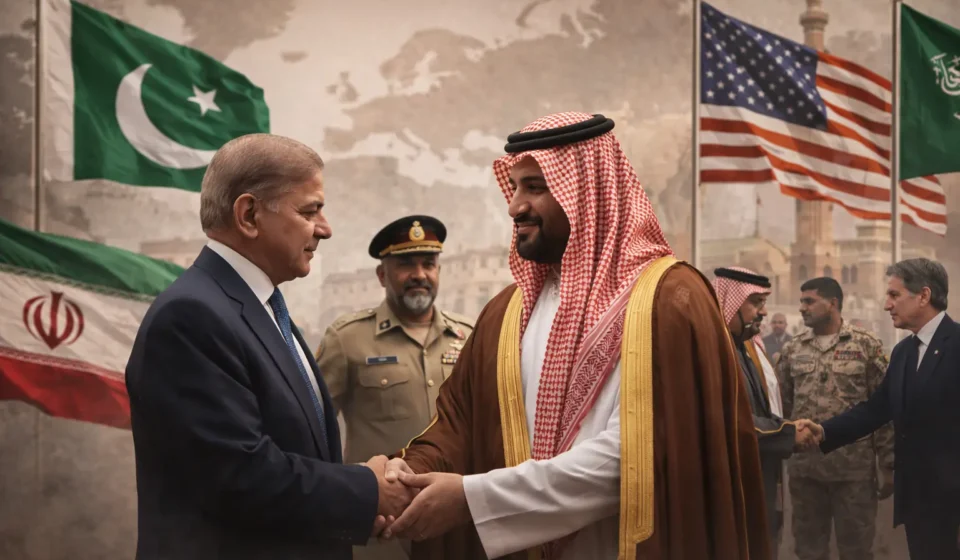
to play a mediatory role to de-escalate the conflict. Earlier, Field Marshal of Pakistan, Syed
Asim Munir met with the Defense Minister of Saudi Arabia and is now Pakistan’s Prime Minister
Shabaz Sharif in Saudi Arabia for a State Visit.
Table Of Content
Strategic Neutrality and Diplomatic Balance
Strategic neutrality and diplomatic balance have increased Pakistan’s soft image among the
conflicting countries. Islamabad condemned the attack on Iran, and at the same time
condemned Iranian attacks on brotherly Muslims countries. Ministry of Foreign Affairs of
Pakistan issued a press release on 1st March 2026:
“ Pakistan condemns the unwarranted attacks against Islamic Republic of Iran, Pakistan
also strongly condemns the attacks by Iran against brotherly countries of Saudi Arabia,
Jordan, Kuwait, Qatar and UAE, and stands in solidarity with all brotherly countries and
underscores the need to exercise maximum restraint”
Academically, this is termed a hedging strategy in foreign policy, which Pakistan has been
doing in its relations with China and the United States of America. During this crisis, Pakistan
has become a responsible and trustworthy partner as it has maintained its relations and offered its
mediation to de-escalate the conflict. In his recent visit to Saudi Arabia Prime Minister
Shabaz Sharif reiterated solidarity and support for the brotherly country. In the United NationsThe
Security Council of Pakistan voted for both the competing Resolutions, one of which was presented by
Qatar and others by Russia and Bahrain.
Increasing Tension in the Middle East and Pakistan’s Smart Power
“ Smart power is the combination of hard power and soft power. “
~Joseph Nye
Increasing tension in the Middle East has contributed to Pakistan’s smart power, Pakistan’s
might, and recent victory against India, which added to its hard power, ultimately increasing
its soft power coupled with trust and reliability. It’s evident from the ‘Strategic Pact between
Pakistan and Saudi Arabia. The rest of the Arab countries also ambitious to join this
arrangement because United States of America failed to protect them from Israel
aggression that caused trust deficit.
This security arrangement of Arab nations with Pakistan has significantly decreased the risk
of major escalation with Iran as the latter welcome this arrangement and ensures on
Pakistan’s request not to attack Saudi Arabia. In this connection Pakistan’s image has
improved significantly regionally as well as globally.
Pakistan’s Economic Interests
Pakistan’s economic interests are paramount with religious and cultural ties. Saudi Arabia
is one of the economic partners of Pakistan. Deposit to Investment and trade are the major
and uninterrupted outcomes of balanced foreign policy and diplomatic approach of
Pakistan this nation . Pakistan needs $5 billion for deposits and now requesting to Saudi
Arabia, the latter also determined to fulfill Pakistan’s energy needs during supply chain
interruption due to closure of Strait of Harmuz.
This is actually the outcome of rational decision making in Islamabad and civil military
convergence at diplomatic level. Public opinion in Pakistan and abroad welcome this
arrangement and Pakistan’s strategic and diplomatic role during this flaring conflict. With
limited resources as compared to its rival India. Unlikely to its rivals Pakistan is in limelight
as a relevant and impactful actor in the regional and international politics.
Conclusion
To conclude, Pakistan’s Foreign Policy and diplomatic approach in Middle East conflicts
shows that Pakistan’s shows its pragmatic and balancing approach shows rational decision
making keeping in view its national interests. Pakistan’s always stress peaceful resolution
of conflict in bilateral communication as well as in multilateral arrangements.
Although, Pakistan has been facing price increases at home due to rise in international
markets because of to low production and supply chain disruptions but it constantly
struggling to mitigate it with balanced diplomatic approach.