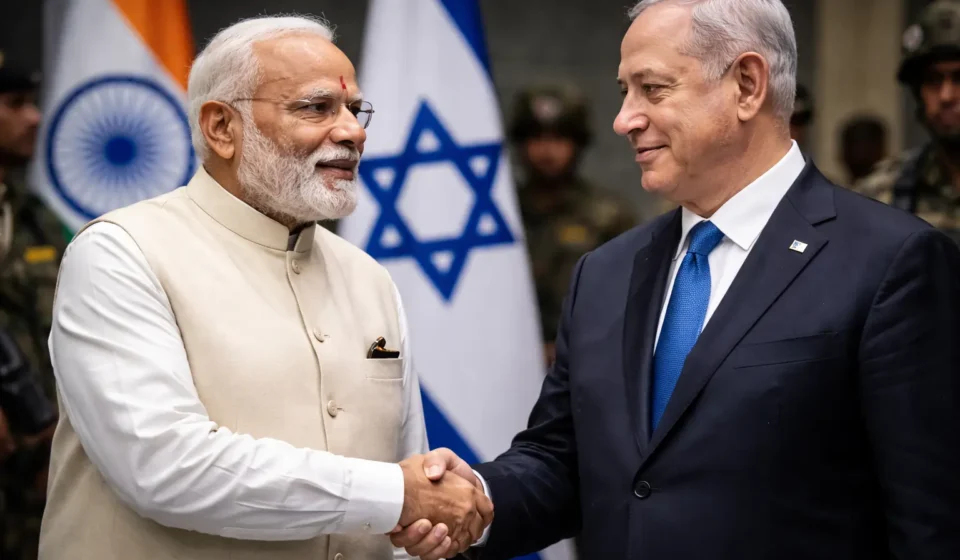

Modi is about to land in Israel. This is more than another occasion of Modi “sing and dance” for Israel, on Epstein’s advice, to please Trump. This visit is important for several reasons. Here are a few.
• Indian Connivance in Genocidal and Imperialistic Wars
India has emerged as the largest and perhaps most significant backer of Israeli actions outside the Western world. It not only abstained on key UN ceasefire resolutions but also provided arms to Israel for use in Gaza. While Global South nations like South Africa led a case against Netanyahu’s war crimes and Brazil and China openly condemned Israel, India remained firmly aligned with it. India also did not join the Shanghai Cooperation Organisation condemnation of Israel’s attacks on Iran during the 12 day war.
This visit comes at a time when the US has its largest military buildup since the Iraq War, preparing for a potential imperialist war on Iran at Netanyahu’s behest. In Occupied Palestine, Israel’s expansion in the West Bank continues at full pace killing any remotest prospects of a two-state solution.
Yet Modi’s mentor Mohan Bhagwat dreams of leading the Global South. India’s claim to leadership at this point looks less like principle and more like an imperial maneuver to counter and dilute China’s position.
• India Israel Led Hexagon Alliance – A Plan Against the Muslim World
Indian alignment with Netanyahu is not limited to Gaza. Netanyahu recently claimed he plans to form a new regional bloc, a “hexagon” alliance, to stand against so called radical Sunni and Shia majority nations. Israel, India, Greece and Cyprus, along with other unnamed Arab, African and Asian states, are expected participants. This appears to be an expansion of I2U2, the India-Israel-US-UAE grouping. Mohammed bin Zayed has already signed a strategic defence agreement with India.
With potential participants such as Greece, Cyprus, Morocco and Somaliland, this so called hexagon looks like a comprehensive design to check Turkey, destabilize North Africa and the Middle East, and weaken Saudi influence. In effect, it aligns with Israeli expansionism while positioning India as a key partner. This is why Netanyahu said of India, “We are partners in security and a shared strategic vision.”
• Domestic Importation of Zionism – the Demonization and Victimization of Indian Muslims
Pankaj Mishra, an Indian essayist, described the ideological affinity between Zionism and Hindutva in these words: “Many of their radical ideologists longed to overcome what they perceived as a shameful lack of manhood among Jews and Hindus.”
This ideological overlap has domestic consequences. Kashmir increasingly resembles a security laboratory, with surveillance and state overreach expanding daily. Beyond Kashmir, the persistent marginalization of Indian Muslims, whether through Yogi’s bulldozer justice, disenfranchisement using ECI Form 7, or mob violence, echoes patterns of ethnic and religious exclusion associated with Zionist practices.
- Military Alliance Against Pakistan – False Flags and Perpetual War
Beyond ideology and domestic policy lies the construction of a national narrative that fuels endless confrontation with neighbors. Just as Israel frames itself around an existential threat from Muslim states while often being the initiator of escalation, India appears to follow a similar path. Originally articulated in the Cold Start Doctrine, this approach was seen in the May conflict, which resembled Israel’s Lavon style false flag operation in Pahalgam.
Indian and Israeli coordination against Pakistan is widely discussed. While the past plan to bomb Kahuta is now well known, less reported beyond security circles are claims about Israeli tactical support during the four day war in May 2025. India’s drone arsenal, including Harop and Heron systems, reportedly relied heavily on Israeli cooperation.
India was also the largest importer of Israeli weapons during this period at 34 percent, followed by the US at 13 percent and the Philippines at 8.1 percent. Israeli daily Haaretz reported that India and Israel are poised to sign a defence deal worth 10 billion dollars to be implemented over several years. This collaboration is significant and warrants close attention.