The Gradual Occupation of Jammu and Kashmir by India: A Historical Analysis

It is a widespread misconception that the princely state of Jammu and Kashmir acceded to India on October 26 or 27, 1947, and that India occupied the territory only after its troops landed in Srinagar on October 27. In reality, the accession and occupation of Kashmir was not an isolated event, but a layered and gradual process that began immediately after the announcement of the Indian Independence and Partition Plan on June 3, 1947. What culminated in the open military invasion of October 27 had, in fact, been unfolding systematically for several months.
From the moment of partition, an alliance of key Indian leaders (Mahatma Gandhi, Lord Mountbatten, Jawaharlal Nehru, and Sardar Vallabhbhai Patel) began to devise strategies to ensure Kashmir’s incorporation into India. On the very day of the Partition announcement, Patel wrote to Maharaja Hari Singh, advising him that it was in Kashmir’s interest to join India without delay, invoking “ancient Hindu traditions and history” as justification (Acharjee, 1951, p. 107). Mountbatten reassured the Congress leadership that the acceptance of the partition plan would be advantageous, as the acquisition of Kashmir would strategically weaken Pakistan’s viability as a new state (Saraf, 1977; Korbel, 1954).
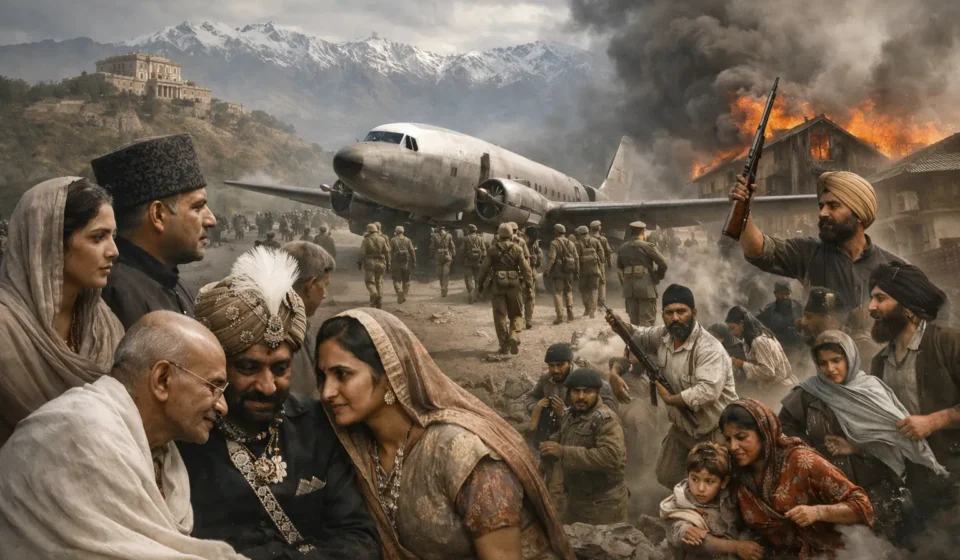
In June 1947, Mountbatten visited Kashmir, while Nehru sent him a detailed memorandum advocating for Kashmir’s inclusion in India. Yet, perhaps the most critical step in this unfolding plan was Mahatma Gandhi’s visit to Kashmir between August 1 and 3, 1947. Ostensibly a personal trip, Gandhi’s visit had three political aims: to persuade Maharaja Hari Singh to accede to India, to secure the release of Sheikh Abdullah from prison so that he could align himself with pro-India forces, and to facilitate the removal of Prime Minister Ram Chandra Kak, who opposed Kashmir’s alignment with either dominion.
Gandhi met the Maharaja, his wife Tara Devi, Sheikh Abdullah’s wife, and Kak himself. Within a week of his departure, on August 11, Ram Chandra Kak was dismissed from office. His replacement, Mehr Chand Mahajan, a known Arya Samaj leader and India’s representative on the Boundary Commission, had already played a crucial role in securing Gurdaspur for India through the Radcliffe Award, thereby ensuring a land corridor to Kashmir (Sarila, 2005). With Mahajan in office, administrative and political alignment with India accelerated. Sheikh Abdullah was later released and placed in an administrative role under Mahajan, where he swore allegiance to the Maharaja and indirectly strengthened India’s control over the state.
Throughout August and September 1947, India worked to establish physical and administrative access to Kashmir. New roads and bridges were constructed to ensure connectivity, while large quantities of arms and ammunition were dispatched to the region. Pro-Indian officials were placed in key posts, and the state’s military chain of command was quietly absorbed into Indian control. By early October, the Maharaja’s forces were placed under the command of Colonel Kashmir Singh Katoch, an Indian Army officer, while Shiv Saran Lal, an Arya Samajist known for his anti-Muslim stance, was appointed Inspector-General of Police.
On October 17, 1947, troops of the Patiala State Forces, which had already been integrated into the Indian Army following Patiala’s accession, entered Kashmir. They took control of key installations such as the Srinagar Secretariat and the Hyhama Airfield. This occurred while the state had a valid Standstill Agreement with Pakistan and before any formal instrument of accession had been signed. Indian forces were operating within Kashmir under the guise of “Patiala troops” well before October 27 (Lamb, 1991; Korbel, 1954).
Meanwhile, from mid-August onward, Hindu and Sikh militias,including the Rashtriya Swayamsevak Sangh (RSS), Akali Dal, Bajrang Dal, and the Patiala Regiment began coordinated attacks on Muslim communities in Jammu, Rajouri, and Poonch. The violence amounted to large-scale ethnic cleansing. Justice Yusuf Saraf (1977) records that on October 19 and 20, the roads from Samba to Jammu were “strewn with corpses.” Around 20,000 Muslims from Akhnoor were expelled toward Pakistan, only to be massacred while crossing the bridge. Similar atrocities were reported from Kathua and Rajpura in the following days. All these events occurred before October 22 , before any tribal incursion from Pakistan had begun, demonstrating that mass killings and expulsions were already underway as part of India’s consolidation of control.
Thus, the campaign of violence and occupation in Kashmir was not a defensive response to Tribals entry, as the official Indian narrative claims, but part of a premeditated plan to subdue the Muslim-majority population and secure the state’s annexation. The process that began with Gandhi’s visit in early August reached its open conclusion on October 27, when India airlifted troops to Srinagar, citing the Maharaja’s alleged request for assistance. The authenticity of the so-called Instrument of Accession remains disputed, as no contemporaneous record confirms its existence prior to India’s military intervention (Lamb, 1991; Korbel, 1954).
The evidence, therefore, supports the view that India’s occupation of Jammu and Kashmir was not the result of a single political act, but a gradual and deliberate campaign involving political persuasion, administrative manipulation, and covert military infiltration. What was publicly presented as an act of legal accession was, in reality, the culmination of months of covert operations and violence. By the time Indian troops officially entered the Valley on October 27, 1947, the groundwork for control both political and military had already been laid.